Fox News Interview
"Tariff Revenue Is High Enough to Actually Replace Other Sources"
Donald Trump, the President of the United States, who has launched a tariff war against the entire world, stated that the loss in tax revenue from income tax cuts could be compensated by tariffs. Despite repeatedly retreating from his recent aggressive tariff policies, he continues to make the 'unrealistic' claim that tariffs, which account for about 2% of federal government revenue, could become a major source of government income.
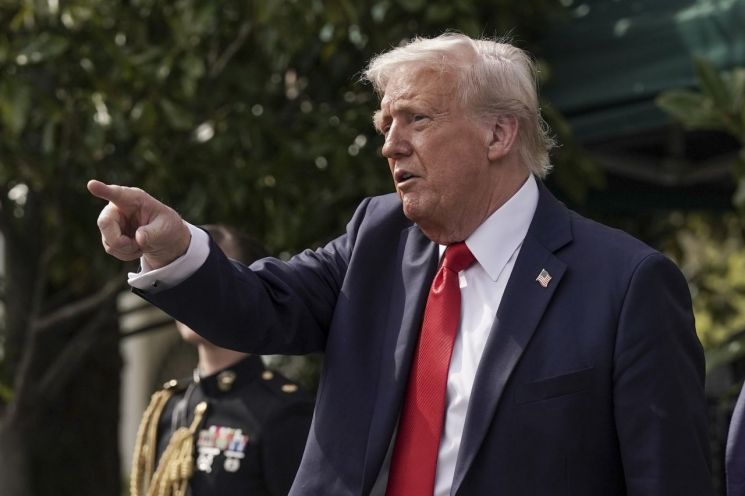
President Trump said in an interview with Fox News, scheduled to air at 4 p.m. local time on the 15th, "There is a lot of money coming in from tariffs, so it is possible to replace other things (like income tax) with it."
He argued, "It is actually possible," adding, "From 1870 to 1913, tariffs were the only form of revenue, and at that time, we were relatively the wealthiest."
The United States had no income tax until the 1800s, and tariffs were the main source of national revenue. President Trump's idea is to revive the 19th-century economic model and cover a significant portion of tax revenue through tariffs. In particular, he intends to offset the reduced tax revenue caused by income and corporate tax cuts with tariffs imposed on imported goods. However, this is unrealistic given that tariff revenue accounts for less than 2% of the U.S. federal government's revenue. According to the U.S. Treasury Department, in 2023, federal income tax revenue exceeded $2 trillion, while tariff revenue was only $83.7 billion, accounting for 1.7%.
Regarding the increase in tax revenue from tariff policies, President Trump said, "We earned $2 to $3 billion a day," adding, "We have never made such a large amount of money." He explained, "Since it is a transitional period, we gave a grace period just to slightly lower (tariffs)," and "some flexibility is needed."
He also refuted claims that the Great Depression worsened after the implementation of the Smoot-Hawley Tariff Act in 1930, which significantly raised U.S. tariff rates.
He said, "The income tax system was introduced in 1913, and there was an attempt to revive tariffs in 1931-1932, but it was too late," adding, "People like to blame tariffs for the Great Depression, but the Great Depression had already occurred before tariffs were imposed."
President Trump claims that tariffs can secure trillions of dollars in tax revenue, not only replacing income tax but also reducing federal government debt. Peter Navarro, the White House trade advisor known as Trump's 'tariff strategist,' mentioned that tariff revenue could reach $6 trillion over the next decade, and with automobile tariffs included, it could total $7 trillion.
Despite his boast that tariffs can replace income tax, President Trump has recently been retreating from his existing tariff policies. On the 9th, he suspended reciprocal tariffs by country for 90 days, and on the 11th, he exempted electronic products such as smartphones and PCs from reciprocal tariffs. The day before, he also hinted at the possibility of exempting tariffs on automobile parts. Due to uncertainty over tariff policies causing turmoil in financial markets such as stock and bond sell-offs, and rising concerns about a recession within the U.S., there is an assessment that he is stepping back from aggressive tariff policies.
© The Asia Business Daily(www.asiae.co.kr). All rights reserved.

















