Korea-U.S. Industrial Cooperation Conference
Unified Voice from Energy Experts of Both Countries
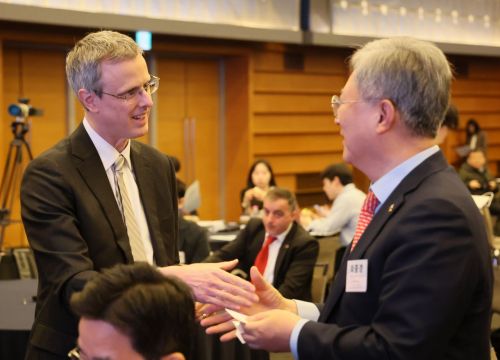 Choi Joong-kyung, Chairman of the Korea-America Association, and Andrew Gately, Charg? d'Affaires at the U.S. Embassy in Korea, are exchanging greetings at the Korea-U.S. Industrial Cooperation Conference held on the 15th at the Korea Chamber of Commerce and Industry in Jung-gu, Seoul. 2025.04.15 Photo by Yoon Dong-joo
As active discussions on economic cooperation between South Korea and the United States continue following the imposition of high tariffs during the second term of the Donald Trump administration, an analysis has emerged suggesting that both countries can achieve mutual benefits in the energy sectors such as liquefied natural gas (LNG), hydrogen, and nuclear power.
Mark W. Menezes, President of the U.S. Energy Association, stated at the Korea Chamber of Commerce and Industry and the Korea-America Association’s Korea-U.S. Industrial Cooperation Conference on the 15th, "In 2024, South Korea is expected to import approximately 5.7 million tons of U.S.-produced LNG, establishing itself as the largest importer from the U.S." He added, "Under the second Trump administration, policies aimed at reducing the trade deficit could lead to increased imports of LNG, liquefied petroleum gas (LPG), and crude oil by South Korea."
President Menezes also noted that "since the Inflation Reduction Act (IRA) of 2022, growth has accelerated in various fields including small modular reactors (SMRs), wind turbines, solar panels, electric vehicles, and charging infrastructure," and evaluated that "beyond energy infrastructure, the two countries are expanding cooperation in hydrogen and ammonia sectors."
He expressed optimism, saying, "Following the Korea-U.S. nuclear agreement memorandum of understanding (MOU) signed earlier this year, private nuclear cooperation between the two countries is expected to accelerate." He explained that if U.S. research capabilities combine with South Korea’s construction technology, nuclear power could become a core element of both countries’ energy strategies.
Menezes emphasized, "South Korea plays a key role in the essential minerals sector for the global energy transition," and assessed, "While China dominates mineral production and refining, South Korea, as the chair country of the Critical Minerals Security Partnership, is leading efforts to establish a stable supply chain and diversify critical minerals."
Professor Yoo Seung-hoon of the Department of Future Energy Convergence at Seoul National University of Science and Technology, who participated as a panelist, expressed a negative view on expanding U.S. crude oil imports, stating, "The transportation period is two to three times longer compared to Middle Eastern oil, and domestic refining plants are optimized for Middle Eastern heavy oil, so importing U.S. light oil could increase costs."
Instead, he said, "Natural gas consumption is expected to increase for the time being to reduce greenhouse gas and fine dust emissions," and added, "LNG is almost the only commodity that South Korea can increase imports of from the U.S., making price conditions critical."
Professor Yoo also highlighted the potential for strengthening nuclear cooperation between South Korea and the U.S. He evaluated, "The U.S. holds core technologies for both large nuclear power plants and SMRs but has limited construction capabilities," and suggested, "There is room for win-win cooperation through joint ventures in constructing large nuclear power plants in Europe, the Middle East, and Asia."
He further pointed out, "The U.S. not only has abundant solar and wind resources suitable for green hydrogen production but also possesses plentiful natural gas reserves necessary for blue hydrogen production and gas fields and oil fields for carbon dioxide storage," proposing cooperation possibilities in clean hydrogen and ammonia sectors between the two countries.
Jang Ji-ho, team leader at Doosan Enerbility, explained, "Support for securing global dominance in next-generation nuclear power such as large nuclear plants and SMRs is expected to be further strengthened under the second Trump administration," and added, "Through enhanced nuclear cooperation between South Korea and the U.S., joint entry into overseas markets is possible."
Joo Young-geun, senior researcher at POSCO Research Institute, expressed optimism about LNG cooperation with the U.S., stating, "Since 1972, the POSCO Group has secured capabilities and experience related to LNG, including commercial operation of LNG power generation, operation of LNG terminals since 2005, construction of LNG power plants since 2012, and production of energy-use steel such as high manganese steel and well pipes."
© The Asia Business Daily(www.asiae.co.kr). All rights reserved.

















