Expectations for a Convergent Basic Science Cluster with Three Research Groups
Presentations on Quantum Transformation and Relativistic Laser Science Research
"IBS Demonstrates Research Capabilities and Competitiveness"
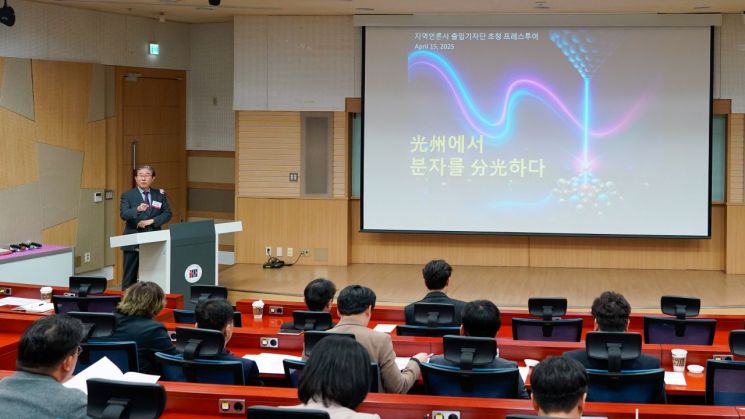 Im Ki Chul, president of Gwangju Institute of Science and Technology, held a press conference at the GIST Oryong Hall on the 15th and stated, "Following DJ and Han Kang, we will produce the third Nobel Prize winner in science by 2030." Provided by GIST
Gwangju Institute of Science and Technology (GIST, President Lim Ki-cheol) held a press conference on the 15th and announced, "Following DJ and Hangang, we aim to produce our third Nobel Prize winner in science by 2030."
During the press conference held at the Oryong Hall of GIST, participants shared the significance, research direction, and vision of attracting the Institute for Basic Science (IBS) research groups. The event was organized to commemorate the establishment of the IBS campus research groups at GIST.
Starting with the launch of the 'IBS Quantum Transformation Research Group' in September last year, GIST also established the 'IBS Relativistic Laser Science Research Group' in December of the same year. To attract a third IBS campus research group in the field of life sciences, GIST has been selecting the final candidate for the group leader and negotiating since November last year, aiming for a prompt launch. Once this research group is established, GIST is expected to complete a convergent basic science cluster encompassing physics, chemistry, and life sciences.
Attending the press conference were GIST President Lim Ki-cheol, Director of External Cooperation Kim Jae-gwan, as well as the heads of the research groups: Kim Yusu, head of the IBS Quantum Transformation Research Group (professor of chemistry at GIST), and Kim Kyungtaek, head of the IBS Relativistic Laser Science Research Group (professor of physics and photonic science). The two research group leaders presented the vision and main research directions of their respective groups, emphasizing GIST's role as a world-class hub for basic science research.
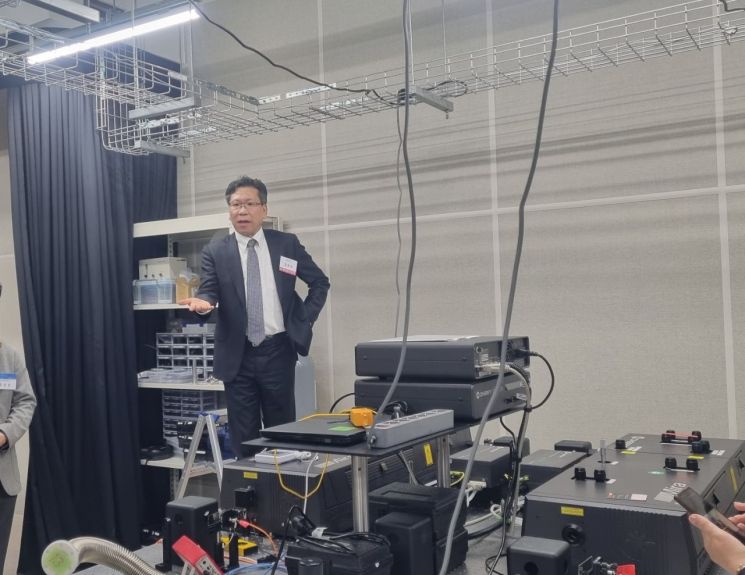 On the 15th, Kim Yusu, head of the Quantum Transformation Research Group, is explaining the experimental equipment at the GIST Central Instrumentation Laboratory. Photo by Min Chanki
Kim Yusu, head of the Quantum Transformation Research Group, is a globally renowned scholar who served as a chief scientist at RIKEN in Japan and possesses extensive experience in international collaborative research and a broad global network.
The Quantum Transformation Research Group focuses on precisely analyzing quantum interactions that occur during the conversion processes of energy and matter, and scientifically elucidating their fundamental principles. The ultimate goal is to develop core technologies that can design new functional materials or maximize energy conversion efficiency.
In particular, by combining precision measurement techniques and quantum control methods that go beyond conventional experimental methodologies, the group quantitatively tracks quantum interactions within complex molecules or between different states. Based on this, they conduct advanced research to design the structure of materials and finely control their functions.
Kim Yusu stated, "Basic science achieves greater results when done together, not alone," and added, "The technology to precisely control interactions between quantum states at the atomic level goes beyond simple theory and can be applied to various fields such as actual energy conversion devices and catalytic reactions. Through international collaborative research, we will create achievements at GIST that can change the landscape of global basic science."
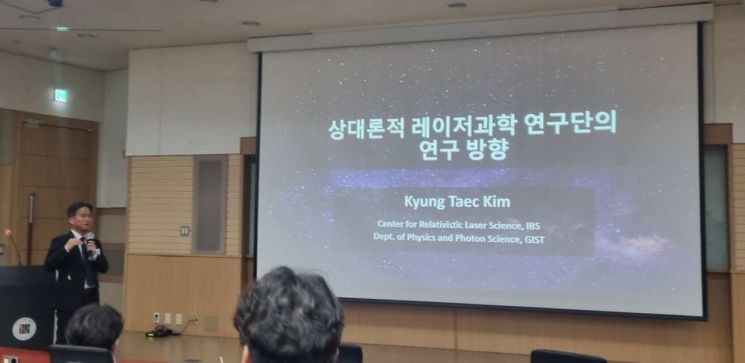 On the 15th, Kyungtaek Kim, head of the Relativistic Laser Science Research Division at IBS, explained the research direction at a press briefing. Photo by Chanki Min
The Relativistic Laser Science Research Group is undertaking an unprecedented challenge to experimentally reproduce on Earth the extreme cosmic environments observed around neutron stars and black holes using ultra-high-power lasers. The aim is to verify how matter responds under extreme high-energy density conditions and to experimentally elucidate quantum electromagnetic phenomena that occur in such environments.
The research group, based on a petawatt (PW, 10^15W) class ultra-high-power laser system, generates pulses with attosecond (10^-18 seconds) precision time resolution to explore the formation of relativistic plasma and the generation of high-speed particles under extreme pressure and temperature conditions. This research is expected to provide new insights not only in basic physics but also in various astrophysical fields such as the analysis of stellar interior structures, mechanisms of cosmic particle acceleration, and the origins of high-energy radiation.
Kim Kyungtaek, professor leading the Relativistic Laser Science Research Group, has conducted years of research at the GIST Advanced Photonics Research Institute and the IBS Extreme Laser Science Research Group, accumulating extensive experience and expertise in operating advanced equipment.
Kim Kyungtaek said, "Experiments that reproduce the extreme environments of the universe on Earth using lasers are among the most precise and creative challenges humanity has undertaken in science," and added, "Based on the technological capabilities and human resources accumulated at the GIST Advanced Photonics Research Institute and IBS, we will present a new paradigm for next-generation plasma science and expand the boundaries of space science and high-energy physics."
President Lim Ki-cheol stated, "The establishment of IBS research groups on the GIST campus is a symbolic example that demonstrates GIST's research capabilities and competitiveness," and added, "As we leap forward as a world-class hub for basic science research, we expect to see a Nobel Prize winner in science around 2030."
He continued, "The GIST-IBS campus research groups will go beyond simple academic achievements to become a new model of cooperation that grows together with the local community."
© The Asia Business Daily(www.asiae.co.kr). All rights reserved.
![Clutching a Stolen Dior Bag, Saying "I Hate Being Poor but Real"... The Grotesque Con of a "Human Knockoff" [Slate]](https://cwcontent.asiae.co.kr/asiaresize/183/2026021902243444107_1771435474.jpg)


















