18 Major Political Reform Initiatives Proposed
"Return to Cheong Wa Dae if Elected President... Abolish the Constitutional Court"
"Consolidate Government Ministries and Establish a Future Strategy Institute"
On April 15, Hong Joonpyo, former mayor of Daegu and a presidential primary candidate for the People Power Party, announced his intention to pursue constitutional reform through a national referendum during next year's local elections.
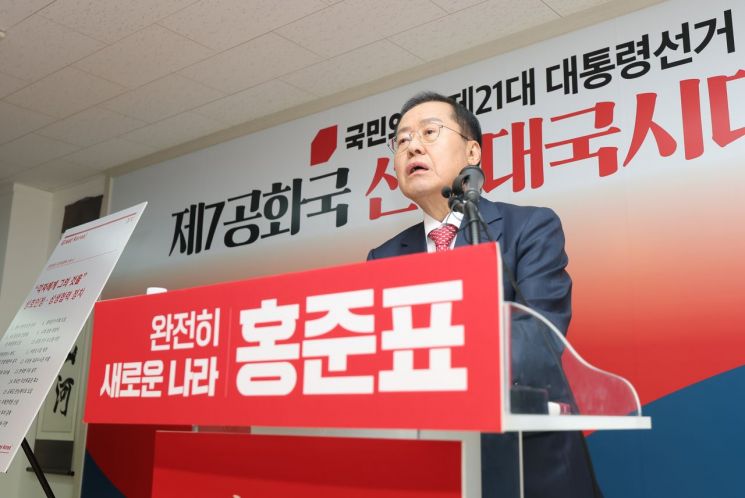
On this day, at his campaign headquarters in Yeouido, Seoul, Hong held a presentation titled "100+1 Major Reforms for an Advanced Nation," where he unveiled his vision for sweeping political reforms.
He identified constitutional reform as his top priority. He pledged to establish a presidential task force dedicated to constitutional amendment immediately after taking office, thereby initiating discussions on the matter. Hong stated, "The structural cause of the current political crisis stems from the limitations of the Sixth Republic Constitution," and added, "As a solution, I will push for constitutional revision, including the introduction of a four-year presidential term with the possibility of re-election and a bicameral legislature."
He set the timing for the constitutional amendment as next year's local elections. He explained that if the amendment is passed through a national referendum at that time, the cycles for the 2030 presidential and local elections would align, allowing for a mid-term evaluation of the administration through the general elections. Hong further stated, "It is necessary to have a constitutional amendment task force within the National Assembly as well, so that each side can develop its own proposal and reach a grand compromise with the government."
He also announced his intention to return the presidential office to Cheong Wa Dae if elected president. He said, "Cheong Wa Dae is a symbol of the nation and national dignity," and emphasized, "We must restore and return to it." Regarding the relocation of the administrative capital to Sejong, he made his opposition clear, stating that it would be "unconstitutional."
Hong also presented his ideas for electoral system reform. He promised to restore public trust in elections and normalize overall operations by completely restructuring the National Election Commission and establishing a fair election system. In addition, he pledged to enact a "Public Opinion Poll Act" that would prohibit the publication of polls with a response rate below 10%, in order to prevent distorted public opinion.
For judicial system reform, he proposed abolishing the Constitutional Court and establishing a Constitutional Division within the Supreme Court. Hong explained, "The Constitutional Court itself has become a politicized judicial body," and suggested, "Only cases related to the dissolution of political parties and impeachment trials should be handled by the full bench, while all other cases should be handled by the Constitutional Division within the Supreme Court." He also announced plans to abolish the Corruption Investigation Office for High-ranking Officials (CIO), which has been criticized for political bias, and instead monitor power-related corruption through a special inspector system. Additionally, he proposed establishing a National Investigation Bureau, modeled after the FBI, to take charge of all criminal investigations.
To reform the administrative system, he proposed consolidating the current 18 government ministries into 13 or 14, thereby creating a smaller and more efficient government. He also expressed his intention to establish a "Future Strategy Institute" to develop long-term national development strategies and ensure policy continuity.
Other pledges included: a comprehensive overhaul of regulatory laws, restoring the National Intelligence Service's counterespionage authority, reducing voting rights for foreign residents, and implementing an artificial intelligence (AI)-based e-government.
Hong emphasized, "I have spent over 30 years preparing to lead the nation, and now I will design the next 100 years for Korea," adding, "With the spirit of 'Rebuilding the Nation,' we must change everything in our institutions, systems, and even the public consciousness, except for the name of the Republic of Korea itself."
© The Asia Business Daily(www.asiae.co.kr). All rights reserved.

















