110 Fixed Survey Plots Established in Cities and Counties
Monitoring 15 Major Forest Pests Including Pine Wilt Disease
Regular Monthly Operations Until September
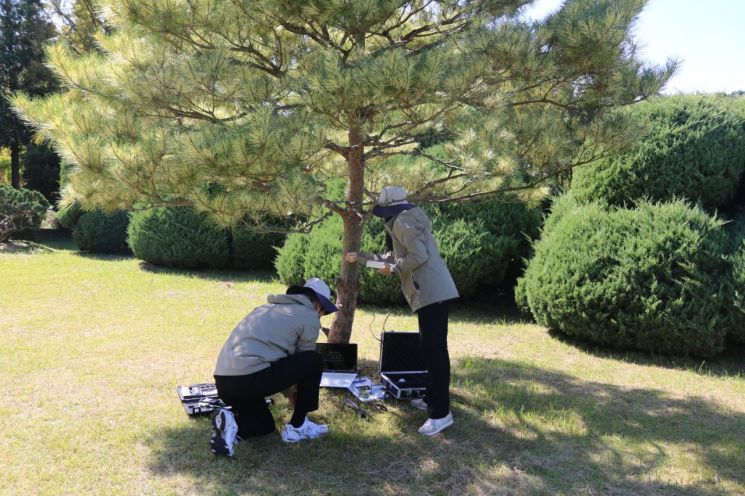 The Jeollanamdo Forest Research Institute is focusing administrative efforts on forest pest monitoring and diagnosis. Provided by Jeonnam Province
The Jeollanam-do Forest Research Institute is focusing all efforts on monitoring and diagnosing forest pests and diseases, as the emergence period of these threats accelerates due to climate change.
Recently, due to climate change, not only the activity period of sudden pests but also of vectors such as Solsuyeom-haneulso, which transmits pine wilt disease, has been extended, leading to the spread of damage caused by forest pests and diseases.
Forest pest and disease monitoring (preliminary observation and survey) involves observing and investigating areas where outbreaks are likely or have already occurred, to assess the presence, severity, and damage status. For efficient monitoring, criteria such as target sites, priorities, frequency, and timing are established separately to develop and implement plans tailored to field conditions.
In rugged forest areas that are difficult for people to access, aerial monitoring using drones is also conducted. The plan is to respond proactively by detecting forest pests and diseases early, diagnosing them accurately, and ensuring timely control measures.
The Jeollanam-do Forest Research Institute has established fixed survey plots in 110 locations across 22 cities and counties to monitor the occurrence timing and scale of 15 major forest pests and diseases, including pine wilt disease, pine needle gall midge, pine scale insect, oak wilt disease, cherry broom disease, American white moth, sycamore powdery mildew, and privet rust.
In particular, for pine wilt disease, which causes the most significant damage in the forestry sector, the institute plans to newly implement pheromone trap control tests this year in areas with severe damage, in addition to monitoring the emergence of vectors.
Oh Deuksil, Director of the Jeollanam-do Forest Research Institute, said, "Since early monitoring is crucial for forest pests and diseases, we will do our utmost to conduct monitoring, diagnosis, and research on control technologies to respond proactively not only to major forest pests and diseases affected by climate change but also to sudden outbreaks."
© The Asia Business Daily(www.asiae.co.kr). All rights reserved.

















