Over 30% of Seoul's Sewer Pipelines Are Over 50 Years Old
More Than 55% of Pipelines Have Exceeded 30 Years
About 30% of Seoul's sewer pipelines have been confirmed to be over 50 years old. In particular, the proportion of sewer pipelines over 50 years old reached half in Jongno, Yongsan, Seongbuk, and Yeongdeungpo districts.
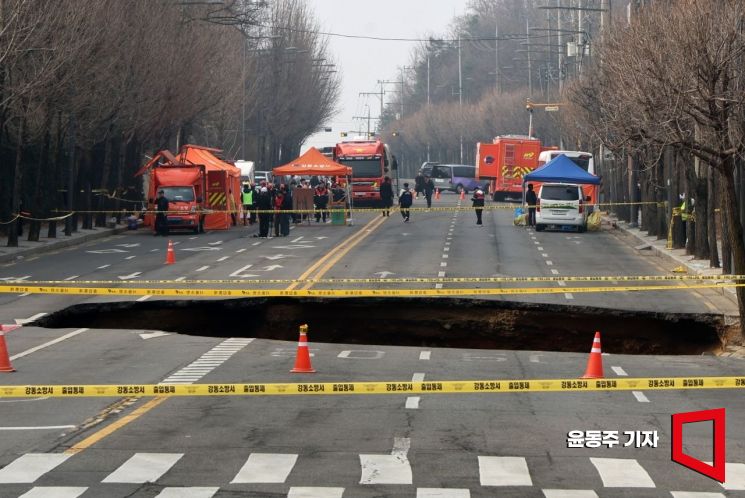 On the 24th, a large sinkhole spanning four lanes occurred at an intersection near Daemyeong Elementary School in Gangdong-gu, Seoul. On the 25th, the area around the accident site is being cordoned off. One passenger car and one motorcycle fell into the sinkhole, and one occupant of the passenger car was transported to a nearby hospital. Currently, one motorcycle driver is buried under the sinkhole. The depth is estimated to be 30 meters. 2025. 03. 25 Photo by Yoon Dong-ju
According to data submitted by the Seoul Metropolitan Government to Jin Sun-mi, a member of the Democratic Party of Korea, as of December 2023, out of the total length of Seoul's sewer pipelines of 10,866 km, 3,300 km (30.4%) are over 50 years old.
Generally, sewer pipelines over 30 years old are classified as aged, and the length of sewer pipelines over 30 years old reaches 6,028 km (55.5%).
By region, the proportion of sewer pipelines over 50 years old is highest in Jongno-gu (53.5%). Yongsan-gu (48.5%), Seongbuk-gu (47.7%), Yeongdeungpo-gu (45.7%), Mapo-gu (45.4%), Guro-gu (43.5%), and Seongdong-gu (42.2%) also exceeded 40%.
The proportion of sewer pipelines over 30 years old ranks as follows: Jongno-gu (66.3%), Dobong-gu (66.2%), Yongsan-gu (65.2%), Yeongdeungpo-gu (63.6%), and Seocho-gu (63.2%).
Aged sewer pipelines are considered the main cause of sinkhole (ground subsidence) phenomena. Water leaking through holes and cracks in the sewer pipes washes away the soil underground, creating empty spaces that cause the ground to sink.
According to the Ministry of Land, Infrastructure and Transport, among a total of 867 cases of ground subsidence nationwide in the past five years (2020?2024), 394 cases (45.4%) were caused by sewer pipe damage, the highest proportion.
Other causes included poor compaction (18.0%), poor excavation work (9.8%), damage to other buried facilities (7.0%), and water pipe damage (4.8%).
With sinkholes occurring in various places such as the collapse accident at the Sinansan Line construction site, as well as in Gangdong-gu and Mapo-gu in Seoul and Sasang-gu in Busan, citizens' anxiety is growing.
To prevent sinkholes, the Seoul Metropolitan Government plans to intensively conduct surveys using GPR (Ground Penetrating Radar) equipment on surrounding roads in five urban and metropolitan railway construction sections, including the Dongbuk Line, Sinansan Line, and GTX.
GPR is a method that sends electromagnetic waves and inspects internal structures by the waves reflected underground. However, it can only inspect up to 2 meters underground.
Although Seoul spends 200 billion KRW annually to maintain aged sewer pipelines, there are criticisms that this is insufficient to catch up with the aging. The city is considering ways to accelerate replacement by utilizing disaster management funds in addition to the special sewer account budget.
Assemblywoman Jin Sun-mi urged, "We cannot leave the safety of roads that citizens use daily for commuting to chance," and added, "The government and local governments must transparently disclose safety-related information and promptly prepare measures to prevent recurrence, such as sewer pipeline maintenance."
© The Asia Business Daily(www.asiae.co.kr). All rights reserved.
![Clutching a Stolen Dior Bag, Saying "I Hate Being Poor but Real"... The Grotesque Con of a "Human Knockoff" [Slate]](https://cwcontent.asiae.co.kr/asiaresize/183/2026021902243444107_1771435474.jpg)
















