The 4th Korea-U.S. Civil Space Dialogue Held in Washington D.C.
Discussions on Expanding Space Cooperation Including Participation in NASA Missions
Discussions were held on space cooperation measures between Korea and the United States, including Korea's support and collaboration in various U.S. missions such as NASA's IMAP (Interstellar Mapping and Acceleration Probe) and NOAA's SWFO-L1 (Space Weather Follow-On L1) mission.
On the 14th (local time), the Korea Aerospace Administration and the Ministry of Foreign Affairs held the "4th Korea-U.S. Civil Space Dialogue" in Washington D.C., USA, and announced that they discussed concrete and practical measures to strengthen Korea-U.S. space cooperation.
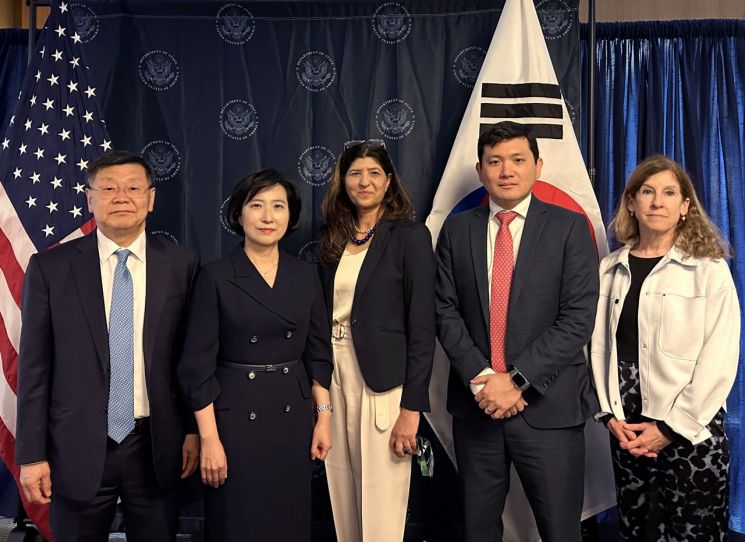 Officials attending the 4th Korea-US Private Space Dialogue are taking a commemorative photo. From the left: John Lee, Director of the Space Administration; Han Min-young, Director of the Climate Environment Science Diplomacy Bureau, Ministry of Foreign Affairs; Rahima Kandahari, Deputy Assistant Secretary of State; Kevin Kim, Deputy Assistant Secretary for East Asia and the Pacific; Karen Feldstein, Director of International Cooperation at NASA. Photo by Space Administration
John Lee, Director of the Aerospace Mission Headquarters at the Korea Aerospace Administration, and Han Min-young, Director of the Climate Environment Science Diplomacy Bureau at the Ministry of Foreign Affairs, served as Korea’s joint chief representatives, while the United States was represented by Rahima Kandahari, Deputy Assistant Secretary for Science, Technology, and Space at the U.S. Department of State, and Karen Feldstein, Director of International Cooperation at NASA, as joint chief representatives.
This 4th Korea-U.S. Civil Space Dialogue marked the first time since the Korea Aerospace Administration’s inauguration in May last year that the diplomatic and space authorities of both countries served as joint chief representatives. Delegations of about 30 members from various space-related agencies of both governments participated, comprehensively discussing specific cooperation measures, diplomatic, security, and economic implications centered on 10 agenda items including space policy, space exploration, and satellite navigation.
The two countries discussed expanding Korea’s participation in the Artemis program and cooperation on the 4th Lagrange Point (L4) exploration mission. Additionally, Korea agreed to support and collaborate on various U.S. missions underway, such as NASA’s IMAP (Interstellar Mapping and Acceleration Probe) to understand the interaction between solar wind and interstellar medium, and NOAA’s SWFO-L1 (Space Weather Follow-On L1) mission for studying solar wind and coronal mass ejections.
Measures to enhance interoperability between Korea’s Korean Positioning System (KPS) under development and the U.S. GPS system were also discussed. Furthermore, Korea’s potential participation in the Landsat 2030 international partnership, which the U.S. is promoting to assess climate change and wildfire impacts, as well as satellite information sharing plans for Korea’s next-generation mid-sized satellite No. 4 (to be launched in 2026 for use by the Rural Development Administration and the Korea Forest Service), were also discussed.
Considering the growing importance of maritime domain awareness using space, cooperation measures between the relevant agencies of both countries (Korea Coast Guard and U.S. National Oceanic and Atmospheric Administration’s National Ocean Service) were also discussed.
Other topics included exploring opportunities to participate in NASA’s low Earth orbit commercial space station (CLD) and Commercial Lunar Payload Services (CLPS) programs, as well as cooperation measures such as building space industry supply chains and sharing radiation test data between the two countries.
John Lee, Director of the Korea Aerospace Administration, stated, "With the inauguration of the Korea Aerospace Administration, space cooperation between Korea and the U.S. is accelerating, focusing on space science and exploration," adding, "We look forward to expanding cooperation between the two countries into various fields such as technology, industry, security, and policy."
© The Asia Business Daily(www.asiae.co.kr). All rights reserved.

















