Withdrawal of Previous Presidential Pledge
Shift in Focus from Fairness to Growth
Targeting Centrist and Conservative Voters
Former Democratic Party leader Lee Jae-myung has confirmed that he will not include his policy brand, basic income, in his pledge for the June 3 early presidential election. Unlike the previous election, Lee has shifted his economic policy focus from fairness to growth, marking the start of a so-called 'rightward shift.' His strategy is to expand his appeal by targeting centrist and conservative voters.
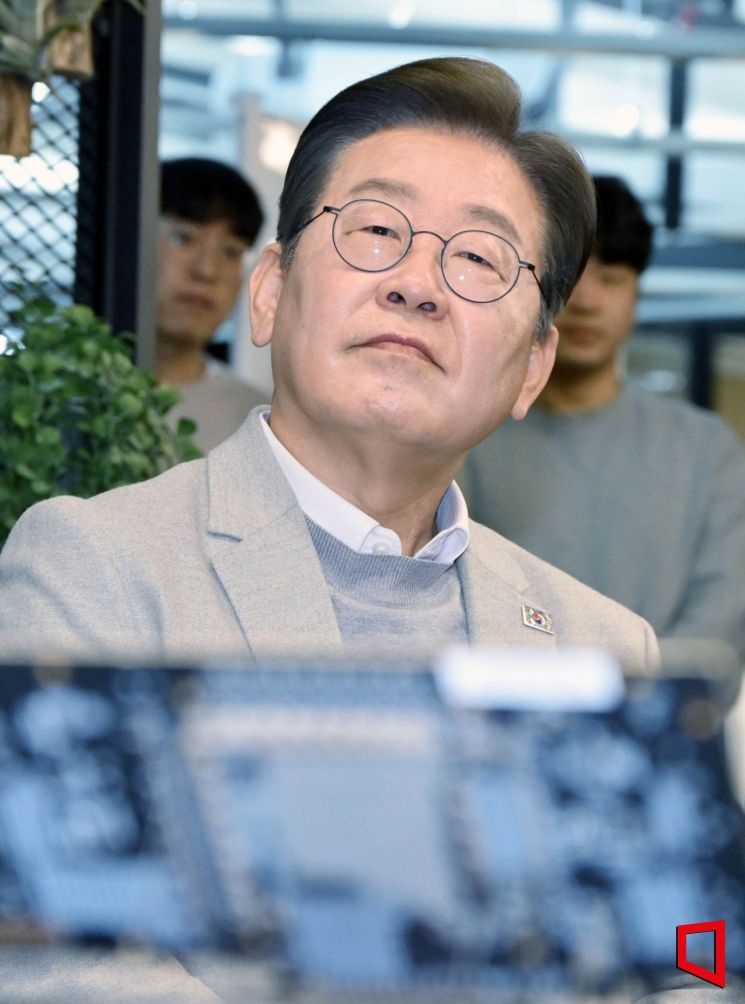 Lee Jae-myung, the Democratic Party presidential pre-candidate, is listening to Baek Jun-ho, CEO of Puriosa AI, introduce technology at Puriosa AI in Gangnam-gu, Seoul on the 14th. Photo by the National Assembly Press Photographers Group
A key official from Lee's campaign told Asia Economy on the 15th, "The economy is currently in crisis. It is time to recover the economy, and growth is the priority," adding, "It is difficult to plan a basic income policy of 250,000 won per year at an implementation level. We have never discussed it as a pledge."
During the 20th presidential election, the Democratic Party pledged universal basic income for all citizens. The plan was to establish a presidential basic income committee to facilitate public discussion and then provide 250,000 won annually in local currency. The plan also included aiming for 1 million won annually during the term, funded by land value dividends and carbon dividends. Lee also devoted effort to the basic income policy during his tenure as party leader. In January 2023, he personally took on the role of chairman of the Democratic Party’s Basic Society Committee, which supported his vision of a basic society. The concept of a basic society was that the state should support not just a minimum standard of living but a life above a certain level. This encompassed basic income, basic housing, and basic finance.
The disappearance of basic income, which had been Lee’s trademark, from the forefront is seen as a strategic move for this election. Basic income has long been criticized by conservatives as 'handouts' and 'populism.' These criticisms also influenced centrist voters and were considered a limiting factor for Lee’s approval ratings. After announcing his candidacy, Lee’s first official schedule was a visit to AI semiconductor design startup PuriosaAI, emphasizing economic growth.
Earlier, from his New Year’s press conference in January, Lee had indicated a reconsideration of the basic income policy. He said, "Policy is not about doing or not doing something, but about choosing what to prioritize," adding, "At the moment, South Korea is too broken and struggling too much regarding priorities." He continued, "I believe that the process of creating is now more important than the issue of distribution," and said, "Economic stability, recovery, and growth are the most urgent issues right now."
Instead of basic income, the card Lee played was the 'Black Cat, White Cat' theory. Lee stated, "Pragmatism beyond ideology and factionalism is the driving force for overcoming crises and achieving growth," adding, "Ideology and factions do not put food on the table. Whether the cat is black or white, as long as it catches mice well, it is a good cat." Regarding specific growth methods, he said, "Companies must take the lead and the state must support to open the path to growth again," and "In an era where corporate competitiveness is national competitiveness, jobs are created by companies, and corporate growth is national economic development. We must shift from an era where the government decides everything to one where the private sector leads with government support."
© The Asia Business Daily(www.asiae.co.kr). All rights reserved.

















