Four-Year Project from 2025 to 2028 with a Total Budget of Approximately 1.2 Billion KRW
Business Agreement to Be Signed with Korea Fisheries Resources Agency in April for Joint Cooperation
Gijang-gun (Governor Jeong Jongbok) announced on the 14th that the Sirang-ri coastal area in Gijang-eup has recently been finally selected as a target site for the Ministry of Oceans and Fisheries' '2025 New Marine Forest Creation Project.'
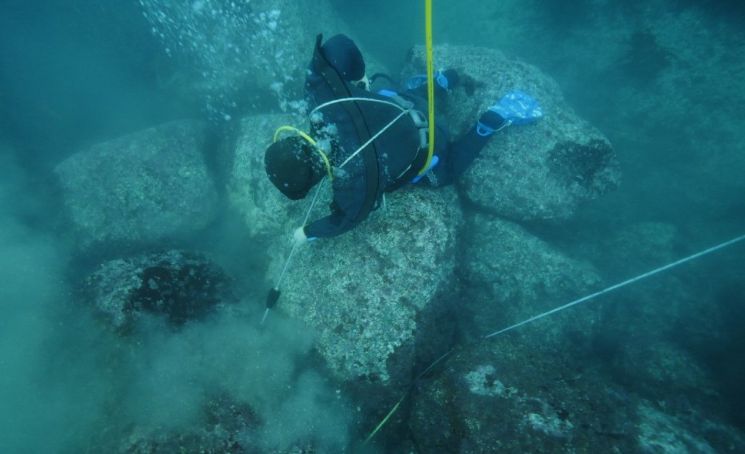 Work for seaweed transplantation (substrate improvement) is underway in the coastal waters of Dongbaek-ri, Ilgwang-eup. Provided by Gijang-gun
The 'Marine Forest Creation Project' is an initiative to restore coastal ecosystems damaged by marine desertification. The project will be carried out over four years from 2025 to 2028, with a total budget of approximately 1.2 billion KRW, including 950 million KRW in national funding.
This project aims to restore the ecological health of coastal areas suffering from severe 'Gatnogeum' (marine desertification), enhance biodiversity, and create seaweed habitats that provide essential shelters and spawning grounds for various marine organisms.
Following the selection of the Dongbaek-ri coastal area in Ilgwang-eup as a new project site in 2023, the project area has now expanded to include the Sirang-ri coastal area. This expansion is expected to further accelerate the restoration of coastal ecosystems and the realization of carbon neutrality.
In particular, the existing Dongbaek-ri coastal area in Ilgwang-eup has already shown positive results in reducing 'Gatnogeum,' restoring seaweed habitats, and improving the coastal ecosystem through substrate improvement, seaweed transplantation, and the dispersal of zoospores (seeds). Based on these achievements, even greater synergy is anticipated.
To ensure the successful implementation and expertise of the project, the county plans to sign a business agreement in April with the Korea Fisheries Resources Agency (FIRA), a specialized marine ecosystem restoration institution, and establish a close cooperative system.
Upon completion of the project, a sustainable fisheries foundation is expected to be established around the Gijang coast. Through the photosynthetic activity of seaweed, the area will function as a marine carbon sink (blue carbon), actively contributing to climate change response. In addition, the restored coastal landscape is expected to become a valuable regional tourism resource, creating various added values such as marine healing and ecological tourism.
Governor Jeong Jongbok stated, "With the selection of the Sirang-ri coastal area following Dongbaek-ri, the ecological restoration project for the Gijang coast has gained even more momentum. We will successfully carry out the project to create a clean and abundant Gijang sea and provide substantial benefits to the lives of fishermen."
© The Asia Business Daily(www.asiae.co.kr). All rights reserved.

















