'External Force Theory' Completely Ruled Out
Abnormal Steering Gear Operation, Not Helmsman's Error
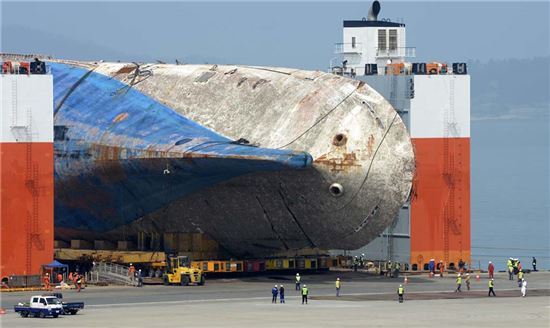 Sewol ferry salvage operation. Photo by Asia Economy DB
The Marine Accident Investigation Board has concluded that the cause of the Sewol ferry disaster in 2014 originated from the vessel itself, including steering device failure and insufficient stability.
According to Yonhap News on the 14th, the Mokpo Regional Maritime Safety Tribunal (Mokpo Maritime Tribunal) special adjudication division made a ruling on the 'Passenger Ferry Sewol Capsizing Incident' last November, 10 years and 7 months after the accident occurred. While general cases and accidents are judged by courts, maritime vessel accidents undergo adjudication by the Maritime Safety Tribunal.
According to the ruling obtained by Yonhap News, the Mokpo Maritime Tribunal excluded the 'external force theory,' which suspected that the Sewol sank due to external factors such as a submarine collision. The tribunal explained, "Based on the investigation after the vessel was salvaged, no evidence was found on the damaged parts of the Sewol hull that could definitively indicate external forces causing sudden maneuvers," and "Since no valid evidence of external forces was confirmed, it was not included in the cause review."
Excluding the external force theory, the tribunal judged that the Sewol's sudden turn was not due to the helmsman's error but rather abnormal operation of the steering gear. In particular, it acknowledged the 2018 Sewol Hull Investigation Committee's view that the solenoid valve of the steering gear's No. 2 pump was stuck, causing abnormal steering gear operation.
At that time, the Sewol's stability was significantly reduced. This was due to the hull being extended and remodeled to increase passenger capacity, which raised the center of gravity. Although a vessel with low stability should carry less cargo, the Sewol was found to have carried 2,214 tons of cargo?twice the 1,077 tons allowed in the 'stability calculation report.'
Furthermore, when cargo that was not properly secured shifted to one side, the turning and hull tilt intensified, allowing seawater to enter through the hull openings, resulting in loss of stability, according to the tribunal's conclusion.
The tribunal also attributed the large-scale casualties?304 deaths or missing persons out of 476 passengers onboard?to the crew's failure to take active rescue measures. It pointed out, "Although the captain and crew recognized the risk of sinking and requested rescue from the Coast Guard, they did not devise methods to evacuate or disembark passengers outside the vessel until they themselves were rescued by the Coast Guard."
Accordingly, the Mokpo Maritime Tribunal revoked the licenses of five individuals, including Captain Lee Jun-seok, navigators, and engineers, and suspended the duties of two engineers and one navigator for six months to one year. It also issued corrective orders to Cheonghaejin Marine Company, the operator of the Sewol ferry.
Meanwhile, Cheonghaejin Marine and related parties have appealed the ruling, and the second trial is currently underway at the Central Maritime Safety Tribunal.
© The Asia Business Daily(www.asiae.co.kr). All rights reserved.
















