Body Width 2.2m, Weight 120kg... Made into a Scientific Specimen
The National Honam Biological Resources Institute, under the Ministry of Environment (Director: Park Jinyoung), announced on the 14th that it had received the carcass of a large Mobula mobular, which was accidentally caught during fishing operations off the coast of Yeonggwang-gun, Jeollanam-do last July, from a local fisherman and made it into a scientific specimen.
The Mobula mobular is commonly referred to as the "devil ray" because the pair of fins on both sides of its head resemble the horns of a devil. It is found in tropical and subtropical waters around the world.
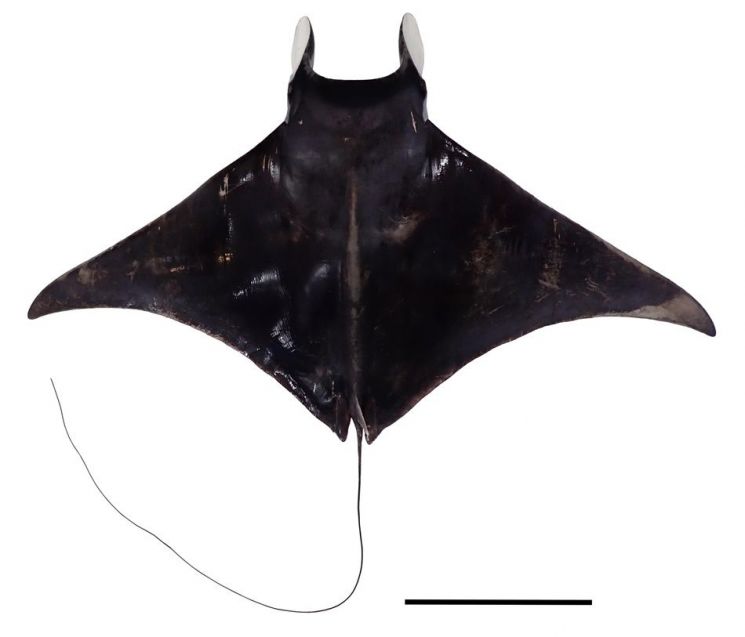 A large stingray accidentally caught while fishing off the coast of Yeonggwang County. Provided by the National Honam Biological Resources Center.
The specimen identified this time is a large individual with a body width of 2.2 meters and a weight of 120 kg. It is a rare species with few official observation records along the entire coast of Korea. This discovery marks the first confirmation along the west coast of Korea since it was first recorded by Japanese scholar Mori in 1928.
In particular, the Mobula mobular is a large fish species with a body width of up to 3 meters, making it extremely difficult to produce and manage as a wet specimen. As a result, cases of its preservation as a scientific specimen are extremely rare. Therefore, the specimen produced this time holds significant value as an important scientific record supporting its occurrence in Korea.
The National Honam Biological Resources Institute plans to use this specimen to analyze the morphological and ecological characteristics of the Mobula mobular and to utilize it in genetic research, thereby strengthening research on biodiversity conservation.
Kim Changgyun, head of the Island Biological Resources Research Division at the National Honam Biological Resources Institute, stated, "Biological specimens are essential research materials for understanding changes in the Earth's environment and biodiversity, and are national biological assets. As the distribution of biological species is rapidly changing due to recent climate change, we will do our best to systematically conserve national biological resources by strengthening biodiversity monitoring."
© The Asia Business Daily(www.asiae.co.kr). All rights reserved.

















