Market Research Firm 'Omdia' Forecasts
Panel Shipments to Reach 3.16 Million Units This Year
Rapid Growth Driven by Gaming Market Demand
Korean Companies Hold 99.6% Market Share
Samsung Display Dominates with 77% Share
The market size of 'Organic Light Emitting Diode (OLED) for monitors,' gaining attention as a new growth driver in the electronics industry, is expected to exceed $1 billion for the first time this year. Korean companies such as Samsung Display and LG Display, which have virtually monopolized the market, plan to maintain a significant market lead by leveraging various sizes and panel technologies.
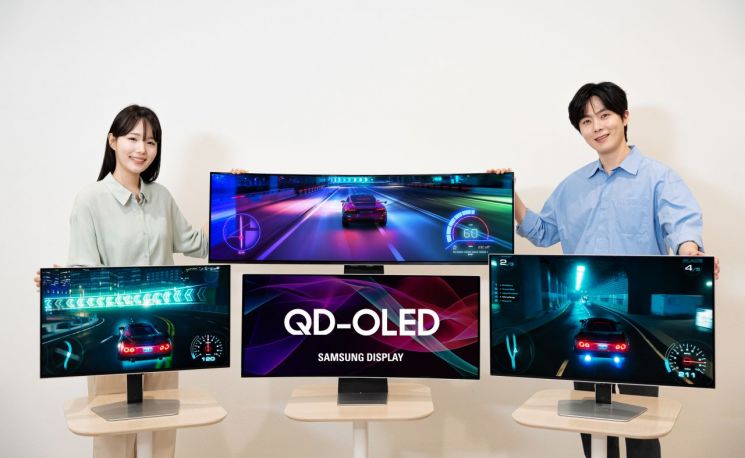
According to the market research firm Omdia on the 14th, the total shipments of OLED panels for monitors worldwide in the first quarter of this year are expected to reach 503,000 units. This is a 47.5% increase compared to the same period last year (341,000 units). The total shipments for the entire year are projected to be 3.16 million units, more than 20 times the 160,000 units shipped in 2022.
The market size is also growing explosively. The sales revenue of the monitor OLED market was only $75.2 million in 2022, but this year it is expected to reach approximately $1.11 billion, about 15 times more, surpassing $1 billion for the first time in history. OLED panels for monitors have advantages such as clearer image quality, higher refresh rates, and faster response times compared to Liquid Crystal Displays (LCDs). They are mainly installed in premium products such as gaming monitors and monitors for broadcasting and film production. The industry analyzes that strong consumer demand for gaming monitors is the driving force behind the rapid market growth.
According to another market research firm, IDC, despite the global monitor market shrinking last year, gaming monitor sales increased by 21.8%, from $5.878 billion to $7.158 billion. Among these, OLED monitors grew rapidly by 2.5 times, from $485 million to $1.23 billion during the same period.
The market leader is Samsung Display. According to Omdia, Samsung Display's market share of OLED panels for monitors (based on shipments) in the first quarter of this year is estimated at 76.5%. The company claims to lead the market with its Quantum Dot (QD)-OLED technology. QD-OLED combines the excellent black expression of traditional OLED with the characteristics of quantum dots, enabling rich color expression and distortion-free image quality from any angle.
The industry expects Samsung Display's shipments of OLED panels for monitors this year to exceed 2 million units, a more than 50% increase compared to last year. Following the launch of the first 27-inch QHD (2560x1440) OLED monitor supporting 360Hz last year, Samsung Display plans to introduce a product supporting the highest 500Hz refresh rate among existing OLED monitors in the first half of this year.
LG Display, which entered the market later than Samsung Display, currently holds the second position. According to Omdia, LG Display's market share of OLED panels for monitors (based on shipments) in the first quarter of this year is estimated at 23.1%, and panel shipments, which were around 280,000 units in 2023, are expected to reach 690,000 units this year.
LG Display recently began mass production of a 45-inch gaming OLED panel applying its proprietary variable refresh rate & resolution (DF) technology, accelerating its market penetration. This product allows users to select between a high refresh rate mode (330Hz) and a high resolution mode (5120x2160).
Meanwhile, display companies are planning to expand the application of OLED panels not only to premium but also to mid- to low-priced product segments. This strategy is interpreted as an effort to outpace competitors, including Chinese companies that have not yet entered the market, and to further expand their market influence.
© The Asia Business Daily(www.asiae.co.kr). All rights reserved.

















