Health Insurance Union Criticizes Government's "Free-Riding" Amid Direct Impact of Demographic Changes
Crisis of Reserve Depletion by 2030... High Public Trust but Low Coverage
The National Health Insurance Service Labor Union strongly urged the next government, which will be launched following the early presidential election in June, to prioritize the state's responsibility for health insurance finances. With health insurance expenditures rapidly increasing due to low birth rates and ultra-aging, while the government's statutory support remains stagnant, concerns are growing that the point of financial depletion could come sooner. The union argued that health insurance coverage should be enhanced and the burden of medical expenses on the public reduced to establish a virtuous cycle where the livelihood economy can grow.
According to the 2023 Health Insurance Statistical Yearbook on the 14th, medical expenses for elderly people aged 65 and over in South Korea amounted to 48.9011 trillion won, accounting for 44.1% of total medical expenses. This means that the elderly population, which makes up 17.9% of the total population, used nearly half of the health insurance finances. Under the current system, where insurance premium burdens are concentrated on households and businesses and the system is operated mainly through private medical care, it is realistically difficult to cope with the rapidly increasing elderly medical expenses.
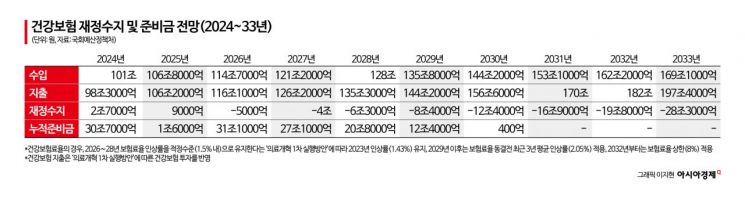
According to projections by the National Assembly Budget Office, factors such as reduced property insurance premiums from regional subscribers leading to decreased revenue, increased elderly medical expenses, costs to address medical gaps due to conflicts over increasing medical school quotas, and essential medical fee increases (20 trillion won + α) are intertwined. As a result, health insurance finances are expected to turn to a deficit in 2026 and the accumulated reserves are predicted to be depleted by 2030.
However, so far, South Korea's health insurance system has received very high public satisfaction, with over 80% positive evaluations in various opinion polls. The perception of it as the last social safety net to rely on when ill was strong, and satisfaction rose to 92.1% during the COVID-19 period. For this reason, strengthening coverage has been a staple pledge in all past governments, regardless of political faction.
But the reality falls short of these public expectations. South Korea's health insurance coverage rate is 64.9% (as of 2023), which is much lower than the OECD average of 76.3%, ranking among the lowest. The Health Insurance Labor Union points out that despite numerous policies to alleviate the public's medical expense burden, the low coverage rate reflects repeated 'policy failures.'
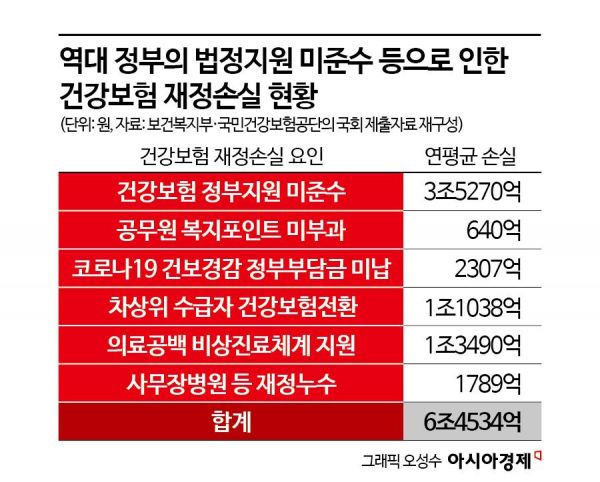
Health insurance finances are shared among three entities: households, businesses, and the government. The current 'National Health Insurance Act' stipulates that the government must annually support about 20% of the expected insurance premium revenue from the national treasury. However, successive governments have repeatedly engaged in 'free-riding' administration by failing to properly pay the statutory support funds and shifting costs that the state should bear, such as medical aid resources, onto health insurance.
According to the Health Insurance Labor Union, the financial losses and leakages caused by the government's neglect of responsibility amount to an average of 6.4534 trillion won annually. This is a massive scale that could enable benefits such as coverage for nursing care costs or nationwide implant support.
Accordingly, the Health Insurance Labor Union called for clarifying the state's responsibility for health insurance finances in conjunction with the 25th anniversary of integrated health insurance and the launch of the next government this year.
Specifically, they proposed ▲establishing a 'health insurance financial settlement clause' that mandates the government to settle and return unpaid support funds within the next fiscal year ▲abolishing sunset provisions on government support and enacting permanent legislation ▲changing the government support standard from '20% of expected insurance premium revenue' to '50% of the previous previous year's elderly (65+) benefit expenses' to strengthen state responsibility in the aging era. Applying this standard, government support in 2025 would be about 18.7 trillion won, which is 21.3% of the insurance premiums borne by households and businesses. The union argued that this would establish a balanced sharing structure in the long term, with households, businesses, and the government each bearing one-third of the burden.
For example, Taiwan, which adopts a social insurance system, has legislated a minimum government support rate of 36%, and Japan also bears about 28% of costs, including 50% of late-stage elderly medical expenses.
Hwang Byeong-rae, chairman of the Health Insurance Labor Union, emphasized, "The next government must promptly prepare practical measures to strengthen the state's responsibility for financial management to secure the sustainability of health insurance and alleviate the public's burden." He added, "This is not merely a financial issue but a timely challenge to protect the public's right to health and realize the value of social solidarity."
© The Asia Business Daily(www.asiae.co.kr). All rights reserved.



















