Emphasis on "Mega Sandbox" at Expert Roundtable
Regulatory Suspension Needed for Future Strategic Industries
Infrastructure Required for Digital Industries such as AI
Choi Tae-won, Chairman of the Korea Chamber of Commerce and Industry (KCCI), stated, "If we create business conditions in regions that are absolutely comparable to those in advanced countries, we can transform them into future growth hubs for South Korea." He proposed four practical measures: nurturing and attracting local talent, establishing an artificial intelligence (AI) industry infrastructure, drastic deregulation, and incentive support.
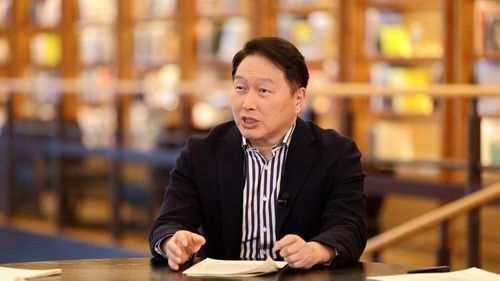
According to KCCI on the 13th, Chairman Choi recently participated in a roundtable discussion moderated by Professor Ma Kang-rae of Chung-Ang University's Department of Urban Planning and Real Estate, along with Son Bo-mi, CEO of Starseed, and Lee Je-hyung, CEO of Stratio Korea. He mentioned the "Gordius Knot," emphasizing that "various issues such as low birth rates, regional extinction, and education are interconnected, requiring a new approach to solve these problems simultaneously."
Chairman Choi diagnosed, "Our country is currently facing many challenges both internally and externally. AI is rapidly transforming all industries, and technological revolutions continue, placing us in a situation where we must evolve into new models through new innovations." He added, "Open AI is only 10 years old, yet ChatGPT has over 100 million users. However, domestically, we are not seeing the emergence of such companies, nor sufficient growth to create and expand new jobs."
As a solution to these structural problems in South Korea, he proposed the "Mega Sandbox." The Mega Sandbox goes beyond the existing sandbox focused on regulatory innovation by selecting future strategic industries specialized for metropolitan regions such as Daegu-Gyeongbuk, Gangwon, and Chungcheong. It involves suspending regulations and providing related infrastructure and incentives, including education, workforce, and research and development (R&D).
Chairman Choi explained, "We cannot create all industrial conditions at once, but we can establish environments tailored to specific industries. Based on this, we aim to simultaneously solve issues related to jobs, education, and housing." He emphasized, "Existing special zones have mostly been manufacturing-based industrial complexes and lacked environments that companies genuinely want or that are sufficient for relocation from the metropolitan area. Autonomous management is necessary to secure the workforce companies need."
He continued, "An environment must be created where careers can be planned locally, linking university education to employment. Housing, education, and culture should be designed in a way that suits the region."
He also stressed the importance of infrastructure for digital industries such as AI. Chairman Choi said, "There must be at least one place in South Korea with properly established AI infrastructure. Only then can we demonstrate that AI transformation can be driven in any industry based on this infrastructure."
He mentioned the need for open-minded and open regulations, stating, "When companies ask, 'Is this allowed?' the answer should be 'Do whatever you want.' This calls for negative regulation methods."
He explained, "New industries like autonomous driving should not be hindered by regulations. Freedom must be given to regions and companies that want to solve such problems themselves. Creating this structure will help attract global demand." He added, "Transferring workforce from nearby regions is a zero-sum game and meaningless. External inflow is necessary."
CEO Lee also pointed out, "In the U.S., when a technology is perceived as 'the first' or 'the best,' there is a cowboy spirit to boldly invest and make that company number one in the field. In contrast, in Korea, too much time is spent analyzing whether there are existing cases in other countries, causing missed opportunities."
Chairman Choi emphasized, "Regions themselves must be able to provide incentives that companies want, and the level should satisfy not only domestic but also global corporate demand." He added, "What the demand side wants must start from a bottom-up approach. It is strange that new attempts cannot be made because of laws; if necessary, laws should be flexibly changed."
The roundtable was partially featured in the documentary "The Road to Future Society, Mega Sandbox," which aired on KBS1 the previous day. The documentary begins with CEO Son Bo-mi, a native of Busan, visiting her hometown and highlighting the reality of the region by touring various parts of the city losing vitality.
It then shows local workers from the region working in Pangyo and efforts by regional companies to solve problems themselves, as well as introducing overseas cases such as Japan's Toyota "Woven City."
© The Asia Business Daily(www.asiae.co.kr). All rights reserved.

















