Exports increased by more than 13% until the 10th of this month, continuing the export growth trend that began in February. However, the government assesses that downward pressure on the economy has increased due to worsening external conditions such as U.S. tariffs.
According to the Korea Customs Service on the 13th, exports from April 1 to 10 amounted to $18.6 billion, up 13.7% compared to the same period last year. The number of working days was 8.5, one day more than the same period last year. Considering this, the average daily export value was $2.19 billion, an increase of 0.3%.
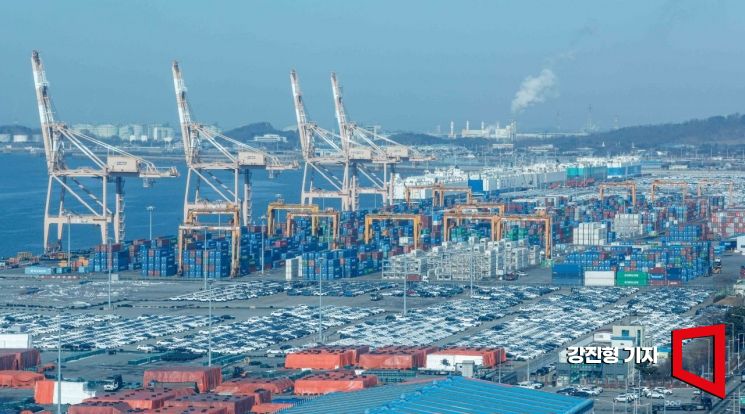 President Donald Trump signed a proclamation imposing a 25% tariff without exceptions on steel and aluminum products imported into the United States, and announced that tariffs on automobiles and semiconductors are also under consideration. On February 13, 2025, export vehicles were waiting to be loaded at Pyeongtaek Port, Gyeonggi Province. Photo by Kang Jin-hyung
By item, semiconductors (32.0%), passenger cars (11.9%), and auto parts (10.5%) increased, while petroleum products (-3.9%) and computer peripherals (-14.1%) decreased. By country, exports to China (8.8%), the European Union (EU, 30.6%), Vietnam (14.3%), and Japan (0.7%) increased, while exports to the United States (-0.6%) decreased.
Imports until the 10th of this month amounted to $19.7 billion, up 6.5% compared to the same period last year. Crude oil (10.2%), semiconductors (15.5%), and machinery (10.3%) increased, while gas (-19.1%) and petroleum products (-7.3%) decreased. Imports from major countries increased from China (4.7%), the United States (2.3%), Japan (15.1%), and Australia (19.9%), but decreased from the EU (-18.7%).
The trade balance recorded a deficit of $1.1 billion. Accordingly, the cumulative surplus from the beginning of this year until the 10th of this month reached $6.177 billion.
Earlier, the Ministry of Economy and Finance stated in the April issue of the 'Recent Economic Trends (Green Book)' released on the 11th, "Recently, our economy is experiencing delayed recovery in domestic demand such as consumption and construction investment, and employment difficulties persist mainly in vulnerable sectors," adding, "Downward pressure on the economy is increasing due to worsening external conditions caused by the imposition of U.S. tariffs."
The Ministry of Economy and Finance announced, "While making every effort to respond to trade risks, including swift implementation of essential supplementary budgets to support damages to Korean companies caused by U.S. tariffs and to strengthen industrial competitiveness, we will continue and strengthen the recovery of the livelihood economy by supporting jobs, construction, and small business owners."
© The Asia Business Daily(www.asiae.co.kr). All rights reserved.
![Clutching a Stolen Dior Bag, Saying "I Hate Being Poor but Real"... The Grotesque Con of a "Human Knockoff" [Slate]](https://cwcontent.asiae.co.kr/asiaresize/183/2026021902243444107_1771435474.jpg)
















