Approved Following Last Year's Chinese Registration
North Korea Acquires Its First Global Geopark
The North Korean territory of Baekdusan has been registered as a UNESCO (United Nations Educational, Scientific and Cultural Organization) Global Geopark.
On the 10th (local time), the UNESCO Executive Board approved North Korea's Baekdusan as a Global Geopark. Previously, last year, the Chinese territory of Baekdusan was registered as a UNESCO Global Geopark. With the recognition of the North Korean side of Baekdusan this time, the entire mountain has been designated as a Global Geopark. This is the first time North Korea has possessed a Global Geopark.
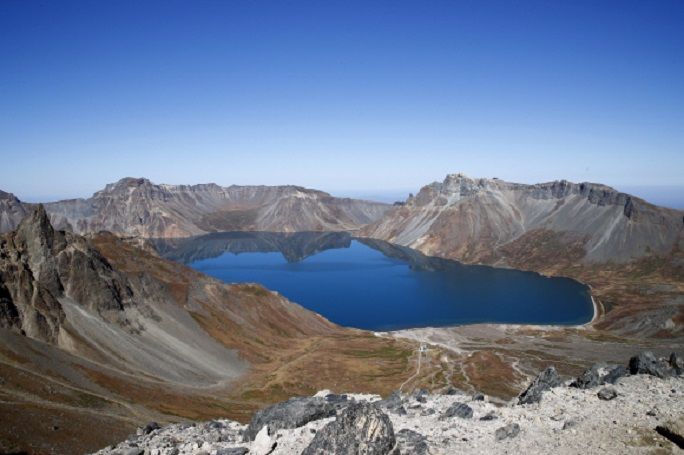
Global Geoparks are designated to preserve areas with geological value and to manage them sustainably. After being recognized as a Global Geopark, sites must undergo review and re-evaluation every four years, and certification may be revoked if standards are not met.
North Korea applied for Baekdusan Global Geopark certification in 2019, one year earlier than China, but due to COVID-19 delaying on-site inspections by experts, approval came later than China's side. Baekdusan, located in China, is registered as a UNESCO Global Geopark under the Chinese name "Changbaishan (長白山)".
The UNESCO Global Geopark Council announced in an online meeting last December that 16 locations, including the northern region of Baekdusan, were selected as new UNESCO Global Geopark candidates.
In the candidate introduction released by the council in February, it was explained that "Baekdusan is characterized by majestic landscapes formed by volcanic eruptions," and "this area has developed glacial landforms such as cirques (bowl-shaped valleys formed by glacial erosion) created by glacial erosion (the process of glaciers moving and eroding the surface)." It also introduced the "Millennium Eruption" that occurred around the year 1000 at Baekdusan, adding that "it is considered a volcano with a high possibility of erupting again in the future." Previously, Baekdusan was registered as a UNESCO Biosphere Reserve in April 1989. One quarter of Baekdusan is in North Korea, and the remaining three quarters are in China, with Lake Chonji (Heaven Lake) mostly belonging to North Korea.
Meanwhile, the UNESCO Executive Board also newly registered the Chungbuk Danyang Geopark and the Gyeongbuk East Coast Geopark as Global Geoparks on the same day. As a result, the number of Global Geoparks in South Korea has increased to seven, including the existing five sites: Gyeongbuk Cheongsong, Hantan River, Jeju, Jeonbuk West Coast, and Gwangju Mudeungsan.
© The Asia Business Daily(www.asiae.co.kr). All rights reserved.

















