Deputy Prime Minister and Minister of Economy and Finance Choi Sang-mok announced, "To respond to the export crisis caused by changes in the trade environment under the new U.S. administration, we will additionally supply 9 trillion won in policy funds annually."
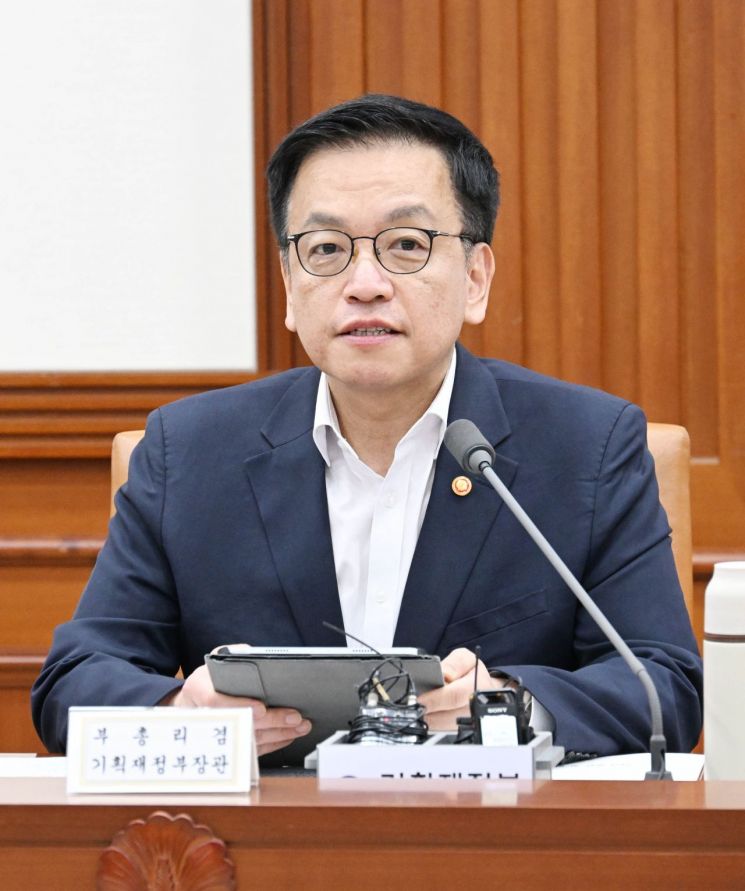 Choi Sang-mok, Deputy Prime Minister and Minister of Economy and Finance, chaired the Ministerial Meeting on External Economy at the Government Seoul Office on the 11th. The meeting discussed the impact of U.S. tariff measures on South Korea's macroeconomy, key tasks and implementation checks for the Korea Eximbank's policy finance operation strategy, tariff administration response strategies according to the U.S. administration's tariff policy, and the review of overseas order performance and future initiatives.
On the 11th, Deputy Prime Minister Choi presided over the Ministerial Meeting on External Economic Affairs at the Government Seoul Office and said, "Although the U.S. has postponed the imposition of reciprocal tariffs for 90 days, basic tariffs and tariffs on items such as automobiles are still being imposed, so we cannot let our guard down," adding, "We will promptly prepare and implement bold support measures suitable for the emergency situation."
The government plans to establish a 'Crisis Response Special Program' at the Export-Import Bank to provide 3 trillion won to small and medium-sized enterprises (SMEs) and mid-sized companies, offering up to a 2 percentage point reduction in interest rates. An additional 2 trillion won in funds will be supported for large export companies.
Deputy Prime Minister Choi stated, "We will also supply 3 trillion won in policy funds and offer preferential interest rates to support win-win cooperation for SMEs and mid-sized companies that supply domestic large corporations," and added, "We will establish a 1 trillion won export diversification financial program to support diversification of export target regions and products."
A government-wide domestic response task force (TF) related to trade issues will also be established to review and respond to tariff damage areas and seek solutions to changes in trade, industry, and supply chains. To cope with the increasingly complex U.S. tariff system, customs administration will also be strengthened. The Korea Customs Service will enhance practical cooperation through consultation channels between Korean and U.S. customs authorities and will open a U.S. tariff item classification consultation center. Additionally, pre-export inspections for shipments to the U.S. will be strengthened to prevent Korea from being mistakenly identified as a third-country transshipment and suffering disadvantages.
© The Asia Business Daily(www.asiae.co.kr). All rights reserved.

















