Production of Safety Map Instead of Undisclosed Priority Maintenance Zone Map
Observation Network to Be Established in Three Areas: Jung-gu, Jongno-gu, and Gangseo-gu
Ground Displacement to Be Detected by Measuring Variations with In-ground Sensors
The Seoul Metropolitan Government is creating a 'safety map' focused on excavation sites with a high risk of ground subsidence following the sinkhole accident in Myeongil-dong, Gangdong-gu. It is also accelerating the installation of the nation's first 'ground subsidence monitoring network.' The city is considering ways to link this with the existing priority maintenance zone map and plans to establish a practical ground subsidence management system.
According to Seoul City on the 11th, the city is currently reviewing a plan to conduct geological surveys of large excavation sites such as subways and tunnels where ground subsidence is a concern, and to produce safety maps. This is based on the judgment that it is difficult to complete a wide-ranging and detailed geological survey covering the entire Seoul area within a short period.
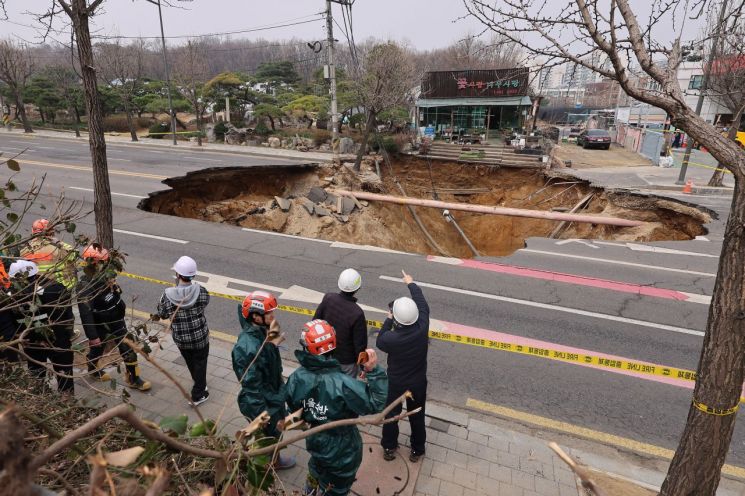 The scene of a recent large-scale ground subsidence incident in Myeongil-dong, Gangdong-gu, Seoul. Photo by Yonhap News
This differs from the 'priority maintenance zone map,' which Seoul City maintains as 'not for public disclosure.' After the sinkhole accident in Yeonhui-dong, Seodaemun-gu, in August last year, Seoul City created the priority maintenance zone map to strengthen preventive activities by intensively inspecting the main causative factors of ground subsidence and detecting underground cavities in advance. The map was produced using information on five ground conditions (clay thickness, sediment thickness, sand thickness, gravel thickness, weathered soil thickness) and six types of underground facilities (water pipes, sewage pipes, gas pipes, communication ducts, heating pipes, power cables), considering the main causes of ground subsidence.
However, it has been criticized as insufficient because it does not include geological surveys or laser exploration. Adding to this, concerns that it could cause unnecessary misunderstandings and anxiety such as housing price instability have led Seoul City to withhold its disclosure.
Seoul City’s decision to build a 'ground subsidence monitoring network' alongside the safety map focused on excavation sites is also aimed at minimizing public anxiety. Internally, three locations?Jung-gu, Jongno-gu, and Gangseo-gu?have been selected as priority targets. Seoul City is reviewing a plan to establish 30 monitoring sites through on-site investigations.
This system installs observation sensors within the ground to measure displacement in real time, allowing potential risks to be recognized in advance and proactively addressed. In this process, all underground facilities such as subways, water and sewage pipes, communication ducts, power cables, and heat transport pipes will be examined. The impact of underground development projects that Seoul City is promoting in the mid to long term will also be reviewed.
Data accumulated from the 'ground subsidence monitoring network' is under consideration for integration and compatibility with Seoul City’s integrated underground safety management system, raising the possibility of future disclosure. The safety map focused on excavation sites will also have its data effectiveness verified, expert opinions gathered, and public consensus formed to decide on disclosure in consideration of the public interest.
Meanwhile, Seoul City is currently operating a 'Road Innovation Task Force (TF)' to strengthen underground safety management. By 2027, it plans to establish a Road Management Innovation Center under the Road Planning Office and increase personnel. Considering that damage to water and sewage pipelines accounted for the largest proportion (64%) of ground subsidence causes over the past 10 years, the main task is to focus on repairing aging water and sewage pipelines. Currently, in Seoul, pipelines over 30 years old account for 5,081 km (38.5%) out of a total 13,201 km of water pipes, and 6,017 km (55.6%) out of a total 10,838 km of sewage pipes.
© The Asia Business Daily(www.asiae.co.kr). All rights reserved.

















