'Kim Gajin: From the Korean Empire to the Republic of Korea'
Exhibition Runs Until June 29
Kim Gajin's Portrait and Calligraphy on Display
The Gyeonggi Cultural Foundation Gyeonggi Museum is holding the first exhibition of the three-part special exhibition "Gwangbok80-Hap合" in celebration of the 80th anniversary of Liberation Day, titled "Kim Gajin: From the Korean Empire to the Republic of Korea," until June 29.
This exhibition highlights the political and artistic world of Kim Gajin (1846?1922), who served as a minister of the Korean Empire and, after the forced annexation by Japan, went into exile at the Provisional Government of the Republic of Korea in Shanghai to devote himself to the independence movement. Centered on Kim Gajin’s poetry, calligraphy, photographs, and paintings, the exhibition also introduces over 120 works by loyal families and contemporaries and later figures who participated in the independence struggle.
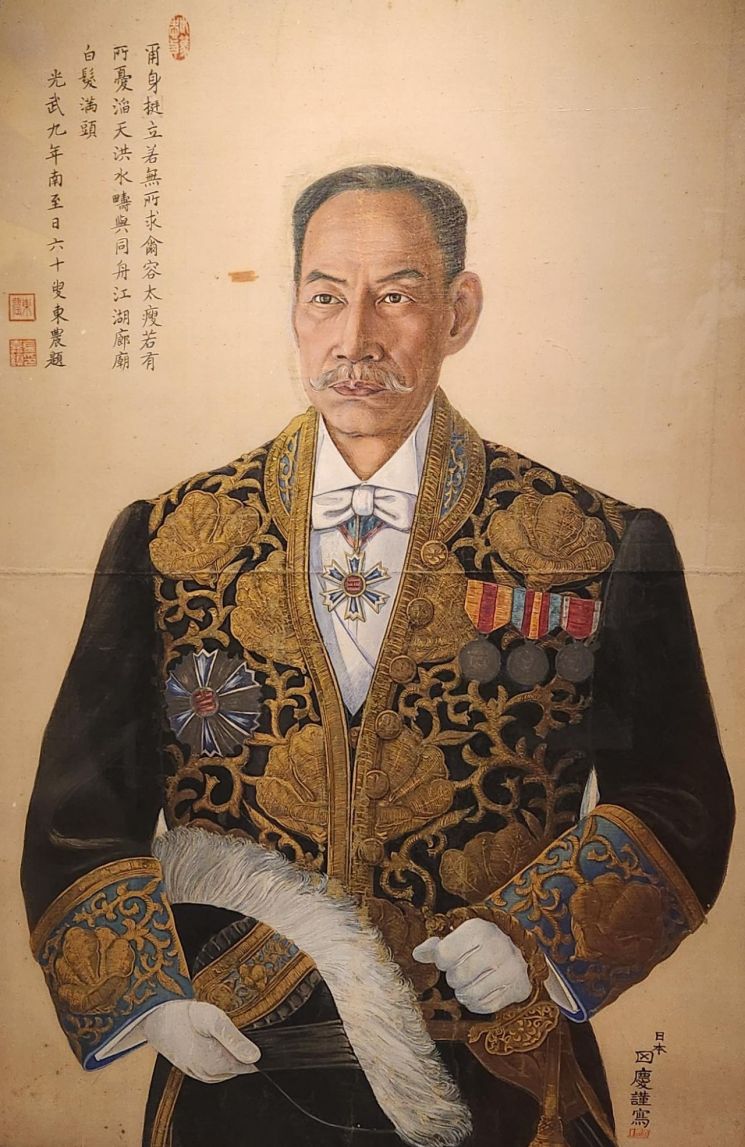
The oil portrait of Kim Gajin (1905) painted by Japanese artist Tenkai reveals the deep sorrow of a fallen nation beneath the proud dignity of the Korean Empire. In the portrait, Kim Gajin wears the Korean Empire’s second-class official ceremonial uniform, adorned with four fully bloomed Mugunghwa flowers, white decorative fur on the ceremonial hat, and various medals, all expressing his dignity. However, the poem Kim Gajin wrote himself, included in the portrait, reveals his worries about the bleak situation facing his homeland.
The "Independence Gate (獨立門)" signboard written in both Hangul and Hanja was also unveiled. It symbolizes the declaration of independence from the Qing Dynasty to both domestic and foreign audiences and is believed to have been written by Kim Gajin after the completion of the Independence Gate. Although there is a theory that Lee Wan-yong, one of the "Eulsa Five Traitors," wrote it, Lee Dong-guk, director of the Gyeonggi Museum, pointed out that "the brushstrokes are solid and rounded like Kim Gajin’s persimmon wood club in terms of calligraphy style and structural aesthetics, showing a stroke quality completely opposite to Lee Wan-yong’s horizontal strokes," identifying Kim Gajin as the author of the Independence Gate signboard. Kim Sun-hyun, Kim Gajin’s great-granddaughter and director of the Dongnong Cultural Foundation, said, "I remember seeing a rubbing of the Independence Gate inscription at home when I was young, but it was unfortunately lost during a move."
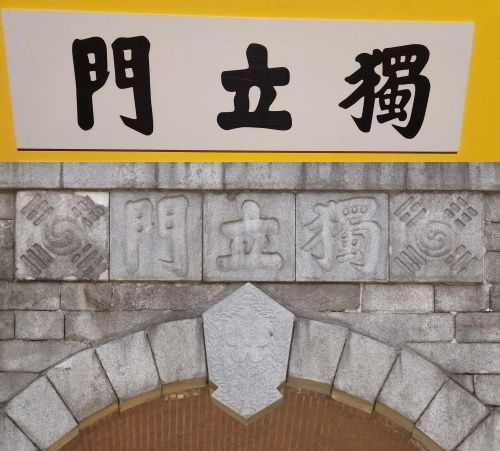 Kim Gajin's handwriting (above the photo) and the actual Independence Gate signboard. Gyeonggi Provincial Museum
The "Great Unity Declaration," an independence declaration announced during the "Second Independence March" on November 28, 1919, was also displayed. Kim Gajin, who served as the president of Daedongdan, a secret independence movement organization formed shortly after the March 1st Movement, is known to have drafted the declaration. It was written on November 28, 1919, in the name of 33 national representatives shortly after Kim Gajin fled to the Provisional Government of the Republic of Korea in October 1919 to evade Japanese surveillance.
This exhibition focuses on how Kim Gajin achieved independence from the Qing Dynasty and Japan through the Joseon Dynasty, the Korean Empire, the Japanese colonial period, and the Provisional Government of the Republic of Korea. Director Lee Dong-guk said, "I hope this exhibition serves as an opportunity to understand that, having achieved liberation from Qing and Japan, the mission of complete liberation through unification still remains for us."
From July 17, the second part "Yeo Un-hyung: The Path to North-South Unification" will be held, followed by "Oh Se-chang: Cultural Patriotism" starting November 27.
© The Asia Business Daily(www.asiae.co.kr). All rights reserved.


















