Coalition Government Formed in 45 Days
"Germany Will Move Forward Again; Europe Can Rely on Germany"
Merz to Meet Trump Soon
The German Christian Democratic Union (CDU) and Christian Social Union (CSU) alliance and the Social Democratic Party (SPD) reached a final agreement on forming the next coalition government on the 9th (local time), just 45 days after the early general election. They are expected to focus on reviving Germany’s economy, the largest in Europe, and strengthening Europe’s security system, which has been shaken by distancing from the United States. Additionally, given the impact of tariffs threatening the stability of Germany’s manufacturing powerhouse, especially its automobile companies, they are likely to engage in negotiations with the U.S. to resolve tariff issues.
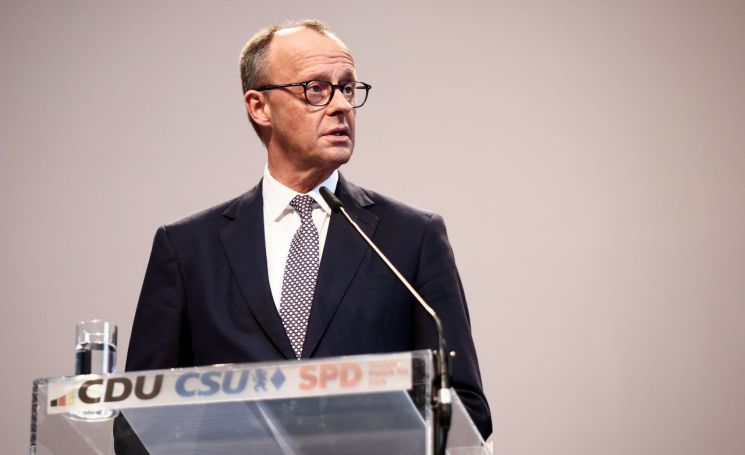
On the same day, the two parties disclosed their major policy agreement and announced plans to elect Friedrich Merz, leader of the Christian Democratic Union, as Chancellor in the second week of May.
Leader Merz stated, "The coalition agreement signals a new beginning for our country," adding, "We will move Germany forward again. Europe can rely on Germany." When asked if he had a message for U.S. President Donald Trump, he replied, "Germany has returned to its proper course and will fulfill its defense obligations."
The grand coalition representing both the left and right wings of German politics is the fifth since the 1949 West German Constituent Assembly. This coalition agreement was reached relatively quickly compared to past cases. The swift agreement was due to increased uncertainty in the external environment. Europe’s security, which had been firmly allied with the U.S., was shaken, and the Trump administration’s tariff onslaught worldwide heightened the sense of crisis in both the economy and security.
In the coalition agreement, the two parties pledged to continue controlling borders to prevent illegal immigration and to lower electricity prices to the lowest level in Europe. They also agreed to pursue tax cuts, including lowering income tax rates for the middle and lower income brackets and corporate taxes, and exempting overtime work from taxes. The minimum wage will be raised from the current 12.82 euros (20,888 won) to 15 euros (24,440 won) next year. Furthermore, they plan to revise the constitutional debt limit regulations within this year and continue promoting voluntary military service in the Swedish model.
British broadcaster BBC reported, "The coalition government announced last month a major reform of Germany’s strict debt regulations, signaling urgency for reform," and added, "This change means the new government will be able to make significant investments in the military and aging national infrastructure."
With the formation of the next coalition government, Leader Merz will lead the new German government. Procedurally, Merz is expected to become the new Chancellor in May. Accordingly, his leadership will face a full-scale test. Immediate attention is required to devise countermeasures against the tariff policies of the Donald Trump administration. The federal government plans to negotiate a free trade agreement (FTA) with the U.S. as a medium-term goal in trade and, in the short term, focus on avoiding trade conflicts and reducing import tariffs with the U.S.
In an interview with German broadcaster RTL on the same day, when asked about President Donald Trump’s reversal of position, Merz responded that the announcement was "a reaction to the resolve of Europeans." In a separate interview with public broadcaster ARD, Merz revealed that he plans to meet President Trump soon after taking office.
Earlier, on the 2nd, U.S. President Donald Trump announced country-specific reciprocal tariffs but abruptly suspended them on the same day. However, tariffs on China were increased to 125%, while other countries were subject only to a basic 10% tariff. The Trump administration stated that during the 90-day suspension period, negotiations would be conducted on a country-by-country basis, implying that individual tariff rates could vary depending on the negotiation outcomes.
© The Asia Business Daily(www.asiae.co.kr). All rights reserved.
![User Who Sold Erroneously Deposited Bitcoins to Repay Debt and Fund Entertainment... What Did the Supreme Court Decide in 2021? [Legal Issue Check]](https://cwcontent.asiae.co.kr/asiaresize/183/2026020910431234020_1770601391.png)















