There is a forecast that the volatility of the domestic export industry will increase due to the United States' America-first trade policy.
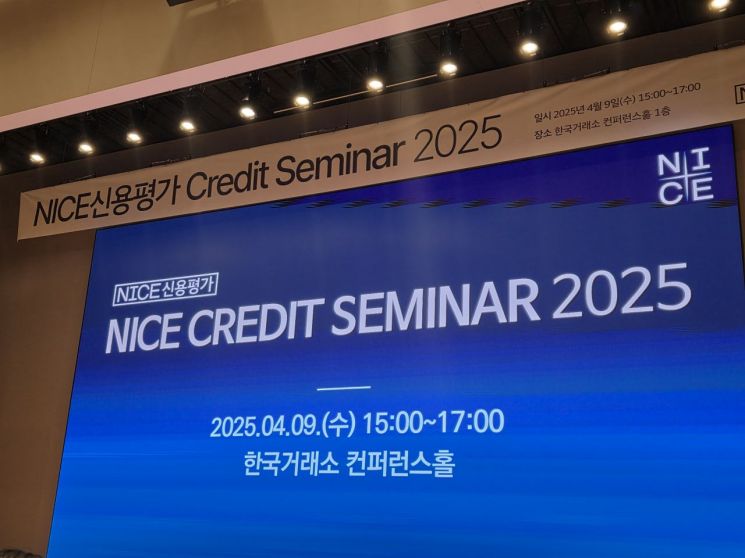
On the 9th, NICE Credit Rating (NICE) held the '2025 Credit Seminar' at the Korea Exchange and stated, "In the process of responding to changes in U.S. policies, an expansion of investment in the U.S. and thus an inevitable increase in financial burden are expected."
According to the Korea International Trade Association, as of last year, the top 10 export items of Korea were led by automobiles in first place, computer parts in second, and automobile parts in third. NICE predicted that the automobile industry would be most affected by President Donald Trump's tariff policies.
As of last year, Hyundai Motor Group's sales volume to the U.S. was 1.7 million units. Among these, about 1.01 million units of exports are exposed to the risk of tariff imposition. Park Se-young, head of corporate evaluation at NICE, said, "Due to the inevitable short-term tariff burden, Hyundai Motor Group's operating performance is expected to decline," adding, "With the announcement of an investment plan worth $21 billion, including the expansion of local factories in the U.S., an increase in financial burden is anticipated."
However, it is expected that the burden will decrease in the long term. He said, "With the expansion of Hyundai Motor Group's production capacity in the U.S., the mid- to long-term impact of tariffs can be mitigated," and "Although investment burdens are expected, considering the financial capacity, the impact on credit ratings will be limited."
The secondary battery industry is expected to have limited direct impact from tariff imposition as major battery cell companies' factories are scheduled to start operations this year. However, there is concern that tariffs on electric vehicles, a downstream industry, could lead to a decrease in demand. Park explained, "If tariffs are imposed on material companies with low U.S. production ratios, cost burdens are expected to increase."
In the case of semiconductors, although the export ratio is low, the burden is considered high when indirect exports are taken into account. He said, "Exports of semiconductors to the U.S. amount to $15.3 billion, about 10% of the total, but considering indirect exports, dependence on the U.S. is high," adding, "The contraction in demand for IT products due to the U.S.'s reciprocal tariff imposition is a risk."
Additionally, it was explained that many groups are experiencing performance slowdowns and negative impacts due to U.S. protectionism and China's oversupply. Regarding LG Group, credit risk has eased in the display sector but expanded due to prolonged poor performance in petrochemicals. Choi Jae-ho, head of Corporate Evaluation Division 2 at NICE, said, "LG Group has over 50% of its business in battery, petrochemical, and display sectors, which are under unfavorable market conditions," and evaluated, "There is an increase in financial burden in the petrochemical sector and policy uncertainties regarding secondary batteries in various countries."
Regarding SK Group, he said, "Credit risk is on the rise in the battery sector following petrochemicals," but added, "Considering the expansion of profit generation in the semiconductor business and the sale of non-core businesses, financial burden relief is possible."
Regarding Lotte Group, it was evaluated that credit risk is expanding in the petrochemical and construction sectors, which continue to face negative market conditions. Choi explained, "Despite improved financial structure due to asset revaluation, high debt burden relative to cash flow generation persists," but added, "Based on group-level financial improvement efforts such as the sale of non-core businesses and assets, reduction and deferral of investments after 2024, a slight easing of financial burden is expected in 2025."
© The Asia Business Daily(www.asiae.co.kr). All rights reserved.
![Clutching a Stolen Dior Bag, Saying "I Hate Being Poor but Real"... The Grotesque Con of a "Human Knockoff" [Slate]](https://cwcontent.asiae.co.kr/asiaresize/183/2026021902243444107_1771435474.jpg)











