Making the Subway Clean and Safe
Subway Janitors Start the Morning Shift
At 8:20 a.m. on the 14th, at the platform of Samgakji Station in Seoul, subway cleaner Kim (53) was busily moving around the platform, cleaning the floors while commuters sat on benches or looked at their phones waiting for the train. Holding a mop in one hand and a gray rag in the other, beads of sweat had already formed on his forehead. He cleaned the platform floor with the mop and, when he found stubborn stains, he squatted down and wiped them with the gray rag.
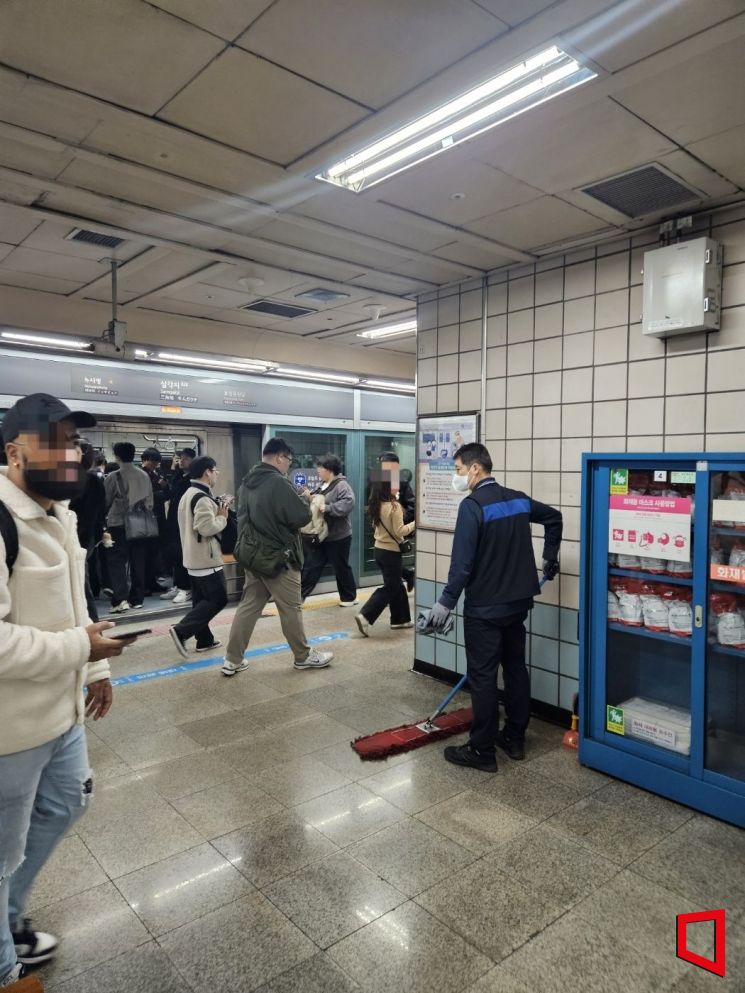 A subway cleaner paused cleaning at the Samgakji Station platform in Seoul on the 9th as passengers crowded, waiting for them to move. Photo by Park Seung-wook
The day for the cleaners at Samgakji Station starts earlier than most office workers, at 6:15 a.m. They scrub away stubborn grime and continuously empty trash bins. From the floor to handrails and restrooms, there is no part of the station that their hands do not reach.
On this day, four cleaners immediately grabbed pink and green rags in both hands and scattered to the ticket gates and handrails. The green rag is primarily used to wipe places frequently touched by passengers, such as handrails and ticket gates. Afterwards, they apply disinfectant with the pink rag to carry out disinfection. Veteran cleaner Kwon Mihyang (64), with 22 years of experience, said, "We clean not only handrails and ticket gates but also all places passengers touch, including elevators," adding, "We walk around the entire station cleaning various spots."
What cleaners pay the most attention to is, above all, passenger safety. They occasionally go out to the entrances during cleaning to check if it is raining. This is because water near the entrances can cause slipping accidents. Kim said, "When it rains, we immediately remove the water from the floor and lay down mats."
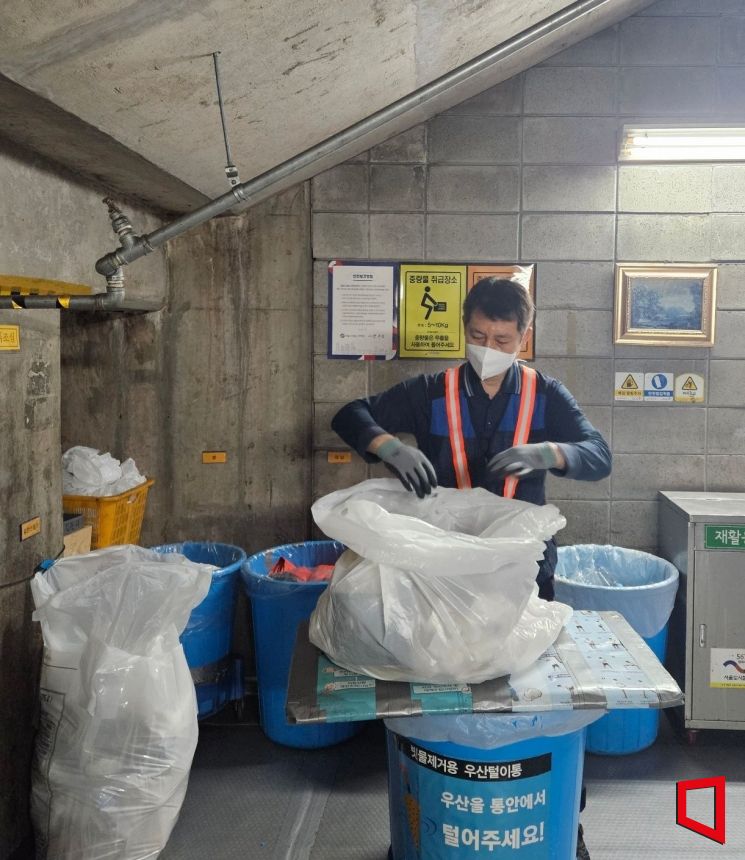 A subway cleaner is emptying a trash bin at the recycling station inside Samgakji Station in Seoul on the 9th. Photo by Park Seung-wook
Kwon also said, "While cleaning itself is important, the most important thing is that passengers using the subway do not get hurt," adding, "During the morning rush, many passengers rush and sometimes collide with cleaners, and there are also cases of slipping due to wet floors." She continued, "We avoid wet cleaning from 8 a.m. to 9 a.m., when the morning rush is at its peak, and start wet mopping from 10 a.m. for the same reason," explaining, "During rush hour, we try to be careful and avoid passengers while cleaning."
Maintaining restroom cleanliness is one of the most important tasks at Samgakji Station. Although it is a large station where Lines 2 and 6 pass through, there is only one restroom. Cleaner Hyun Miae (65) said, "Since many passengers use only one restroom, toilets often get clogged," adding, "Especially when water overflows, we have to clean the entire restroom, which is challenging." She continued, "While cleaning the restroom, we sometimes find underwear, and when passengers cannot hold their bowel movements, the restroom floor gets dirty a lot," adding, "Even after working as a cleaner for over 10 years, restroom cleaning is the most labor-intensive."
The cleaners frequently check trash bins while moving around the station. Beverage trash bins, in particular, require a separate cleaning process because residue inside can rot if only emptied. Hyun said, "Fortunately, it is not summer yet, but in summer, we have to empty beverage trash bins more often, so we have to move busily," adding, "Going up and down stairs and continuously walking inside the station to check cleanliness makes it impossible not to sweat."
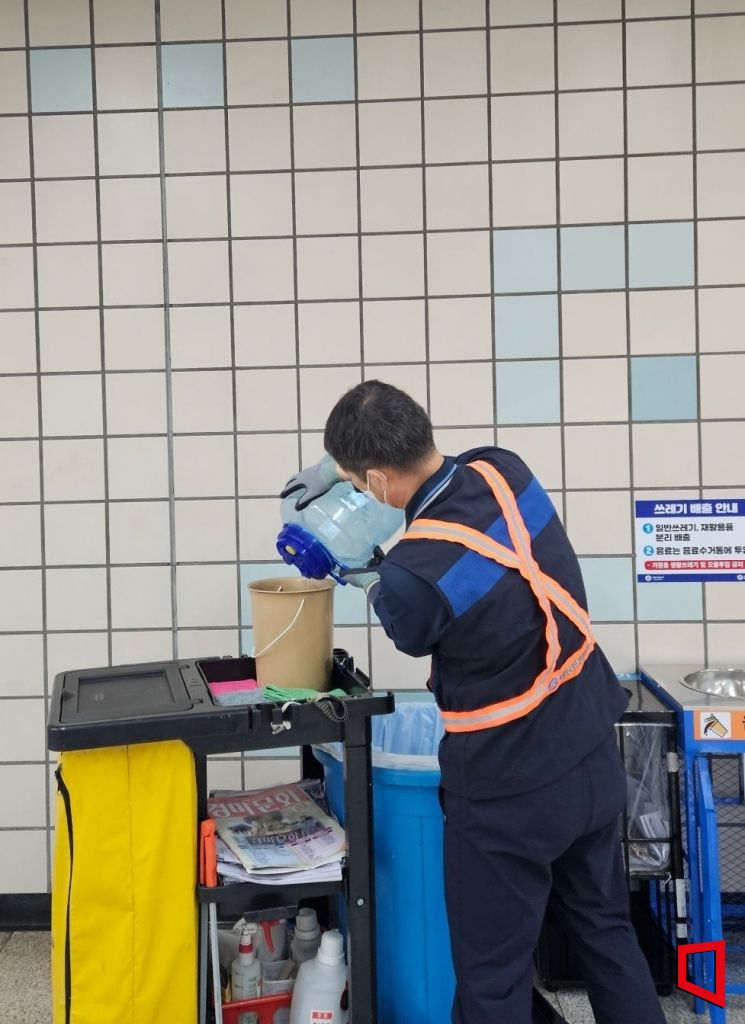 A subway cleaner is emptying beverage trash from a trash can at Samgakji Station in Seoul on the 9th. Photo by Seungwook Park
The cleaners call each other 'juim' (chief). Kwon said, "It is true that the treatment of cleaners has improved compared to before, but there are still cases of disrespect," adding, "Many still call us 'ajumma' (auntie), and we are often suspected when lost items occur." Nevertheless, Kwon smiled and said, "I feel proud seeing the station become cleaner while cleaning, thinking that passengers can commute in a more pleasant environment."
On this day, the first round of cleaning was only briefly completed after 9 a.m. At this time, the cleaners take a short break to eat. After the brief meal, they resume cleaning, moving around the station until 3:15 p.m. Only after countless commuters have passed through are the cleaners allowed a rest.
© The Asia Business Daily(www.asiae.co.kr). All rights reserved.



















