Comparison of Returns on Top Net-Buy Stocks by Foreign and Institutional Investors Over the Past Month
Foreign Investors Focus on Rainbow Robotics, Ligand Chem Bio, and Philoptics
Institutions Favor Alteogen, EcoPro, and Silicon Two
The KOSDAQ index has fallen more than 10% over the past month, causing losses for both foreign and domestic institutional investors. With the tariff war between the U.S. and China intensifying, there remains a possibility of further declines.
According to the financial investment industry on the 10th, from the 10th of last month until the day before, foreigners recorded a cumulative net selling of 1.23 trillion KRW in the KOSDAQ market. During the same period, individuals and institutional investors recorded net purchases of 951 billion KRW and 417 billion KRW, respectively. The index fell by 11.4% during this period.
Foreigners, who are reducing their stock holdings across the market, actively bought Rainbow Robotics, Ligand Chem Bio, and Philoptics. Foreigners have net purchased 32.3 billion KRW worth of Rainbow Robotics, which had risen sharply until February this year, over the past month. Rainbow Robotics, which hit an all-time high on the 19th of last month, showed a weak stock price trend as volatility increased in global markets including the U.S. The foreigners’ average net purchase price per share was 290,551 KRW, which is higher than the current price of 242,000 KRW. The unrealized loss rate reaches 16.7%.
Foreigners also bought 31.2 billion KRW worth of Ligand Chem Bio, a new drug developer based on antibody-drug conjugate (ADC) technology, in the KOSDAQ market. ADC is a next-generation biopharmaceutical developed to meet the unmet needs of existing cancer treatments by attaching highly effective therapeutic drugs to antibodies that specifically bind to cancer cells. Preclinical research results on candidate substances derived through ADC platform technology transfer will be disclosed at the 'American Association for Cancer Research (AACR 2025)' held in Chicago, USA, from the 25th to the 30th. It appears that buying was driven by expectations that the platform contract value will increase, but Ligand Chem Bio’s stock price has been declining for two months since hitting a yearly high on February 6. The foreigners’ unrealized loss rate is 6.2%.
Philoptics, whose stock price sharply rose early this year due to expectations of benefits from glass substrates, also entered foreigners’ portfolios. However, as the stock price fell, foreigners are recording an unrealized loss rate of 25.7%. In addition, foreigners net purchased ISC and HPSP worth 23.6 billion KRW and 17.8 billion KRW, respectively.
Foreigners who bought ABL Bio are currently recording an unrealized gain rate of 22.6%. ABL Bio’s stock price rose sharply regardless of the market decline after signing a technology transfer contract worth a total of 4 trillion KRW on the 7th.
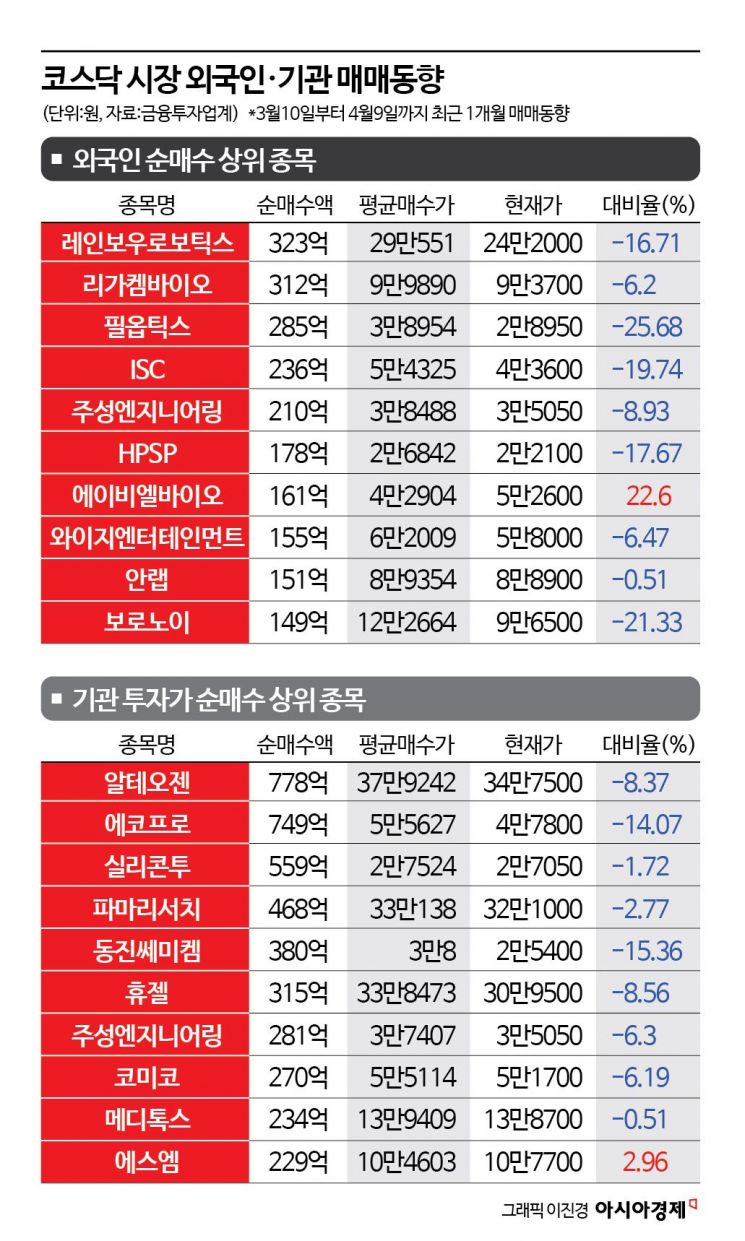
Institutional investors who focused on net buying Alteogen, EcoPro, and Silicon Two also received failing grades. The unrealized loss rate for Alteogen, which was purchased for 77.8 billion KRW, is 8.4%. The unrealized loss rates for EcoPro and Dongjin Semichem are 14.1% and 15.4%, respectively. Institutional investors’ returns on Silicon Two and Pharma Research performed relatively well compared to the index.
The problem is that it is unknown when the KOSDAQ market will rebound. The tariff war between the U.S. and China has not yet passed its peak. Even referring to the first term of President Donald Trump’s administration, there remains a possibility of further declines. Lee Sujeong, a researcher at Meritz Securities, explained, "Referring to the case in October 2018 when the U.S.-China trade conflict was highlighted, the KOSPI and KOSDAQ indices fell by 13% and 21%, respectively, over one month," adding, "The steepest decline period was the one month immediately after the shock."
She added, "The stronger President Trump’s determination to implement tariffs, the weaker the stock prices become," but also noted, "As stock prices fall, President Trump’s approval rating also decreases, increasing the possibility of tariff negotiations."
© The Asia Business Daily(www.asiae.co.kr). All rights reserved.
![Clutching a Stolen Dior Bag, Saying "I Hate Being Poor but Real"... The Grotesque Con of a "Human Knockoff" [Slate]](https://cwcontent.asiae.co.kr/asiaresize/183/2026021902243444107_1771435474.jpg)
















