U.S. Commerce Secretary Ross Reveals True Intentions
Likely to Raise Issues with Technical, Sanitary, and Customs Regulations
'Fool, the problem is the non-tariff barriers, not tariffs.'
While U.S. President Donald Trump is pushing ahead with a 'tariff war' against trading partners worldwide despite domestic opposition and financial market shocks, experts believe his true intention lies in resolving 'non-tariff barriers.' It appears that beyond simply restricting imports, he has set 'resolving non-tariff barriers' as a strategic goal, using tariffs as bait.
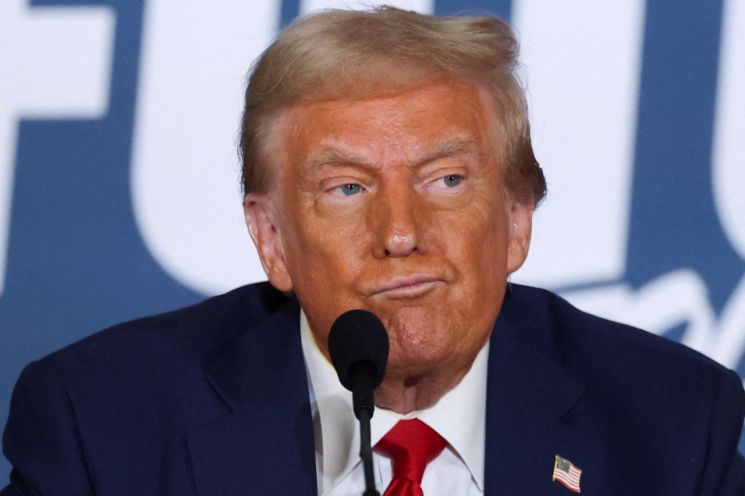
This intention was revealed by U.S. Secretary of Commerce Wilbur Ross. On April 3, Ross appeared on Bloomberg TV and said, "The real issue is not tariff rates but the numerous regulations." He cited South Korea's import of U.S. potatoes as a representative example of these "numerous regulations." Ross claimed, "After the Korea-U.S. FTA was signed in 2012, South Korea agreed to import U.S. agricultural products but blocked the import of French fries because the origin of the potatoes could not be proven."
Experts expect the U.S. will not stop there and will raise issues with various non-tariff barriers one after another. In the recently released '2025 National Trade Estimate Report on Foreign Trade Barriers (NTE),' the U.S. pointed out in detail what it perceives as unreasonable aspects of South Korea's technical, sanitary, and customs regulations. Likely candidates include ▲lack of transparency in the procedures of the Chemical Registration and Evaluation Act (K-REACH) and insufficient protection of corporate information ▲overlapping approval structures for biotech crops ▲imported food residue standards conflicting with international norms ▲lack of transparency in pharmaceutical pricing structures. Additionally, ▲discrimination against U.S.-made cloud equipment in public procurement ▲discussions on OTT content quotas ▲restrictions on the export of location-based data are expected to be included among U.S. complaints following the potato import case.
Jung Ki-chang, a foreign attorney at the law firm Kwangjang and an advisor on economic security diplomacy at the Ministry of Foreign Affairs, said, "The U.S. is primarily applying high tariffs uniformly to exert pressure, then pursuing a strategy of 'tailored negotiations' with each country to demand the removal of non-tariff barriers." He added, "Since negotiations with Japan have already been announced, South Korea is also likely to receive specific demands from the U.S. regarding institutional barriers blocking market entry, such as technical, sanitary, and data-related issues."
During President Trump's first term (2017?2018), tariff policies were pursued alongside renegotiations of the Korea-U.S. Free Trade Agreement (FTA). In this process, issues such as ▲automobile environmental and safety standards ▲agricultural quarantine procedures ▲import quotas were raised. The U.S. secured relaxation of South Korea's safety inspection standards for imported cars and an extension of the tariff exemption clause for pickup trucks through negotiations, thereby lowering non-tariff barriers.
Park Hyo-min (43, Judicial Research and Training Institute class 41), vice president of the Korea Trade Information Society and attorney at law firm Sejong, said, "The current U.S. tariff policy is not merely trade pressure but a strategy to design a new order structure." He added, "South Korea is not just a victim but is being asked questions about which supply chains to join and what values to choose." He emphasized, "The South Korean government should respond by demonstrating strategic trust as a U.S. ally, and companies should establish strategies to prepare for structural changes beyond short-term solutions."
Lee Jin-young, Legal Times Reporter
※This article is based on content supplied by Law Times.
© The Asia Business Daily(www.asiae.co.kr). All rights reserved.
![Clutching a Stolen Dior Bag, Saying "I Hate Being Poor but Real"... The Grotesque Con of a "Human Knockoff" [Slate]](https://cwcontent.asiae.co.kr/asiaresize/183/2026021902243444107_1771435474.jpg)
















