Delivery Prices for Coffee, Burgers, and Chicken Continue to Rise
Side Effects of Win-Win Delivery App Fees
Growing Burden of Delivery Costs
Franchise Headquarters Face Difficult Decisions
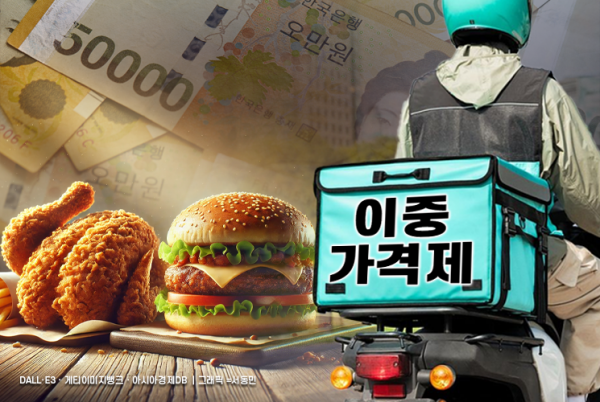
Domestic franchise companies are increasingly adopting a 'dual pricing system' where delivery menu prices are higher than in-store prices. Burger franchises, which already have large offline store operations and relatively low delivery proportions, have mostly completed the implementation of this system.
Chicken franchises, where delivery accounts for an overwhelming majority, are cautious but the outlook is that the adoption of the dual pricing system will spread. It is analyzed that more franchisees will want to introduce the dual pricing system due to high delivery fees. However, there are concerns that the delivery fees are ultimately passed on to food prices, burdening consumers.
Expansion of 'Dual Pricing System' Adoption... Most Burger Chains Have Completed Implementation
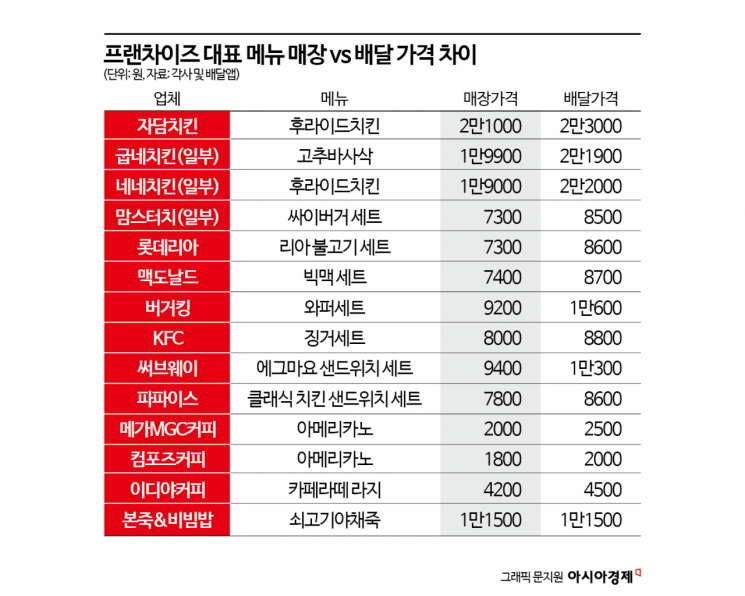
According to industry sources on the 12th, Jadam Chicken decided to raise chicken prices by 2,000 KRW on the three major delivery apps?Baedal Minjok, Coupang Eats, and Yogiyo?starting from the 3rd. Fried chicken prices increased from 21,000 KRW to 23,000 KRW, seasoned chicken and spicy chicken from 23,000 KRW to 25,000 KRW, and boneless spicy chicken from 25,000 KRW to 27,000 KRW.
In the chicken industry, some franchisees have occasionally added extra charges for delivery on their own, but Jadam Chicken is the first to officially formalize the dual pricing system at the headquarters level. Recently, Mom's Touch franchisees in 48 locations independently raised delivery menu prices by an average of 15%, and some franchisees of Goobne Chicken, the fourth largest chicken brand in Korea, increased delivery app prices of their signature menu 'Gochu Basasak' by up to 3,000 KRW.
Chicken franchises have relatively low offline store operating costs but a high delivery proportion of 70-80%, so they are cautious about adopting the dual pricing system because a decrease in demand could significantly impact sales. In fact, the top three chicken brands?Kyochon, bhc, and BBQ?have stated they have no plans to adopt the dual pricing system.
An industry insider explained, "Since most consumers eat chicken through delivery, price increases can directly lead to consumer backlash. Although demands from franchisees have increased significantly, we are still not considering the dual pricing system."
Unlike chicken, burger franchises have mostly completed the adoption of the dual pricing system. Lotteria, Burger King, McDonald's, KFC, and Popeyes all charge higher prices for delivery than in-store. This is because they operate large offline stores with high cost burdens and have a lower delivery proportion. Additionally, franchises such as Subway, Bonjuk, and Hansot Dosirak have also introduced the dual pricing system.
Due to Delivery App Fees... Growing Consumer Burden
The main reason for the spread of the dual pricing system is the burden of delivery app fees. Although sales have increased with more orders through delivery apps, the high fees have continuously reduced franchisees' margins.
In fact, according to the delivery platform's win-win fee system, the previously uniform 9.8% commission fee for delivery apps is now applied differentially: 7.8% for the top 35% of sales, 6.8% for sales between the top 35% and 80%, and 2.0% for the bottom 20%. Because of this, delivery fees, which were around 1,900 to 2,900 KRW for the top 35%, will increase by 500 KRW. Franchisees in the top 35% of sales must exceed an order amount of 25,000 KRW for the total delivery operation burden, including fees and delivery charges, to be less than before.
Actual restaurant operators also feel the delivery fee burden more than raw material or labor costs. A survey conducted last month by the Consumer Public Interest Network targeting over 500 restaurant owners found that 'delivery fee commissions' were cited as the biggest burden in business operations.
A self-employed restaurant operator said, "Delivery platforms implement free delivery but shift the costs to franchisees and induce various additional advertisements, causing 30-40% of the order price to go to the delivery apps. Without raising prices, it has become difficult to sustain the business as there is nothing left."
The industry expects the adoption of the dual pricing system to spread further across the food service sector. Headquarters cannot prevent franchisees from adopting the dual pricing system. Under the current Franchise Transaction Act, headquarters cannot regulate individual pricing policies of franchisees. Also, forcing or unfairly restricting franchisees' product or service prices without just cause is considered an 'unfair restrictive act.'
However, some criticize that the price increases borne by consumers are too large compared to the delivery fees paid by companies. There is criticism that delivery app fees are ultimately being passed on to consumers.
Concerns persist that the dual pricing system drives inflation. According to the 'Consumer Price Trends' released by Statistics Korea, after Hansot introduced the dual pricing system in October last year, the consumer price index for lunch boxes surged 11.1% year-on-year in November. Dining-out prices continue to rise as well. In March this year, dining-out prices increased by 3.0% compared to the same month last year, marking a two-month consecutive rise above 3%.
© The Asia Business Daily(www.asiae.co.kr). All rights reserved.


















