Total Area Reaches 1,069.5㎢
Second Largest Among Special and Metropolitan Cities
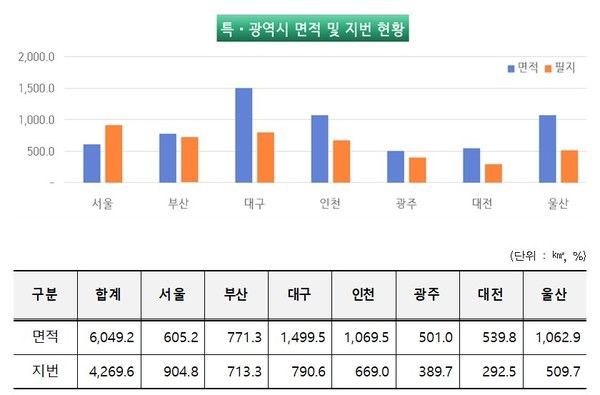
The total area of Incheon was found to be 1,069.5㎢ (669,028 parcels), an increase of 2.4㎢ compared to the previous year. In terms of economic value (based on the 2024 official land price of nearby land), this amounts to approximately 2.3 trillion KRW.
According to Incheon City on the 9th, the total area of Incheon in the 2025 cadastral statistics recently announced by the Ministry of Land, Infrastructure and Transport increased by 2.4㎢ due to the completion of reclamation in Incheon Free Economic Zone District 11-2 (1.5㎢) and District 10 port hinterland complex (0.9㎢).
When the cadastral statistics were first compiled in 1970, Incheon’s area was 189.1㎢, but it has since expanded through continuous reclamation of public waters and incorporation of administrative districts. It increased to 1,069.5㎢, making it the second largest among special and metropolitan cities after Daegu (1,499.5㎢), which incorporated Gunwi County in 2023. This represents a 5.6-fold growth compared to the initial size.
Incheon’s land use distribution shows that forest land accounts for the largest share at 36.1%, followed by rice paddies (14.3%), residential land (11.2%), roads (8.1%), dry fields (7.2%), and parks (4.2%). Forests and agricultural land (dry fields, rice paddies, orchards) make up about 57.8% of the total area. Compared to last year, miscellaneous land, forest land, and rice paddies decreased by 2.5㎢ (0.5%), while residential land increased by 2.2㎢ (2.0%) and recreational and leisure facilities (parks and amusement parks) increased by 1.2㎢ (4.0%).
Over the past 10 years, the areas of dry fields, rice paddies, and forest land decreased by 7.4%, 11.5%, and 3.4%, respectively, while residential land, roads, and parks increased by 17.8%, 16.1%, and 87.8%, respectively. The city explained that this is the result of continuous efforts to expand transportation and recreational facilities to create a pleasant living environment for citizens.
Regarding land ownership status, individuals own 52.4%, national and public land 26.6%, and corporations 19.1%. Over the past 10 years, land owned by individuals decreased by 3.6%, while national and public land and corporate-owned land increased by 11.7% and 6.8%, respectively.
An official from Incheon City stated, "Cadastral statistics are important data that allow us to verify Incheon’s area and land use status as well as social and environmental changes numerically. We plan to produce map services with content including maps, photos, and explanations so that not only policymakers and academic researchers but also the general public can easily understand and utilize the information."
© The Asia Business Daily(www.asiae.co.kr). All rights reserved.

















