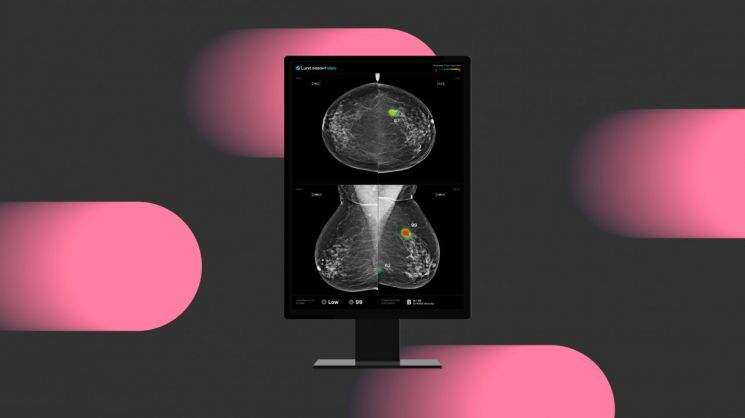
Medical artificial intelligence (AI) company Lunit (CEO Beomseok Seo) announced on the 8th that the research results on interaction between medical staff and AI have been published in 'Radiology,' a world-renowned radiology journal issued by the Radiological Society of North America (RSNA).
The study, led by Dr. Karin Dembrower’s research team at Sweden's largest private hospital, Capio St. G?ran Hospital, was conducted as a follow-up analysis of the prospective study 'ScreenTrustCAD' published in September 2023 in Lancet Digital Health.
The research team conducted an in-depth analysis of interaction scenarios between radiology specialists and the mammography AI image analysis solution 'Lunit Insight MMG' using data from approximately 55,000 women who underwent breast cancer screening from April 2021 to June 2022. In the study, after two specialists and the AI independently interpreted the images, if any one of the three suspected cancer, a consensus discussion was held.
The results showed that when one specialist alone suspected cancer, the recall rate to call patients back for additional testing was 14.2%, higher than the recall rate of 4.6% when AI alone suspected cancer. However, the positive predictive value (PPV), which indicates the proportion of actual cancer cases among recalled patients, was 3.4% for a single specialist’s suspicion, lower than the AI’s PPV of 22% when it alone suspected cancer.
When two specialists suspected cancer, the recall rate was 57.2%, higher than the 38.6% recall rate for the combination of AI and one specialist, but the PPV for two specialists (2.5%) was significantly lower than that of the AI and specialist combination (25%). Furthermore, when both AI and two specialists suspected cancer, the recall rate was 82.6%, and the PPV was the highest at 34.2%.
This suggests that specialists tend to trust their peers’ judgments more than AI, and indirectly or directly shows that even if AI accurately identifies cancer, its value may be overlooked during the consensus process.
Dr. Karin Dembrower said, "The results of this study demonstrate that effectively integrating the high accuracy provided by AI into clinical decision-making can reduce unnecessary recalls and increase early detection rates of breast cancer." She added, "If specialists effectively utilize AI, it will be possible to improve both the efficiency of the screening process and patient prognosis simultaneously."
Beomseok Seo, CEO of Lunit, said, "This study clearly proves once again that collaboration between medical staff and AI can dramatically improve the quality of breast cancer screening." He added, "Lunit will not only develop technically advanced AI but also continue to accumulate practical clinical evidence to establish AI as a trusted partner for medical professionals."
© The Asia Business Daily(www.asiae.co.kr). All rights reserved.
![Clutching a Stolen Dior Bag, Saying "I Hate Being Poor but Real"... The Grotesque Con of a "Human Knockoff" [Slate]](https://cwcontent.asiae.co.kr/asiaresize/183/2026021902243444107_1771435474.jpg)











