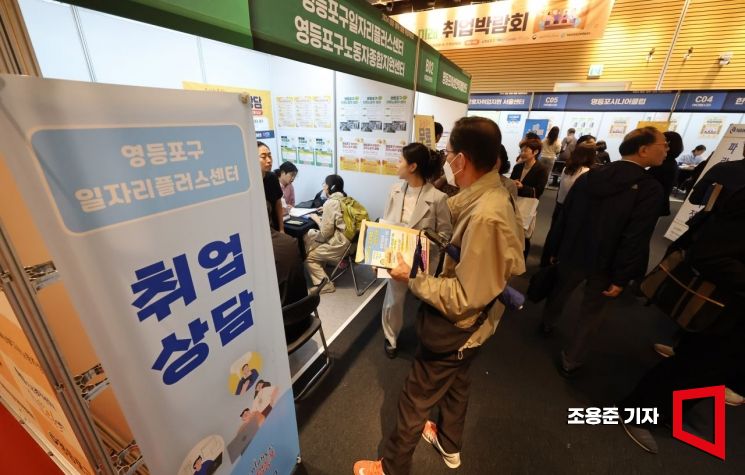
 Job seekers are lining up to receive employment counseling at a job fair held in Yeongdeungpo-gu, Seoul. Photo by Yongjun Cho jun21@
The polarization of the job market is becoming increasingly pronounced. While jobs in the public and welfare sectors have grown rapidly, employment in the construction and manufacturing sectors has been suffering from severe stagnation for several months. Employment indicators for the elderly have improved, but those for young people continue to deteriorate. Despite a solid record of employment increasing by more than 100,000 people for three consecutive months, there are concerns that employment in Korea's key industries could worsen further.
According to the "March Employment Trends" released by Statistics Korea on April 9, the number of employed people aged 15 to 64 last month was 28,589,000, an increase of 193,000 from a year earlier. The number of employed people had decreased by 52,000 in December last year due to the conclusion of job creation projects, but has maintained an increase of over 100,000 for three consecutive months in January (135,000), February (136,000), and March this year.
This growth was led by the public and welfare sectors. The number of people employed in health and social welfare services reached 3,129,000, up 212,000 (7.3%) compared to the same period last year. Employment in public administration and social security, which includes public sector jobs, also rose by 87,000 (6.6%) to 1,388,000 during the same period.

In contrast, employment in the construction and manufacturing sectors was weak. The number of people employed in construction was 1,932,000, down 185,000 (8.7%) from the previous year, marking an 11th consecutive month of decline. This is the largest decrease since the application of the 11th Korean Standard Industrial Classification in November 2013. The downturn in construction orders, which began in 2023, has been reflected in construction performance with a time lag, negatively impacting employment. Recently, a decrease in apartment move-in volumes has further worsened employment, particularly in the specialized construction sector.
The number of people employed in manufacturing was 4,399,000, a decrease of 112,000 (2.5%), continuing a nine-month streak of decline. This is the largest drop in four years and four months since November 2020, when employment fell by 113,000 during the COVID-19 pandemic. The delayed recovery in domestic demand has hurt both light industries producing consumer goods and the machinery and equipment sector, which is highly dependent on corporate demand. The pulp and paper sector has also struggled as digital transformation accelerates.
Although overall employment indicators remain solid, the outlook is precarious. Jang Juseong, Director of Human Resources Policy at the Ministry of Economy and Finance, stated, "Employment in construction and manufacturing continues to deteriorate due to various domestic and international uncertainties," adding, "Depending on the imposition of itemized tariffs by the United States, employment in manufacturing-the core export industry-and related sectors could face even more severe difficulties."
By age group, the increase among the elderly and the decrease among the youth were both pronounced. The number of employed people aged 60 and over rose by 365,000 to 6,732,000 compared to the previous year. In contrast, the number of employed young people aged 15 to 29 fell by 206,000 to 3,569,000 over the same period. Gong Misook, Director of Economic Trend Statistics at Statistics Korea, explained, "It is difficult to say that employment conditions are good for young people," and added, "The practice of frequent and career-based recruitment may pose challenges for youth."
The employment rate for those aged 15 and over was 62.5%, up 0.1 percentage points from March last year. There was also a gap in employment rates between the elderly and the youth. The employment rate for those aged 60 and over was 46.4%, up 0.9 percentage points from a year earlier. However, the youth employment rate fell by 1.4 percentage points to 44.5%, the lowest for any March since 2021, when it stood at 43.3%.
The number of unemployed people was 918,000, an increase of 26,000 compared to the same month last year. During the same period, the unemployment rate rose by 0.1 percentage points to 3.1%. The unemployment rate among young people aged 15 to 29 climbed by 1 percentage point to 7.5%, while the rate for those aged 25 to 29 rose by 1.3 percentage points to 6.8%.
The number of people "resting"-those who are able to work but are not actively seeking employment-rose by 71,000 (2.9%) to 2,517,000. Notably, the number of young people aged 15 to 29 in this category reached 455,000, the highest since statistics began to be compiled in January 2003.
The government announced that it would swiftly execute and monitor this year's job creation budget to generate jobs in the private sector and manage domestic and external risks. It also emphasized that it would promptly prepare a supplementary budget of 10 trillion won to respond to the changing trade environment, including reciprocal tariffs.
© The Asia Business Daily(www.asiae.co.kr). All rights reserved.
![Clutching a Stolen Dior Bag, Saying "I Hate Being Poor but Real"... The Grotesque Con of a "Human Knockoff" [Slate]](https://cwcontent.asiae.co.kr/asiaresize/183/2026021902243444107_1771435474.jpg)

















