Negotiation Results to Be Announced on the 9th (Local Time)
Ending the Five-Month Leadership Vacuum
Urgent Response Needed Amid Tariff Burden on European Steel and Automobiles
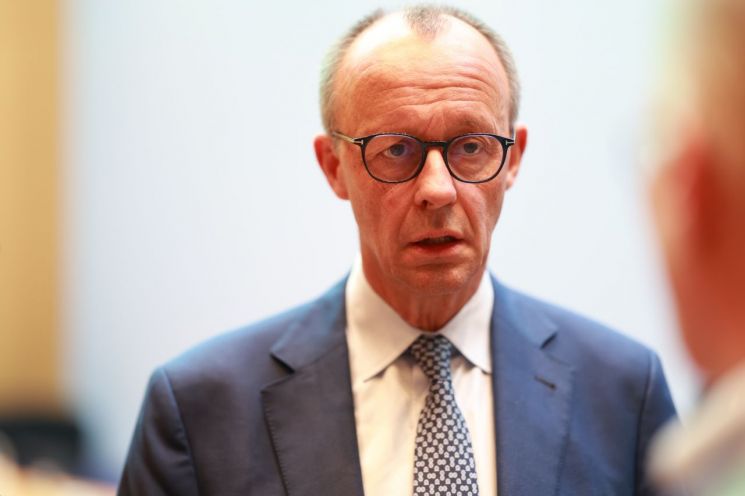 Friedrich Merz, leader of the Christian Democratic Union (CDU), is a leading candidate for Germany's next Chancellor. Photo by EPA Yonhap News
The center-right Christian Democratic Union (CDU) and Christian Social Union (CSU) alliance and the center-left Social Democratic Party (SPD) are on the verge of finalizing negotiations to form the next coalition government. The two parties plan to end the five-month-long 'German leadership vacuum' and prepare countermeasures against the comprehensive reciprocal tariff policy set to take effect on the 9th (local time) under the Trump administration.
The German daily Tagesspiegel reported on the 8th (local time) that both parties are optimistic about reaching a final agreement that night. The parties plan to announce the negotiation results on the 9th and are discussing the election of CDU leader Friedrich Merz as Chancellor in the Bundestag on the 6th of next month. This timeline is even earlier than the initially targeted late April.
The two parties, representing the left and right of German politics, have been negotiating coalition formation since the early election held on February 23, aiming to reach an agreement before Easter (April 20). The so-called grand coalition between the left and right, which is the alliance of these two parties, is the first in 3 years and 4 months since former Chancellor Angela Merkel stepped down in December 2021.
Although the parties showed differences on key policies such as refugee measures, taxation, energy transition, and immigration policy, raising concerns about prolonged negotiations, they are accelerating unification to respond to President Donald Trump's tariff policies. In fact, compared to the 72 days it took for the 2021 traffic light coalition to form after the election and the 171 days for the 2018 grand coalition, this is a faster pace. Manuela Schwesig (SPD), Prime Minister of Mecklenburg-Vorpommern and a participant in the negotiations, said that morning, "Unlike the previous government, these negotiations are proceeding under tremendous time pressure."
The economic and social environment surrounding Germany is challenging. Germany and other European Union (EU) member states are set to face 25% reciprocal tariffs in the steel, aluminum, and automobile sectors, and 20% tariffs across all product categories. German automaker Audi recently suspended deliveries of vehicles that arrived in the U.S. due to the heavy tariff burden. German Chancellor Olaf Scholz emphasized on the 31st of last month, "If the U.S. does not give us a choice, as with the steel and aluminum tariff issues, we will respond in a unified manner at the EU level," lending support to a strong response.
The shoulders of CDU leader Friedrich Merz, the likely next Chancellor, have also grown heavier. For years, he has been regarded as a focal point capable of enhancing the stature of the weak and divided German government under Chancellor Olaf Scholz's administration. The political media outlet Politico noted, "Many European leaders expect Merz to restore Germany's leadership within the EU." Merz himself pledged after winning the early election on February 23 to "strengthen Europe as quickly as possible so that Europe can gradually achieve true independence from the United States."
© The Asia Business Daily(www.asiae.co.kr). All rights reserved.
![Clutching a Stolen Dior Bag, Saying "I Hate Being Poor but Real"... The Grotesque Con of a "Human Knockoff" [Slate]](https://cwcontent.asiae.co.kr/asiaresize/183/2026021902243444107_1771435474.jpg)
















