Korea National Institute of Health Launches Pilot Study on Whole Genome Newborn Screening in March
"Goal to Develop Customized Guidelines Including Ethical and Social Recommendations by Year-End"
A Korean-style operational system for newborn screening based on 'Whole Genome' sequencing will be established. This aims to enable early diagnosis and treatment of rare diseases through whole genome sequencing, which includes all genetic information of a newborn's DNA.
The Korea National Institute of Health announced on the 8th, during a media academy held in collaboration with the Korea Science Journalists Association under the theme "Newborn Genome Analysis, Advancing Genetic Disease Diagnosis," that since the 1st of last month, it has embarked on a pilot study for "Newborn Screening Based on Whole Genome Sequencing."
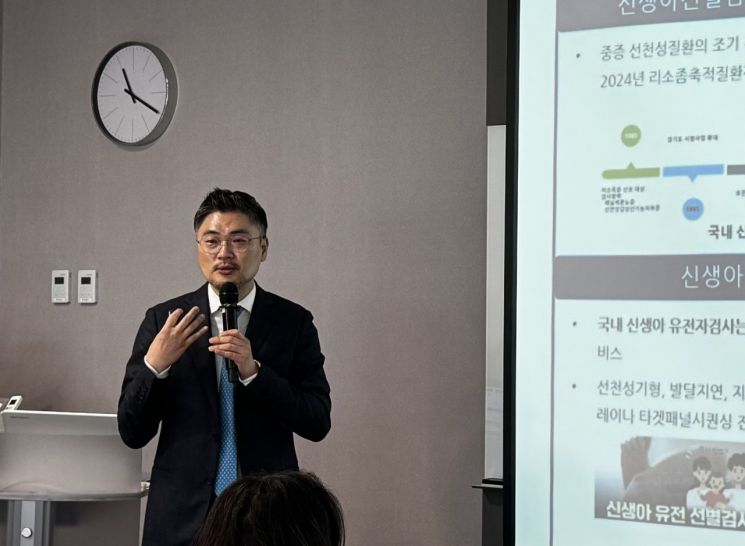 Professor Beomhee Lee of the Department of Pediatrics at Asan Medical Center in Seoul is explaining the "Pilot Study on Whole Genome-Based Newborn Screening for Koreans." Provided by the Korea Science Journalists Association
Newborn screening using whole genome technology can detect treatable genetic diseases early, allowing timely treatment to prevent disease progression and support healthy growth in children. In the long term, it is an essential public health program expected to reduce medical burdens on patients' families and lower socioeconomic costs.
Currently, 90% of newborns in Korea undergo screening for about 70 types of congenital metabolic disorders such as phenylketonuria and Fabry disease, as well as hearing (deafness) screening. However, these tests are limited to specific diseases using the 'tandem mass spectrometry' method, which ionizes substances with two or more mass spectrometers to measure mass, rather than whole genome sequencing.
Recently, due to advances in genome analysis technology and reduced testing costs, there is increasing demand domestically for screening tests that can diagnose more rare genetic diseases at once through analysis and evaluation of whole genome sequencing.
Major countries such as the United States and the United Kingdom are already conducting various projects to verify the medical and clinical utility of newborn whole genome sequencing. The global public health introduction of newborn whole genome analysis is also being discussed through the International Consortium on Newborn Sequencing (ICoNS).
The U.S. Guardian Project has been studying over 260 diseases in 100,000 newborns since 2022, and the UK’s Generation Research Project is researching over 250 diseases in 100,000 newborns. Active research is also underway in Australia, Belgium, and Europe.
Accordingly, Korea has started a pilot study targeting 200 severely ill newborns who require priority diagnosis and treatment. Through this pilot study, the Korea National Institute of Health plans to pursue ▲ selection of diseases and genes for newborn screening ▲ establishment of step-by-step standard guidelines from blood collection to whole genome analysis, diagnosis, treatment, and genetic counseling ▲ development of patient consent systems and clinical guidelines.
A representative from the Korea National Institute of Health stated, "Along with the pilot project, we will strive to prepare a domestically tailored newborn screening guideline including recommendations based on ethical and social considerations by the end of this year."
The pilot study is being led by Professor Beomhee Lee’s pediatric team at Seoul Asan Medical Center. Professor Lee explained the research direction, saying, "Although genome-based paid newborn screening is commercially widespread in Korea, it has become a significant issue because it proceeds without considering the shock families may experience when chromosomal abnormalities are found. During this pilot study, we will prepare guidelines and protocols that include ethical and legal issues, genetic variant diagnosis and treatment application, and family genetic counseling."
Park Hyun-young, director of the Korea National Institute of Health, emphasized, "This pilot project is the first step toward genome-based personalized health management for Korean newborns. We will expand it into a full-scale project by synthesizing the pilot results and expert opinions, and continue research to expand future genome-based medical services."
© The Asia Business Daily(www.asiae.co.kr). All rights reserved.

















