Only Main and Subcontractors Allowed; Temporary Structures for Other Purposes Prohibited
Infrastructure and Fire Safety Standards Introduced to Prevent Accidents
Yongin City in Gyeonggi Province will allow the installation of temporary accommodations around the SK Hynix semiconductor production line (Fab) site under construction in Wonsam-myeon, Cheoin-gu, only for 'actual users.' This measure aims to preemptively block the installation of temporary structures intended for rental purposes or future development.
On the 9th, Yongin City announced that it will establish and implement the "Temporary Accommodation Installation Standards for Construction Sites for Temporary Use" to facilitate the smooth provision of temporary accommodations for workers during the Fab construction process within the "Yongin Semiconductor Cluster General Industrial Complex."
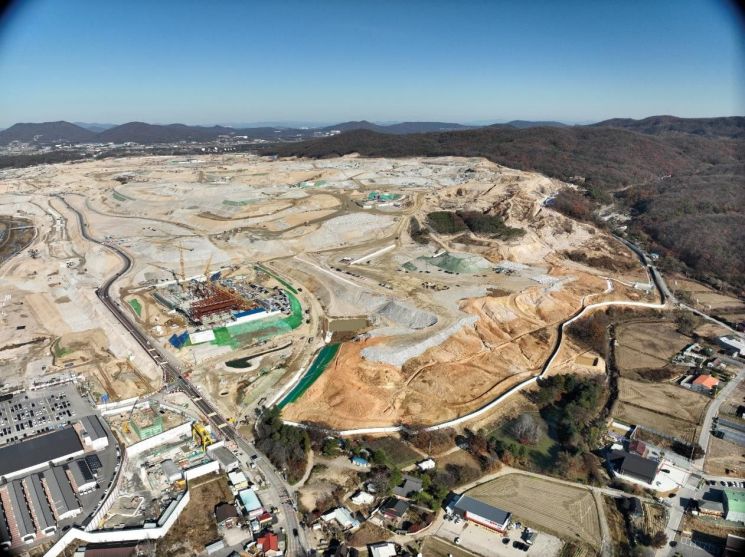 A view of the construction site of the Yongin Semiconductor Cluster General Industrial Complex in Wonsam-myeon, Cheoin-gu, Yongin. Provided by Yongin City
The establishment of these standards is intended to assist in installing temporary accommodations necessary for the industrial complex development while ensuring worker safety and minimizing inconvenience to local residents by presenting specific installation criteria.
Mayor Lee Sang-il of Yongin stated, "We determined that it is urgent to install temporary accommodations where construction workers can live safely to ensure smooth Fab construction," adding, "We will ensure that there is no inconvenience to residents near the construction site and pay special attention to the safety of the workers."
The standards prohibit the construction of temporary structures intended for rental or other purposes with future development in mind, aside from providing accommodations for construction workers. Accordingly, only the actual users of the construction, such as the main contractor SK Ecoplant or subcontractors, are allowed to install temporary accommodations. However, third-party installations may be exceptionally permitted if documentation verifying that the actual user will use the facility is submitted.
Temporary accommodations for workers will have different size standards depending on the land use zone, and they are prohibited in agricultural promotion areas and areas where farmland has been consolidated. However, essential facilities required for construction will be permitted if applied for by the project implementer or subcontractors.
To install temporary accommodations on farmland, restoration must be completed one to two months before the industrial complex's completion. If embankment work is performed, a soil test report must be attached. When installing temporary accommodations on mountainous terrain, the environmental restoration after land disturbance will be reviewed, and processes such as retaining walls and excavation will be restricted during the temporary use notification.
Safety standards for temporary accommodation structures have also been presented. The size per building is limited to a total floor area of 1,000㎡ and up to two stories, and evacuation and building fire safety standards will be applied. Temporary large accommodations remaining for more than two years must have fire extinguishing equipment and evacuation structures installed. A distance of at least 2 meters must be maintained between buildings, and a minimum 4-meter-wide fire truck access road must be secured.
The city plans to apply the standards established this time to future developments such as the "Advanced System Semiconductor National Industrial Complex" in the Idong and Namsa-eup areas and other large-scale industrial complex developments within the jurisdiction.
© The Asia Business Daily(www.asiae.co.kr). All rights reserved.

















