Hamburger Brands Sign Contracts with 30% Higher Tomato Prices This Year
Fresh Tomato Imports Prohibited, Complete Reliance on Domestic Supply
The foodservice industry is being shaken by supply instability of ingredients due to poor crop yields and rising production costs caused by climate change. In particular, hamburger brands are facing increased cost pressures as prices of ingredients such as tomatoes rise. Some companies are taking structural measures such as menu adjustments and price increases.
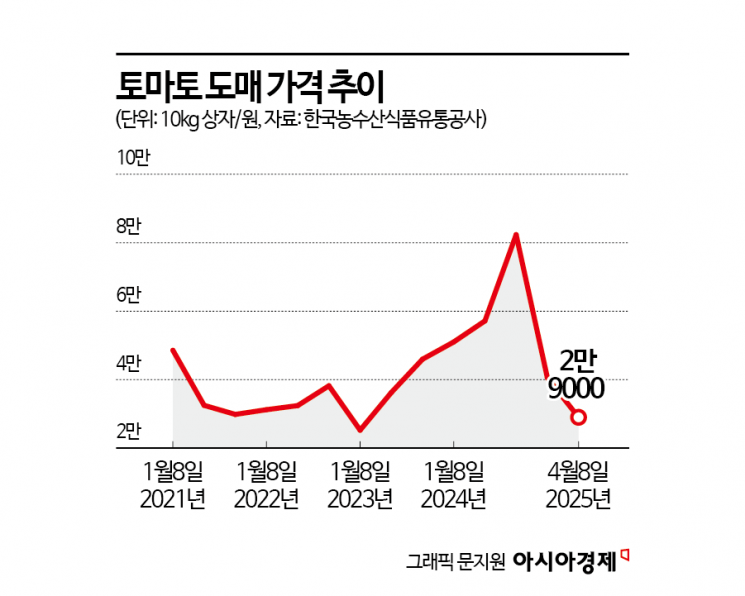
According to the distribution industry on the 9th, Burger King, McDonald's, and others signed contracts with ingredient suppliers this year with the annual unit price of fresh tomatoes raised by nearly 30% compared to the previous year. Lotteria increased prices by 5-10% in their contracts. Although the current wholesale price is 29,000 KRW per 10 kg, down 30% from the previous year, the annual contract price rose due to difficulties in predicting crop yields caused by abnormal weather. This reflects the fact that tomato growth was poor due to record-breaking heatwaves last summer.
In fact, as of October last year, the wholesale price of tomatoes was 80,000 KRW, a surge of over 60% compared to four months earlier. As a result, foodservice companies reduced or completely excluded the use of tomatoes. Sandwich brand Subway reduced the number of tomato slices in their 15 cm sandwiches from 3 to 2, and bakery brand Tous Les Jours raised franchise supply prices by 30%.
Hamburger brand McDonald's sold some menu items without tomatoes. A representative from a burger franchise company said, "Material suppliers determine contract prices by reflecting annual crop forecasts, production costs, and the impact of abnormal weather," adding, "Due to supply disruptions caused by last year's record heatwave, prices were adjusted this year."
The problem is that supply stabilization through tomato imports is also difficult to expect. Fresh fruits and fruit vegetables such as fresh tomatoes, oriental melons, and apples are prohibited from import under the Plant Quarantine Act, so they rely entirely on domestic production. This is a measure to prevent the introduction of foreign pests and protect domestic crops. Tomatoes from overseas, except Japan, cannot be imported, and even if imports are allowed, the import risk analysis process takes an average of more than eight years, making short-term solutions virtually impossible. The industry also explains that Japanese tomatoes are difficult to use due to low price competitiveness.
The import risk analysis consists of eight stages: from export country request, initiation of import risk analysis procedures, preliminary risk assessment, individual pest risk assessment, preparation of risk management measures, drafting of import permit standards, announcement of draft import permit standards, to promulgation and enforcement of import permit standards. This process varies in duration depending on various factors such as item characteristics, pest distribution, and the speed of inter-country consultations.
Within the industry, there are voices calling for increasing supply through imports for climate change and consumer welfare. However, concerns about the collapse of the domestic farming production base remain. A hamburger industry official emphasized, "Prices soar from August to November, which is the period of poor crop yields," adding, "The same situation repeats every year, and the government needs to prepare policies to stabilize prices."
As such, with ingredient supply uncertainties recurring every year, the foodservice industry is responding with price adjustments and diversification of product strategies. KFC, Lotteria, McDonald's, No Brand Burger, and Burger King recently raised product prices by 100 to 300 KRW.
New products excluding ingredients with high supply risks are also emerging. Lotteria is avoiding supply issues by launching items such as the 'Napoli Mafia Mozzarella Burger,' 'Squid Alive Burger,' and 'Bulgogi Poten Burger,' all made without tomatoes. Strengthening premium products is also part of the strategy. McDonald's has increased profitability by introducing high-priced lineups with added patties to popular menus such as the 'Double Quarter Pounder Cheese Burger,' 'Double 1955 Burger,' and 'Double Max Spicy Shanghai Burger.' Prices of these products have also risen by about 30% compared to before.
A foodservice industry official said, "In the past, responses were limited to temporary price fluctuations, but recently, ingredient supply uncertainties have been recurring," adding, "It is necessary to view climate risks as structural variables and establish cost management strategies from a mid- to long-term perspective."
© The Asia Business Daily(www.asiae.co.kr). All rights reserved.
![Clutching a Stolen Dior Bag, Saying "I Hate Being Poor but Real"... The Grotesque Con of a "Human Knockoff" [Slate]](https://cwcontent.asiae.co.kr/asiaresize/183/2026021902243444107_1771435474.jpg)

















