Gwangju Office of Education to Inspect 337 Schools
Managing Standards for Fine Dust and More
Gwangju Office of Education will intensively manage indoor air quality in local schools. The office plans to carry out an air quality measurement project targeting 337 schools, including 14 independent kindergartens, as well as elementary, middle, high, and special schools, until November.
The inspections will be conducted by a professional company that visits schools in person, performing one regular inspection in each semester and one special inspection annually. Two general classrooms and one special classroom will be selected to measure four environmental factors?ventilation, lighting/illumination, temperature/humidity, and noise?as well as 12 air quality indicators, including fine dust, carbon dioxide, and formaldehyde. Newly built or expanded classrooms will also be checked for eight types of volatile organic compounds.
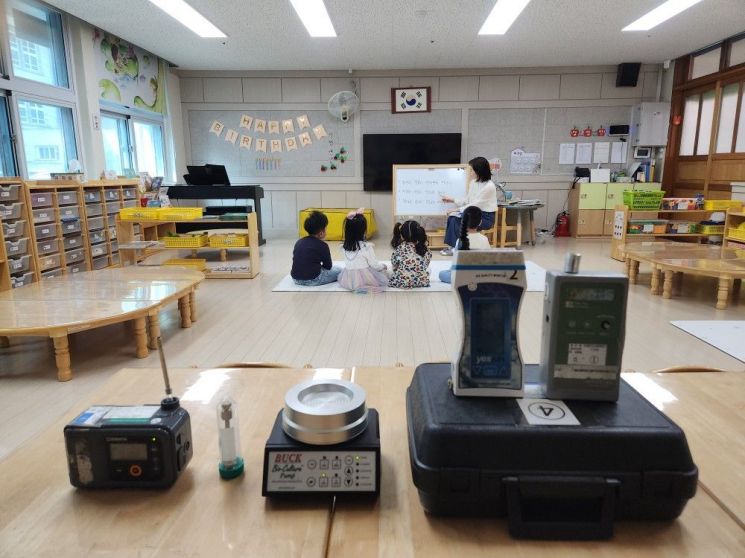 Gwangju Office of Education is conducting an indoor air quality measurement project targeting 337 schools, including standalone kindergartens, until November. Teachers and young children are conducting a class in front of the air quality measurement device installed in the classroom of Yeomju Elementary School Affiliated Kindergarten. Provided by Gwangju Office of Education
In gymnasiums and auditoriums, fine dust will be measured separately to check for any exceedance of pollutant standards. If a school exceeds the standard, the causes will be analyzed by category and improvements will be made. The city education office also plans to conduct unannounced inspections to enhance the reliability of the measurement results.
Park Chaemin, a teacher at Yeomju Elementary School, said, "We are consistently inspecting for harmful substances to protect the health of students and staff." Superintendent Lee Jeongseon stated, "We will thoroughly manage even the invisible air quality in classrooms to create a pleasant educational environment."
© The Asia Business Daily(www.asiae.co.kr). All rights reserved.

















