Maro, Junghung, Buram, and Bongam Fortresses...
Expansive Views and Beautiful Scenery
Fortresses that were once the sites of fierce battles are now gaining attention as spaces for contemplation for modern people driven by intense competition and stress, thanks to their open views and beautiful scenery.
In Gwangyang, there are four historically significant mountain fortresses: Maro Sanseong, Buram Sanseong, and Bongam Sanseong, which are stone fortresses (Seokseong) built during the Baekje period, as well as Junghung Sanseong, an earthen fortress (Toseong) from the Goryeo period.
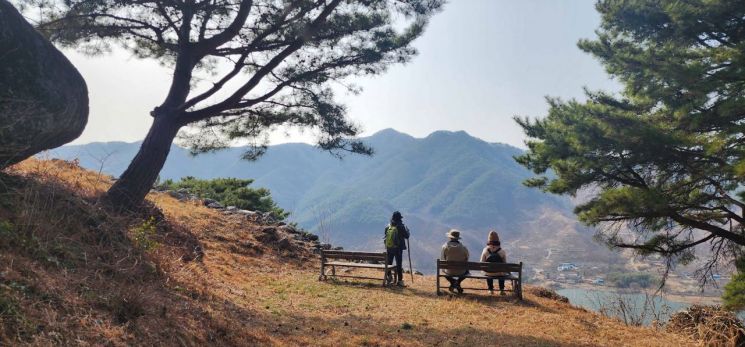 Visitors who came to Bulamsanseong Fortress in Gwangyang are enjoying watching water and mountains while sitting on benches. Photo by Gwangyang City
Maro Sanseong (Historic Site No. 492) is a circumferential fortress encircling the summit of Maro Mountain, 208.9 meters above sea level north of Gwangyang-eup. It is located on the Maanbong terrain, which resembles a horse saddle with elevated edges and a lower center.
Excavations conducted five times between 2001 and 2006 confirmed the presence of fortress walls, watchtowers, building sites, wells, and water tanks believed to have been used from the Three Kingdoms period to the Goryeo period. Roof tiles and earthenware inscribed with characters such as Maro (馬老), Gwan (官), and Gunyeokgwan (軍易官) were unearthed inside the fortress.
Buram Sanseong (Provincial Monument No. 177) is a tightly constructed stone fortress that encircles the southwestern peak of Buram Mountain at 231.5 meters above sea level near Bichon Village in a long trapezoidal shape. According to records in Honam Eupji (1895) and Gwangyang Eupji (1925), it is described as "a fortress 50 ri east of the county seat, 500 cheok in size, with one well inside."
The fortress was confirmed as a Baekje-era mountain fortress built around the year 600 through a detailed survey by the Suncheon National University Museum in 1998, and sites such as gates, building foundations, and wells were excavated.
In addition, various types of roof tiles (lattice pattern, plain, comb pattern, line pattern), earthenware, fishing net weights, and stone balls were also discovered.
On one side of the long-standing Buram Sanseong, a simple bench has been placed, allowing visitors to quietly enjoy "Sanmeong" (mountain gazing) and "Mulmeong" (water gazing) while taking in the magnificent view of Eokbul Peak and the clear Sueurho Lake.
Bongam Sanseong (Cultural Heritage Material No. 263), located at an altitude of 170 meters in Shina-ri, Jinwol-myeon, is a small fortress with a circumference of about 100 meters and an outer wall height of 90 centimeters, also known as "Shina-ri Fort."
The name Bongam (蜂巖) originates from the shape resembling a gathering of bees, and the mountain's summit is called "Hoam" because the top resembles a tiger's face and the rocks stretching toward the Seomjin River look like claws.
Although the southern part has collapsed, the fortress largely retains its original form. As a stronghold built in a location ideal for monitoring enemy movements, it boasts a panoramic view of the Seomjin River, Hadong County, and the Jinwol-myeon area.
Junghung Sanseong (Jeollanam-do Monument No. 178) is a circumferential fortress built during the Goryeo period, encircling six mountain peaks and utilizing the surrounding valleys for a total length of 4 kilometers. It is Gwangyang's only earthen fortress.
Within Junghung Sanseong is Junghungsa Temple, which houses a three-story stone pagoda (Treasure No. 112) and a stone statue of Ksitigarbha Bodhisattva in a half-seated posture (Jeollanam-do Tangible Cultural Heritage No. 142). The temple's name also originates from Junghung Sanseong.
The nationally designated treasure "Gwangyang Junghung Sanseong Twin Lion Stone Lantern," renowned for its outstanding artistry, was once located within Junghung Sanseong. However, it was removed during the Japanese colonial period and, after several relocations, is now housed in the National Gwangju Museum, which remains a source of regret.
Gwangyang City has selected the "Project to Return the National Treasure Gwangyang Junghung Sanseong Twin Lion Stone Lantern to Its Original Location" as the first project for the Hometown Love Donation Program, and is making every effort to have it returned, under the slogan "Cultural heritage shines most beautifully in its original place."
Kim Miran, head of the Gwangyang City Tourism Division, said, "Mountain fortresses were mainly built in military and administrative strategic points that were easy to defend and advantageous for advancing into other regions. The fact that Gwangyang has as many as four mountain fortresses, which require enormous manpower, cost, and sophisticated technology, proves that the area was of great geopolitical importance."
She added, "Mountain fortresses, mostly built on mountain summits for surveillance and defense, are excellent historical sites that provide insight into the architectural and civil engineering techniques, as well as the socio-cultural aspects, of their respective eras. They also offer wonderful spaces for contemplation and leisurely walks with scenic views. I hope you will visit the four major mountain fortresses of Gwangyang in the fresh month of April, when the greenery is budding, and recharge your body and mind from the fatigue of daily life."
© The Asia Business Daily(www.asiae.co.kr). All rights reserved.

















