On the Comfort Women Issue: "No Forced Mobilization"
On Forced Mobilization During Japanese Colonial Rule: "Korean Government Responsible for Compensation"
South Korean Government Referred to as "Partner"
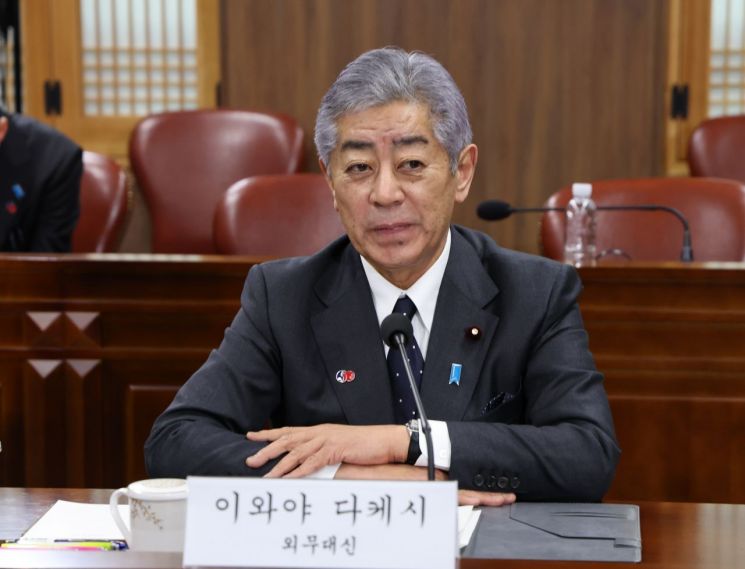 Takeshi Iwaya, Japan's Foreign Minister, is speaking at the Japan-Korea Foreign Ministers' Meeting with Cho Tae-yeol, South Korea's Foreign Minister, held at the Ministry of Foreign Affairs in Jongno-gu, Seoul, on the afternoon of January 13. On the 8th, Japan reiterated its claim that "Dokdo is Japanese territory" through its Diplomatic Bluebook. Photo by Yonhap News Agency
On the 8th, Japan reiterated its claim that "Dokdo is Japanese territory" through its diplomatic white paper. Regarding the comfort women issue, Japan maintained its existing stance that there was "no forced mobilization" and that the figure of 200,000 comfort women is unfounded.
Foreign Minister Takeshi Iwaya reported the contents of the "2025 Diplomatic White Paper" at the Cabinet meeting held that day. The Japanese Ministry of Foreign Affairs publishes the diplomatic white paper every April, which records recent international affairs and Japan's diplomatic activities.
The Japanese government has repeatedly claimed that Dokdo is "Japan's inherent territory both historically and under international law," and the same view was included in this year's diplomatic white paper.
Regarding lawsuits filed by victims of forced mobilization during the Japanese colonial period, the Japanese government indirectly expressed that it will not take responsibility for compensation, stating that the Korean government has "expressed its intention to pay through a third-party compensation method."
The third-party compensation method refers to the system where the Foundation for Supporting Victims of Forced Mobilization under the Ministry of the Interior and Safety provides compensation and delayed interest to victims who have received confirmed compensation judgments in lawsuits, using funds raised voluntarily from the private sector instead of Japanese companies.
On the comfort women issue, Japan repeated its previous claims that there was no forced mobilization, that they were not sex slaves, and that the figure of 200,000 comfort women is an unfounded number. Regarding the installation of comfort women statues in South Korea and some other countries and regions, Japan stated that it is a "regrettable matter incompatible with the Japanese government's position."
However, following last year's reference to South Korea as a "partner" for the first time in 14 years, Japan used the same expression in this year's diplomatic white paper, showing an attitude of valuing South Korea. The Japanese government stated, "South Korea is an important neighboring country with which we must cooperate as partners in addressing various challenges in the international community."
Additionally, through the foreign ministers' meeting between the two countries in January this year, following South Korea's emergency martial law situation in December last year, Japan emphasized that "the importance of close cooperation among South Korea, Japan, and the United States, including responses to North Korea, was reaffirmed."
Meanwhile, according to Kyodo News, the Japanese government pointed out in this diplomatic white paper that North Korea's cooperation with Russia, such as dispatching troops or supplying weapons, has a "seriously concerning" impact on security around Japan.
© The Asia Business Daily(www.asiae.co.kr). All rights reserved.

















