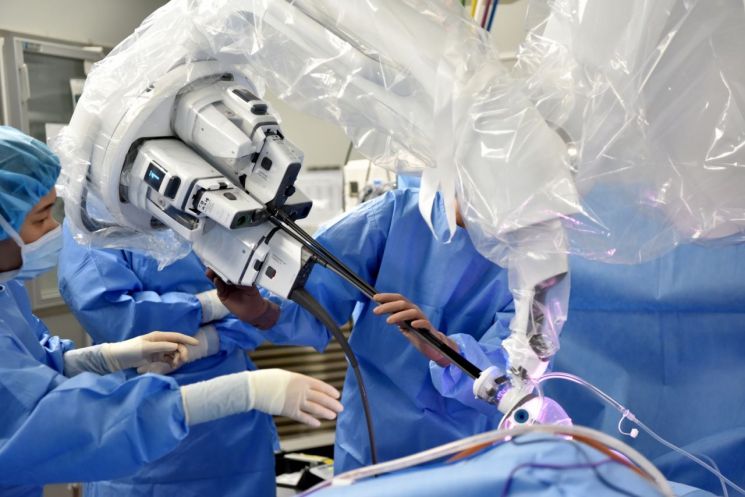
 Medical staff at Hwasun Chonnam National University Hospital are performing surgery using the Da Vinci SP, which allows for more delicate and precise operations through a single incision. Provided by Hwasun Chonnam National University Hospital
Hwasun Chonnam National University Hospital (Director: Min Jungjun) announced on the 8th that it has recently surpassed 2,000 cases of Da Vinci robotic surgery.
Hwasun Chonnam National University Hospital, which was the first in the Gwangju and Jeonnam region to introduce the surgical robot "Da Vinci S" in 2009, replaced it with the "Da Vinci Xi" model in November 2019, further enhancing the precision and efficiency of robotic surgery.
In December 2023, the hospital established a top-level robotic surgery system nationwide by additionally introducing the state-of-the-art "Da Vinci SP," the only single-port robotic system in the Honam region. The "Da Vinci SP" is a system that enters through a single incision using a 3D high-definition camera and robotic arms. While conventional surgical devices require three or four or more incisions, the "Da Vinci SP" enables more delicate and precise surgery through just one incision.
The Da Vinci SP is expected to continuously improve patient satisfaction with treatment, as it results in smaller surgical scars and faster recovery times.
Robotic surgery at Hwasun Chonnam National University Hospital is actively performed for cancer treatment in most departments, including urology, endocrine surgery, colorectal surgery, hepatobiliary and pancreatic surgery, gastrointestinal surgery, thoracic surgery, and obstetrics and gynecology.
The number of robotic surgeries (S, Xi, SP) steadily increased from 150 cases in 2020 to 302 in 2021, 339 in 2022, 358 in 2023, and 405 in 2024. As of the end of March 2025, 147 cases have been recorded. Through this, Hwasun Chonnam National University Hospital recently achieved a cumulative total of over 2,000 cases.
By department, urology accounted for 74% of all robotic surgeries, followed by surgery at 23%, thoracic surgery at 2%, and obstetrics and gynecology at 1%.
In urology (1,588 cases), robotic surgery was widely used for the treatment of prostate cancer, kidney cancer, bladder cancer, and ureter cancer, while in surgery (508 cases), it was applied to colorectal cancer, thyroid cancer, gastric cancer, and breast cancer.
Additionally, in thoracic surgery (43 cases), robotic surgery techniques were used for lung cancer, and in obstetrics and gynecology (20 cases), for the treatment of uterine cancer and ovarian cancer. Da Vinci robotic surgery has also been applied to a variety of other conditions, such as uterine fibroids, ovarian cysts, gallbladder polyps, urinary stones, urinary tract malformations, and benign tumors, providing precise and safe surgeries.
Hwasun Chonnam National University Hospital, which is actively utilizing digital healthcare to bridge medical gaps, is being recognized for this robotic surgery achievement as an important turning point that raises the level of regional healthcare.
Min Jungjun, Director of Hwasun Chonnam National University Hospital, said, "The accumulated know-how in robotic surgery and our excellent surgical outcomes are strengths that other hospitals cannot easily match," and added, "All our medical staff will continue to make every effort to utilize advanced medical devices and provide highly satisfactory care."
© The Asia Business Daily(www.asiae.co.kr). All rights reserved.
![Clutching a Stolen Dior Bag, Saying "I Hate Being Poor but Real"... The Grotesque Con of a "Human Knockoff" [Slate]](https://cwcontent.asiae.co.kr/asiaresize/183/2026021902243444107_1771435474.jpg)
















