Finalization of the 2050 Carbon Neutral Green Growth Basic Plan
Expansion of Zero-Energy Buildings and Eco-Friendly Vehicles
Gwangmyeong City in Gyeonggi Province plans to reduce greenhouse gas emissions by 40% by 2030. To achieve this, the city intends to expand the adoption of zero-energy buildings and eco-friendly vehicles.
On the 8th, Gwangmyeong City announced that it has finalized the "Carbon Neutral Green Growth Basic Plan" after review by the Carbon Neutral Green Growth Committee. This plan serves as a mid- to long-term roadmap to realize a carbon-neutral city by 2050.
Mayor Park Seung-won of Gwangmyeong said, "Since 2018, the city has established a systematic foundation for achieving carbon neutrality by creating the Climate Energy Division and establishing the Carbon Neutral Center, and has quantitatively and qualitatively grown carbon neutrality policies through public-private cooperation. Based on the basic plan, we will promote carbon neutrality policies more systematically and strategically."
Earlier, from August 2023 to the end of last year, the city conducted a service project to establish the basic plan, and finalized the plan through consulting with the Korea Environment Corporation and review by the committee.
According to the plan, the city set a goal to reduce 440,000 tons, which is 40% of the 1.34 million tons of greenhouse gas emissions based on 2018 levels, by 2030. To this end, a total of 150 detailed implementation tasks were established.
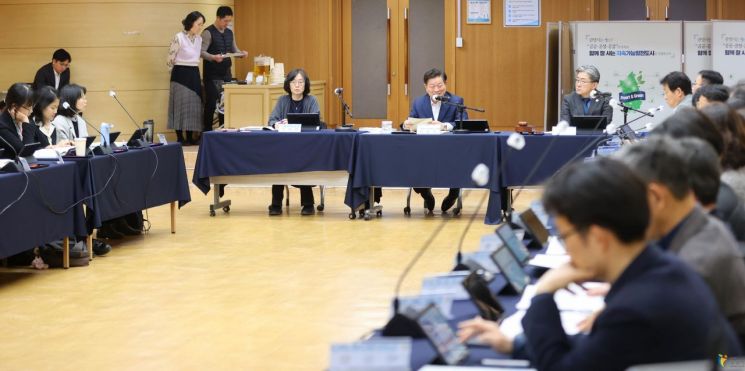 Gwangmyeong City has set a goal to reduce greenhouse gas emissions by 40% by 2030 through the "Carbon Neutral Green Growth Basic Plan." Park Seung-won, mayor of Gwangmyeong City, is presiding over the Carbon Neutral Green Growth Committee meeting. Photo by Gwangmyeong City
Regarding greenhouse gas reduction measures, five sectors with 106 implementation tasks were derived, including ▲expansion of zero-energy buildings and improvement of building energy efficiency ▲support for the adoption of eco-friendly transportation such as electric and hydrogen vehicles ▲creation of eco-friendly urban farming environments such as smart farms ▲source reduction of waste generation ▲expansion of carbon sinks in various spaces such as garden creation.
To strengthen the climate crisis response foundation, 44 implementation tasks were derived across eight sectors, including ▲establishment of systems to enhance climate crisis adaptability ▲climate crisis response for public assets ▲cooperation between domestic and international local governments ▲carbon neutrality education and communication ▲promotion of green growth through green investment and Environmental, Social, and Governance (ESG) management environment creation ▲promotion of clean energy transition ▲improvement of adaptation capabilities for vulnerable groups and occupational communities in local societies ▲training of green growth personnel such as citizen activists.
In particular, to enhance the execution power of the basic plan, the city plans to manage each task with quantitative figures such as greenhouse gas reduction amounts. This aims to objectively assess whether goals are achieved with clear numbers and accurately evaluate the effectiveness of policies. The city also plans to establish indicators to objectively evaluate qualitative tasks such as education, communication, and citizen participation to check whether they are being properly implemented.
To ensure continuous implementation of the basic plan, the responsible departments will check task progress quarterly, while the "Carbon Neutral Promotion Team," led by Vice Mayor Jeong Soon-wook as the carbon neutrality implementation officer, will conduct biannual implementation inspections.
© The Asia Business Daily(www.asiae.co.kr). All rights reserved.

















