206 Construction Closures in Q4 Last Year, 72 More Than New Registrations
First Time Since Q4 2011 That Closures Surpassed Registrations
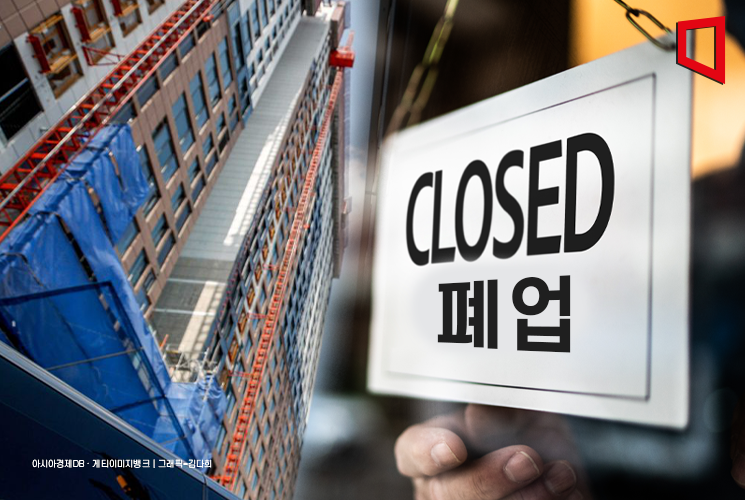
The number of construction companies filing for closure has surpassed the number of new registrations for the first time in 13 years. Amid the worst construction industry downturn, construction companies struggling to achieve results are shutting down one after another, resulting in a sharp decline in new entrants to the construction sector. Experts advise that the new government must introduce measures to revive the market before the construction industry ecosystem collapses.
According to the Construction Industry Knowledge Information System (KISCON) of the Ministry of Land, Infrastructure and Transport on the 8th, the number of comprehensive construction company closure filings in the fourth quarter of last year was recorded at 206.
The construction market appears to be sinking deeper into a slump as time passes. The number of closures in the first quarter of last year was 134, increasing to 158 in the second quarter. In the third quarter, closure filings slightly decreased (143) but surged again in the fourth quarter.
As companies lined up to close, the number of closures even surpassed new registrations. The number of new registrations in the fourth quarter of last year was 134, which is 72 fewer than closures. This is the first time since the fourth quarter of 2011 that closure filings have exceeded registrations. At that time, closure filings were 159, while registrations were 152.
This trend of closure filings exceeding registrations has continued this year as well. In the first quarter of this year, closure filings were 160, whereas registrations were 131.
Most comprehensive construction companies that filed for closure cited "business abandonment" as the reason. Comprehensive construction companies manage overall planning and construction of facilities, but due to high interest rates, rising construction costs, and contraction of real estate project financing (PF), the volume of work has significantly decreased. Especially in provincial areas, the ongoing unsold housing crisis has worsened the situation, causing greater damage.
Mid-sized construction companies are also rapidly running out of liquidity and have applied for corporate rehabilitation procedures (court receivership). Ihwa Construction, ranked 134th in contract ranking with about 70 years of history, applied to the Seoul Rehabilitation Court on the 1st for the commencement of rehabilitation procedures and preservation of company assets. Last year, its financial statements were rejected by auditors due to "uncertainty about the company's ability to continue as a going concern."
In January, the commencement of rehabilitation procedures was decided for Shindonga Construction, ranked 58th in construction capability evaluation. The Seoul Rehabilitation Court explained, "Liquidity deteriorated due to profitability decline caused by rising raw material prices, project delays due to the slump in the sales market, and increased construction receivables." Other companies that have applied for corporate rehabilitation include Daejeo Construction (ranked 103), Sambu Construction (71), Angang Construction (138), Daewoo Shipbuilding & Marine Engineering Construction (83), and Byuksan Engineering (180).
Experts analyzed that the impact of the economic downturn is more severe on small and medium-sized construction companies. Kim Hyoseon, Senior Real Estate Specialist at NH Nonghyup Bank, explained, "For excellent projects, first-tier construction companies are mainly chosen, so smaller construction companies end up working on less viable projects," adding, "Due to high interest rates, capital procurement costs are also increasing, worsening the business environment."
He suggested that the new government needs policies to revive the market. Kim said, "The previous government also provided support for the construction industry and delayed worsening problems such as PF insolvency," adding, "Going forward, it is necessary to promptly proceed with currently stalled redevelopment projects and private public rental housing projects to enable new projects to move forward."
© The Asia Business Daily(www.asiae.co.kr). All rights reserved.

















