Gathering at Seonhyewon in Samcheong-dong
Honoring the Founding Spirit
Chairman Chey Tae-won of SK, along with the owner family and key executives, gathered at the late founder Chey Jong-gun's residence to hold a memorial event marking SK's 72nd anniversary. They reaffirmed their determination to overcome the crisis facing the Korean economy, caused by recent US-originated tariff wars, with the founding spirit.
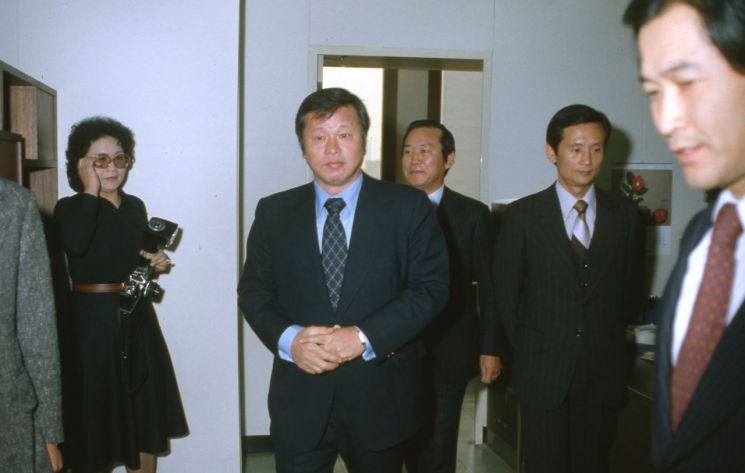 In December 1980, Choi Jong-hyun, then Chairman of SK, greeted employees in the office upon his first day at work after acquiring Yukong, now SK Innovation. Photo by SK
According to SK, Chairman Chey, Senior Vice Chairman Chey Jae-won, Vice Chairman of SK Discovery and Chairman of the SUPEX Council Chey Chang-won, and other owner family members and key executives gathered at Seonhyewon in Samcheong-dong, Jongno-gu, Seoul, on the 7th, the day before the anniversary (the 8th), to honor the founding spirit. Since 2018, the 20th anniversary of the late former Chairman Chey Jong-hyun, SK has designated April 8, the founding date of Seonkyung Textile, as the anniversary and has held events accordingly. Seonhyewon was purchased as a residence by the founding Chairman Chey in 1968 and was where he stayed until the end.
Chairman Chey Tae-won has defined the crisis facing the Korean economy as a 'triple wave' composed of the US-originated tariff war, inflation caused by the tariff war, and artificial intelligence (AI), emphasizing the need for preparation against it. SK has a high export ratio in its refining business and semiconductor sector, and future growth businesses such as batteries and bio are also focused on overseas markets, leading the company to engage in scenario management to prepare for external uncertainties.
Starting from the textile business in 1953, SK laid the foundation for growth by achieving vertical integration from textiles to refining in the 1980s. Subsequently, in the 1990s, it expanded its business portfolio to information and communications, and in the 2010s to the semiconductor industry, growing into the second-largest conglomerate in Korea by asset size.
The founding Chairman Chey established Seonkyung Textile (now SK Networks) in Suwon, Gyeonggi Province, in 1953, providing a stable supply base of textile products in Korea, which was suffering from shortages of goods after the Korean War. The 'Dakpyo lining' launched in 1955 symbolized 'durable and unchanging quality like a chicken' and dominated the domestic suit lining market. In 1962, the company expanded its sales channels to Hong Kong, marking Korea's first textile export.
Thereafter, the founding Chairman Chey expanded the business by building acetate and polyester factories, raw materials for textiles, and acquiring the Walkerhill Hotel, transforming into the 'Seonkyung Group.' After the founding Chairman Chey passed away in 1973, his younger brother, former Chairman Chey Jong-hyun, succeeded the management rights. In 1980, former Chairman Chey acquired Korea Petroleum Corporation, now SK Innovation. This completed the vertical integration known as 'from petroleum to textiles.' Seonkyung renamed the petroleum corporation to 'Yukong' and expanded its business into refining, chemicals, materials, and bio sectors.
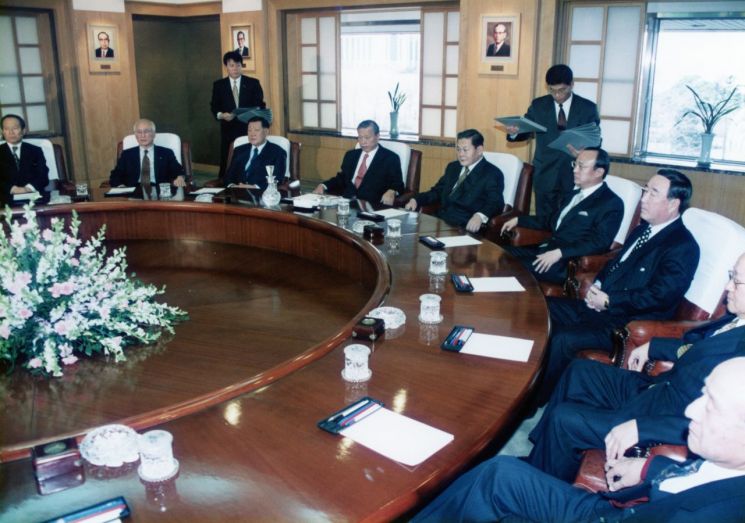 In the January 1998 meeting of the Federation of Korean Industries chairpersons, Choi Jong-hyun, the former chairman of SK (fourth from the left in the seats), is attentively listening to the presentation. He passed away in August of the same year. Photo by SK
Former Chairman Chey designated 'information and communications' as Seonkyung's next core business and established a Telecommunication Team in the Americas Management Planning Office in the US in 1984. In 1991, he founded the corporation 'Daehan Telecom' to prepare for the mobile communications business. Daehan Telecom acquired the second mobile communication business license but returned the license due to controversy over preferential treatment at the time. Two years later, in 1993, it participated in the privatization public bidding of 'Korea Mobile Telecommunications,' the predecessor of SK Telecom, and acquired it. Former Chairman Chey declared a new leap forward by renaming the group SK in 1998, stating, "We must nurture Seonkyung into a global top-tier company of the 21st century."
Currently, SK is conducting proactive rebalancing to strengthen synergy among affiliates, such as the merger of SK Innovation and SK E&S, and to focus on core businesses. In particular, it has designated AI as a core group business and is concentrating capabilities on data centers (DC) and large language models (LLM).
© The Asia Business Daily(www.asiae.co.kr). All rights reserved.
![Clutching a Stolen Dior Bag, Saying "I Hate Being Poor but Real"... The Grotesque Con of a "Human Knockoff" [Slate]](https://cwcontent.asiae.co.kr/asiaresize/183/2026021902243444107_1771435474.jpg)

















