A key factor that hinders immunotherapy for lung cancer cells has been discovered for the first time in Korea. It is expected that inhibiting this factor will enhance the effectiveness of immunotherapy. Immunotherapy has emerged as a treatment method using anti-PD-1 or anti-PD-L1 antibodies that assist immune cells in attacking cancer. However, the response rate to immunotherapy has been low, limiting the number of patients who can realistically expect treatment benefits.
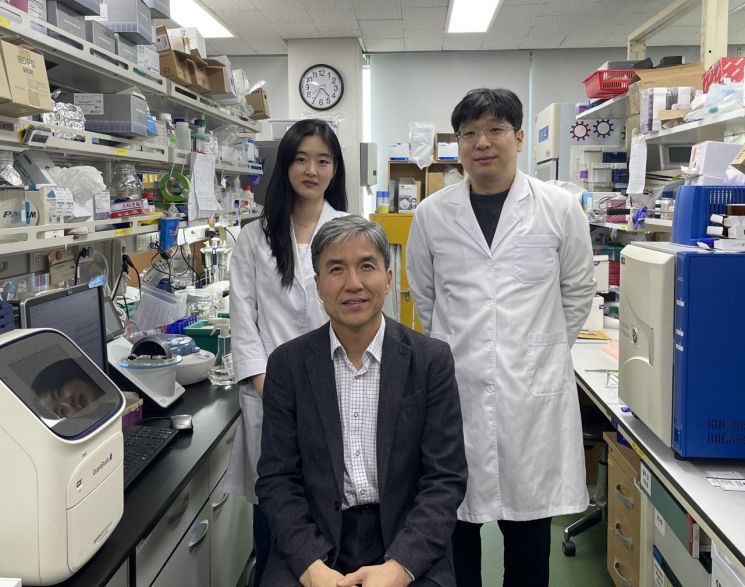 Lee Jung-eun, Master's in Bio and Brain Engineering (back row, left), Professor Jo Kwang-hyun (front row), Gong Jeong-ryeol, Ph.D. in Bio and Brain Engineering (back row, right). Provided by KAIST
KAIST announced on the 8th that Professor Kwanghyun Cho's research team from the Department of Bio and Brain Engineering identified a key factor (DD54) that determines the immune evasion ability of lung cancer cells. They demonstrated that inhibiting this factor increases immune cell infiltration into tumor tissues, thereby improving the effectiveness of immunotherapy.
This research is significant because it confirmed that by identifying and inhibiting a key factor in lung cancer tissues with very low immune cell infiltration, resistance to immune checkpoint inhibitors used in immunotherapy can be overcome.
First, the research team inferred and analyzed gene regulatory networks through systems biology research using transcriptome and genome data derived from lung cancer patients exhibiting immune evasion, identifying a key regulatory factor that enables lung cancer cells to acquire immune evasion capabilities.
Furthermore, when the key factor was inhibited in a syngeneic lung cancer mouse model and the response to immunotherapy was examined, it was confirmed that immune cell infiltration into tissues significantly increased, and the responsiveness to immunotherapy markedly improved.
Single-cell transcriptome analysis and spatial transcriptome analysis, techniques that analyze gene expression at the cellular level, also showed that combined therapy controlling the identified key factor promoted the differentiation of T cells and memory T cells, which have cancer-suppressing effects through immunotherapy. Additionally, it was confirmed that this therapy suppressed the infiltration of regulatory T cells that aid cancer growth and exhausted T cells.
This is because inhibiting the identified key factor deactivates the JAK-STAT, MYC, and NF-κB signaling pathways in lung cancer cells, suppressing the expression of proteins CD38 and CD47 that aid immune evasion. The suppression of these molecules inhibits the infiltration of circulating monocytes that promote cancer development while inducing the differentiation of M1 macrophages that perform anticancer functions.
Professor Kwanghyun Cho emphasized, "Our research team has identified the key regulatory factor that enables lung cancer cells to evade the immune system for the first time. In particular, by controlling this factor, we achieved a breakthrough in developing a new therapeutic strategy that reverses immune evasion and induces a response in cancers that previously did not respond to immunotherapy."
Meanwhile, this research was conducted with the participation of Dr. Gong Jeong-ryeol (first author), Researcher Lee Jeong-eun (co-first author), Dr. Han Young-hyun, and others at KAIST, supported by the Mid-career Research Program and Basic Research Laboratory Program of the Ministry of Science and ICT and the National Research Foundation of Korea. The research results were published on the 2nd in the international journal Proceedings of the National Academy of Sciences of the United States of America (PNAS), published by the U.S. National Academy of Sciences.
© The Asia Business Daily(www.asiae.co.kr). All rights reserved.

![Clutching a Stolen Dior Bag, Saying "I Hate Being Poor but Real"... The Grotesque Con of a "Human Knockoff" [Slate]](https://cwcontent.asiae.co.kr/asiaresize/183/2026021902243444107_1771435474.jpg)















