Air quality in Gyeonggi-do has been improving.
Gyeonggi-do announced on the 8th that during the 6th Seasonal Fine Dust Management Period (December 2024 to March 2025), the number of days with "Good" air quality (PM2.5 concentration of 15㎍/㎥ or less) in the province reached 47 days, the highest since the seasonal management system was implemented in 2019.
The Seasonal Fine Dust Management System is a policy that strengthens emission reduction and management measures from December to March of the following year, when fine dust concentrations are high, to improve air quality.
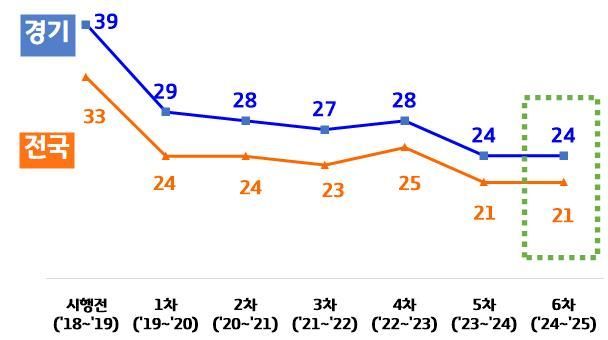
During the 6th seasonal management period, the average PM2.5 concentration in Gyeonggi-do was 24㎍/㎥, the same as the 5th period last year. However, the number of "Good" days increased by 9 days, from 38 to 47 days.
In particular, compared to the same period before the seasonal management system was implemented (December 2018 to March 2019), the number of "Good" days increased more than fourfold, from 11 to 47 days. On the other hand, the number of "Bad" (36?75㎍/㎥) and "Very Bad" (76㎍/㎥ or higher) days decreased by nearly half, from 49 to 25 days.
To reduce fine dust, Gyeonggi-do collaborated with 31 cities and counties to implement 20 fine dust reduction measures across five major sectors during the 6th seasonal management period: ▲ Public Health Protection ▲ Industry ▲ Transportation ▲ Public Sector ▲ Information Provision.
Cha Seong-su, Director of the Climate, Environment, and Energy Bureau of Gyeonggi-do, urged, "Although fine dust concentrations have greatly improved compared to 2018 before the seasonal management system began, sudden high concentration events may occur due to weather conditions and external influences. We ask residents to pay close attention to their health management regarding fine dust."
© The Asia Business Daily(www.asiae.co.kr). All rights reserved.
![Clutching a Stolen Dior Bag, Saying "I Hate Being Poor but Real"... The Grotesque Con of a "Human Knockoff" [Slate]](https://cwcontent.asiae.co.kr/asiaresize/183/2026021902243444107_1771435474.jpg)
















