Nifty 50 in India Drops Over 5% at One Point
Australia, New Zealand, and Southeast Asia Also Plunge Together
Due to U.S. President Donald Trump's global 'tariff war,' major stock market indices and stocks in India, Southeast Asia, Australia, and other regions also experienced significant declines.
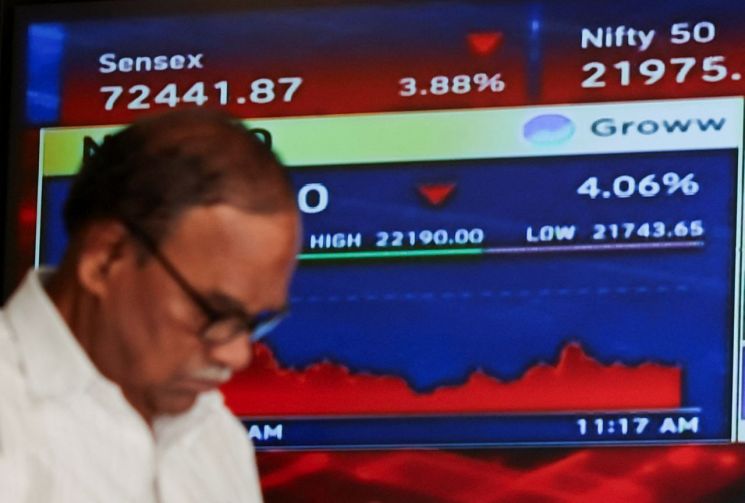 On the 7th, a man is walking past a screen displaying the stock market situation at the Bombay Stock Exchange (BSE) in Mumbai, India. Photo by Reuters Yonhap News
On the 7th, India's leading stock market indices, the Nifty 50 and BSE Sensex, closed down 3.23% and 2.98% respectively compared to the previous trading day. Both indices fell more than 5% at one point during the trading session.
In particular, the stock price of Tata Motors, India's leading automobile company, dropped more than 10% intraday but narrowed its losses to close down 5.56% compared to the previous day. Tata Motors is the parent company of Jaguar Land Rover (JLR), a British luxury car manufacturer. JLR accounts for two-thirds of Tata Motors' total revenue, and the U.S. accounts for 20% of JLR's total exports.
Brokerage CLSA has forecasted that due to the U.S. import car tariff policy, JLR's sales in the U.S. will decrease by 26% in the 2025-2026 fiscal year (April 2025 to March 2026), leading to an overall sales decline of 14%. Since the U.S. announced on the 26th of last month that it would impose a 25% tariff on imported cars, Tata Motors' stock price has fallen about 20%.
The Nifty IT index, representing Indian IT companies that consider the U.S. their largest market, also fell more than 2% that day. The Indian daily Times of India described the stock market situation as a "stock market crash, Monday bloodbath."
On the 2nd, President Trump imposed a 26% reciprocal tariff on imports from India, stating, "Indian Prime Minister Narendra Modi visited the U.S., and he is my great friend." India expects significant damage in sectors with a large export share to the U.S., such as automobiles, IT, and precious metals. In response, the Indian government plans to focus on concluding ongoing trade agreement negotiations rather than retaliating with 'counter tariffs' against the U.S.
The stock markets in Australia and New Zealand also struggled. Australia's S&P/ASX 200 index closed down 4.23%, and New Zealand's representative stock index, the S&P/NZX 50, fell 3.68%. Australia and New Zealand are among the countries subject to the U.S.-designated 'reciprocal tariffs' with a 10% tariff rate. However, since they are heavily influenced by China, which faces a 34% retaliatory tariff, and the U.S. economy, concerns over economic slowdowns in China and the U.S. have worsened economic outlooks for Australia and New Zealand.
Southeast Asian stock markets, hit hard by the tariff bomb, also shook significantly. Singapore's Straits Times Index (STI) fell 7.59%, Malaysia's KLCI dropped 4.01%, and the Philippines' PSEi index declined 4.30%. Vietnam was observing a national holiday commemorating the founding dynasty Hung Vuong, Indonesia was on the Lebaran holiday marking the end of Ramadan fasting, and Thailand was closed for a substitute holiday for the dynasty's founding day, thus avoiding the sharp declines on that day.
Indonesia's central bank announced on the 8th, as financial markets reopened after an eight-trading-day break, that it would "intervene aggressively" in the foreign exchange market to defend the rupiah exchange rate in anticipation of a sell-off. Indonesia has been on a long holiday from the 28th of last month until that day.
© The Asia Business Daily(www.asiae.co.kr). All rights reserved.
![Clutching a Stolen Dior Bag, Saying "I Hate Being Poor but Real"... The Grotesque Con of a "Human Knockoff" [Slate]](https://cwcontent.asiae.co.kr/asiaresize/183/2026021902243444107_1771435474.jpg)
















