'Unbox & Discover 2025' Event Held on the 7th
Yong Seok-woo, head of Samsung Electronics' Visual Display Business Division, said on the 7th, "Despite the uncertainties in the global economy, the premium market is growing, and we will continue to increase the proportion of OLED TVs."
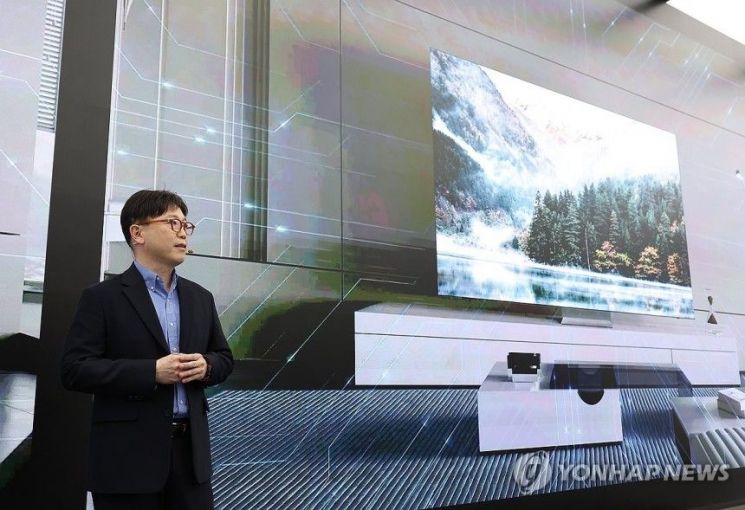 Samsung Electronics President Yong Seok-woo is giving a presentation at the new product launch event "Unbox & Discover 2025" held on the 7th at Samsung Gangnam in Seocho-gu. Photo by Yonhap News
At the 'Unbox & Discover 2025' event held at Samsung Gangnam in Seocho-gu, Seoul, Yong said, "(In this context) this year, we have expanded the lineup of small and large OLED TVs and plan to increase the quantity compared to last year (1.4 million units)."
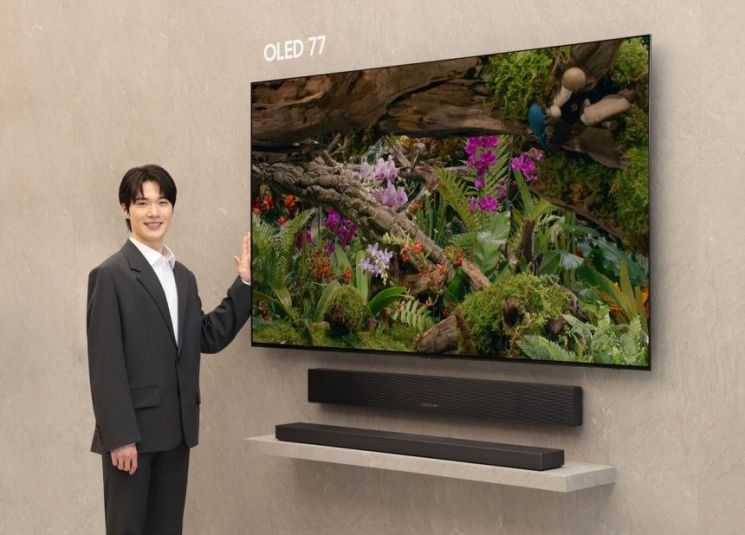
Samsung Electronics, now in its third year of entering the OLED TV market, announced at the event plans to build an OLED TV lineup ranging from 42 inches to 83 inches. Specifically, it will release 14 models across 3 series (SF95, SF90, SF85) and 6 sizes (83, 77, 65, 55, 48, 42 inches).
The organic light-emitting diode (OLED) panels used in OLED TVs have advantages in picture quality and contrast ratio compared to conventional liquid crystal display (LCD) panels, but due to their high price, they are classified as premium products. According to market research firm Omdia, Samsung Electronics' share of the global OLED TV market (by quantity) increased about eightfold from 3.1% in 2022 to 23.5% last year.
Despite internal and external uncertainties, Samsung Electronics plans to continue expanding the proportion of premium products, including OLED TVs, as demand remains solid. Yong said, "We expect the total TV shipments this year to be around 40 million units. Although there are expectations that overall volume growth will be difficult this year, we intend to expand our portion focusing on premium products."
Im Sung-taek, Vice President and Head of Samsung Electronics Korea, said, "We believe the competitiveness of our OLED TVs is at the industry's highest level compared to other companies' products, and we will be number one in the Korean market this year. With a full lineup and powerful features such as AI Vision, we have a good chance of success."
Additionally, Samsung plans to expand its lineup in the mid-segment (mid-price range) to fend off competition from Chinese companies and others. Yong said, "While we have focused on premium and entry-level models, the mid-segment, which was left vacant, has been targeted by competitors such as China, expanding their portion. We expanded our lineup to reclaim the portion taken by China." Samsung Electronics significantly increased its AI TV lineup this year from 9 series and 34 models last year, including OLED, QLED, and The Frame, to 14 series and 61 models.
Regarding the recent announcement of the U.S. administration's country-specific 'reciprocal tariffs,' Yong commented, "Most TVs for export to the U.S. are manufactured in Mexico. Compared to competitors, the tariff impact is expected to be minimal, but since tariffs are continuously changing, we are monitoring the situation." He added, "Samsung has 10 production bases worldwide, so depending on tariffs, we aim to overcome tariff-related challenges through these production bases." Samsung Electronics operates TV manufacturing plants in Mexico, Brazil, Vietnam, Indonesia, India, Egypt, South Africa, Hungary, and Slovakia.
Meanwhile, at the event, Samsung also introduced its strengthened AI TV lineup and AI experiences through 'Vision AI,' which elevates the content viewing experience. TVs equipped with Samsung Vision AI can find and provide the information users want with a single click while watching content and translate subtitles of foreign language content in real time.
Yong said, "The Vision AI that Samsung pursues acts as a companion that makes everyday life easier and more convenient beside the user. We will open a new world of experiences beyond consumers' expectations and what traditional screens could not achieve."
© The Asia Business Daily(www.asiae.co.kr). All rights reserved.


















