Bujeon Station to Become a Transportation, Commercial, and Cultural Hub
Creating a "Walkable City" to Enhance Urban Appeal
Busan Institute of Urban Affairs published the BDI Policy Focus titled "Applying Urban Design to Areas Surrounding Railway Stations" on the 7th.
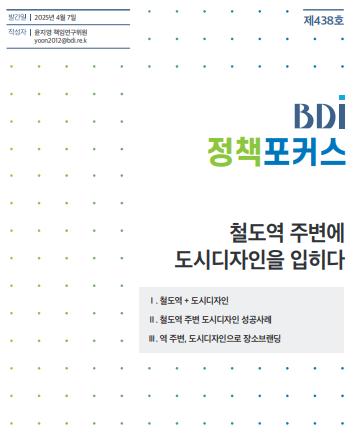
This report reflects the growing interest in Bujeon Station and its surrounding areas due to the recent opening of the Jungang Line and Donghae Line, which has led to an increase in passengers. It highlights the need for facility improvements, enhanced convenience, alleviation of congestion inside the station, and environmental maintenance in the vicinity.
According to the report, the formation of commercial districts and the connection to tourist attractions within walking distance of railway stations serve as key drivers for maintaining a steady flow of people. In particular, it emphasized that creating a "Walkable City" environment is essential to revitalize outdated station areas, allowing people to enjoy the surroundings on foot.
Railway stations, with their excellent accessibility, are spaces where commercial, residential, cultural, and tourism functions can develop together. Therefore, the report pointed out the importance of organizing commercial areas to prevent dispersion and strengthening connections with nearby tourist attractions to attract a continuous influx of visitors.
To achieve these goals, the report proposed the following four core strategies.
First, it suggested fostering Bujeon Station as the transportation, commercial, and cultural hub of Busan. Bujeon Station, where Subway Lines 1 and 2 intersect, is the core of Busan's urban railway network and the hub of east-west transportation. Within a 15-minute walk are Busan Citizens Park, Songsanghyeon Plaza, Seomyeon commercial district, and Jeonpo Cafe Street, offering significant development potential.
Second is the implementation of an integrated approach consisting of hardware, software, and "heartware." This involves people-centered design that combines barrier-free design and the 15-minute city concept as hardware, digital community platforms as software, and "heartware" that induces emotional experiences.
Third is the application of community design. By involving local residents directly in the community design process, it strengthens the sense of community and creates sustainable urban spaces that accurately reflect the unique characteristics of the area.
Fourth is the creation of an attractive pedestrian network. The development of the "Busan Central Parkway," connecting Bujeon Station, Songsanghyeon Plaza, Busan Citizens Park, and Hwaji Park, as well as the "Busan SOHO Street," which links Bujeon Station to the Seomyeon commercial district, will establish pedestrian-friendly streets that people want to walk along.
Yoon Jiyeong, Senior Research Fellow at Busan Institute of Urban Affairs, stated, "A pedestrian-friendly environment that connects railway stations and surrounding areas will stimulate the local economy by attracting citizens and tourists," and predicted, "Bujeon Station will develop beyond a simple transportation hub to become a core tourism resource for Busan."
This BDI Policy Focus can be found on the Busan Institute of Urban Affairs website.
© The Asia Business Daily(www.asiae.co.kr). All rights reserved.

















