17 Local Universities Selected for Gwangju RISE Project
Five Major 'UP' Initiatives Including Talent Skill UP and Company Value UP
Aiming for 35,000 Startups and 40% Local Employment Rate by 2029
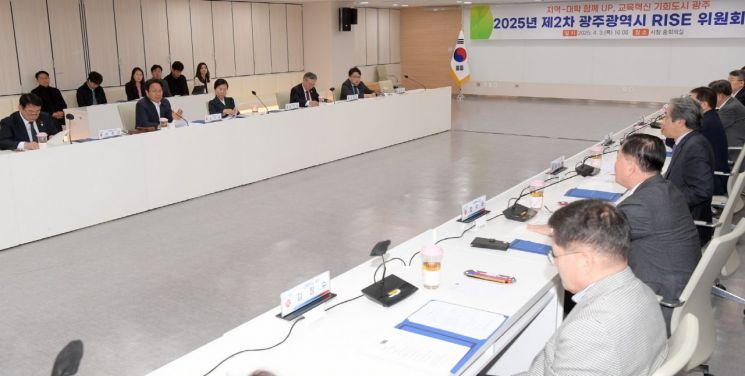 Kang Kijeong, mayor of Gwangju, is presiding over the '2025 2nd Gwangju RISE Committee Meeting' held in the city hall's medium conference room on the afternoon of the 3rd. Provided by Gwangju City
The city of Gwangju has selected and announced 17 local universities to participate in the 'Gwangju Regional Innovation-led University Support System (RISE) Project'.
The Gwangju RISE project will implement five major 'UP' projects: ▲Talent Skill UP ▲Company Value UP ▲Community Grow UP ▲University Inno UP ▲Pan-Ministerial and Mega-Regional Bridge UP, along with 16 individual sub-projects.
The city held an open call for the Talent Skill UP, Company Value UP, Community Grow UP, and University Inno UP projects. On the 3rd, the Gwangju RISE Committee selected 14 sub-projects and 17 universities (63 universities by project) and decided on the allocation method for project evaluation grades for a total project budget of 74.91 billion KRW.
The city will notify each university of the selection results and, after a 10-day objection period, will finalize the selections. After receiving revised plans addressing comments made during the project proposal evaluation, the city will sign agreements with the Gwangju RISE Center (the dedicated agency for the Gwangju RISE project) and the 17 universities in early May to officially launch the RISE project.
The city plans to establish a RISE ecosystem linking education, industry, culture, welfare, and settlement over the next five years, until 2029. The core goals are to produce 1,000 master's and doctoral-level professionals in key industries such as mobility, energy, semiconductors, and artificial intelligence; achieve 35,000 startup companies; and reach a local employment rate of 40% for graduates who find jobs at local companies or institutions after graduation.
The 'Talent Skill UP Project' selected 13 universities (individually or as part of a consortium) for three sub-projects. These universities will foster youth innovation talent tailored to local industries, advanced master's and doctoral-level professionals in cutting-edge fields such as mobility, energy, semiconductors, and artificial intelligence, and pre-professionals linked to high schools.
The 'Company Value UP Project' selected 15 universities for three sub-projects. Aiming for co-growth between universities and companies, the project will operate the Gwangju Startup Valley Startup Academy and, in connection with the Gwangju Job Platform, run a university-local government-company employment support platform to help local talent find jobs locally. In particular, universities will establish and operate demonstration studios so that local companies can utilize university personnel, facilities, and equipment for product development and research.
The 'Community Grow UP Project' selected 17 universities for four sub-projects. Plans include operating living labs to solve local issues, fostering and developing integrated care professionals, training professionals in local culture, arts, and tourism, running industry-academia programs to create business models and jobs in culture, arts, and tourism, and developing and supplying the Neulbom program to local elementary schools.
The 'University Inno UP Project' will be carried out by 18 universities across four sub-projects. These include sharing university facilities and spaces with local residents, establishing shared education systems among local universities, providing lifelong vocational education, and attracting and supporting international students.
Kim Kisook, Director of Education and Youth, said, "Through the RISE project, we will establish a virtuous cycle system for local talent employment and entrepreneurship, and regional settlement, laying the foundation for the co-growth of universities and the region."
Meanwhile, in February, the city received applications for 81 projects from 17 universities through a project call. A review committee of 15 experts from academia, education, economy, and research at both central and local levels evaluated the university project proposals through document review, in-person evaluation, and comprehensive deliberation, with the final selection made by the Gwangju RISE Committee.
© The Asia Business Daily(www.asiae.co.kr). All rights reserved.
![Clutching a Stolen Dior Bag, Saying "I Hate Being Poor but Real"... The Grotesque Con of a "Human Knockoff" [Slate]](https://cwcontent.asiae.co.kr/asiaresize/183/2026021902243444107_1771435474.jpg)
















