Professor Yoo Jinwook's Team Designs Innovative Drug Delivery System to Overcome Limitations of Conventional Anticancer Drugs
Oral Administration Protects Drug in Stomach, Enables Selective Release in Colon... Precisely Targets Only Tumor Tissue
Researchers at Pusan National University have developed a new technology that enables effective treatment of colorectal cancer with oral medication, without side effects.
Existing anticancer drugs spread throughout the body and affect normal cells, causing side effects. However, in this study, the drug was smartly designed to be selectively delivered only to the colorectal cancer site.
The research team led by Professor Yoo Jinwook of the Department of Pharmacy at Pusan National University (President Choi Jaewon) announced on the 7th that they have recently developed an effective local precision colorectal cancer treatment platform technology. This technology enables direct and selective delivery of drugs to colorectal cancer tissue via oral administration, without systemic distribution.
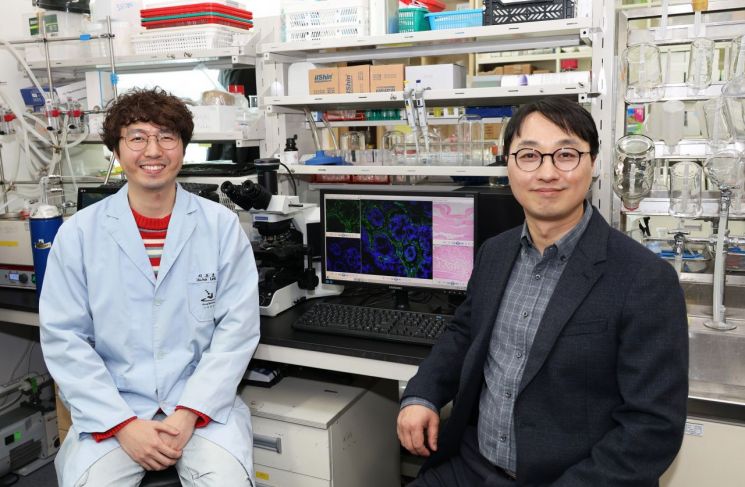 From the right, Professor Eugene Wook Yoo and Dr. Juho Lee from Pusan National University. Provided by Pusan National University
Chemotherapy is widely used as the main treatment for colorectal cancer, but current therapies have a major limitation: most drugs are distributed to normal tissues rather than cancer tissues, causing severe side effects, while only a very small amount accumulates in the tumor, limiting therapeutic efficacy.
To address this, the researchers developed a new drug delivery system that combines sol-gel-sol transition technology with cancer cell-specific nanocomposites. They verified the selective drug distribution to tumor tissue and enhanced tumor growth inhibition in a colorectal cancer animal model.
Sol-gel-sol refers to a method where the drug alternates between a solid (gel) and liquid (sol) state depending on the environment.
In this study, the drug is protected in a gel state after ingestion, and then reverts to a sol state in the colon, releasing the drug. This ensures that the drug safely reaches the colorectal cancer site and acts effectively.
The orally administered drug delivery system transforms into a gel state in the acidic environment of the stomach, protecting the encapsulated drug nanocomposites from being absorbed or degraded. Upon reaching the colon, the gel structure disassembles in response to pH changes, allowing the nanocomposites to be selectively distributed to the tumor tissue. Furthermore, once in the tumor tissue, the nanocomposites respond to specific enzymatic activity within cancer cells, triggering drug release. This enables a powerful anticancer effect without affecting healthy tissue.
The drug delivery mechanism proposed by the research team is expected to dramatically reduce the side effects of conventional systemic administration in cancer therapy and maximize therapeutic efficacy. It also shows high potential for application in the treatment of other colorectal diseases, such as inflammatory bowel disease and microbiome-based therapeutics, opening a new horizon for the development of local precision therapies for various colorectal conditions.
Professor Yoo Jinwook of the Department of Pharmacy at Pusan National University said, "This study goes beyond simply treating colorectal cancer and presents a new paradigm for local therapy. We hope this technology will greatly improve the quality of life for patients."
This research was conducted with support from the National Research Foundation of Korea’s Mid-Career Research Program and the Sejong Science Fellowship, with Professor Yoo Jinwook as the corresponding author and Dr. Lee Juho as the first author. The results were published in the February 1 issue of the international journal 'Chemical Engineering Journal.'
© The Asia Business Daily(www.asiae.co.kr). All rights reserved.

















