KOSDAQ Falls 4% to the 650 Level
Sidecar Triggered Amid Market Plunge
The KOSPI started with a sharp drop of over 4%, falling to the 2350 level due to the impact of the US tariff imposition on the 7th and the resulting plunge in global stock markets.
As of 9:28 a.m. that day, the KOSPI index stood at 2,339.16, down 126.26 points (5.12%) from the previous session. The index opened at 2,359.25, down 106.17 points (4.31%) from the previous session, showing a decline of around 4.5%.
As the index plunged, a KOSPI sell-sidecar was triggered from 9:12 a.m. to 9:17 a.m. A sidecar is a measure that suspends the effectiveness of program sell orders for five minutes when the KOSPI 200 futures index rises or falls by more than 5% for more than one minute. This was the first time a KOSPI sell-sidecar was triggered since the 'Black Monday' on August 5 last year, when global stock markets plunged.
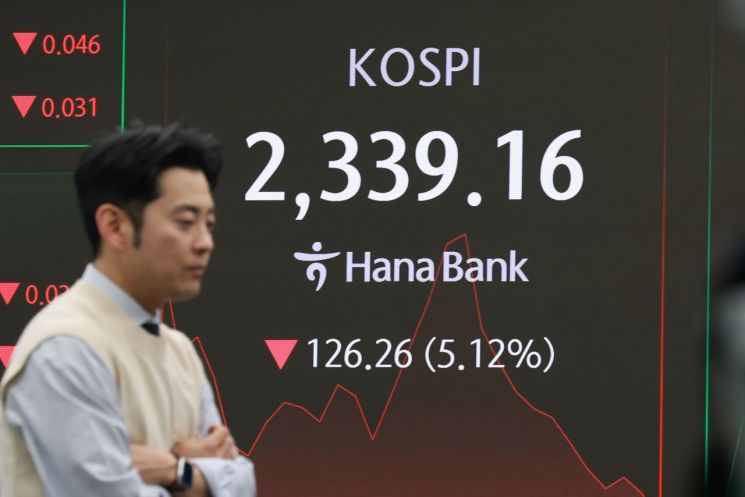 On the 7th, dealers are working in the dealing room at the Hana Bank headquarters in Jung-gu, Seoul. Photo by Yonhap News.
In the securities market, foreigners are net sellers of 419.6 billion KRW, and institutions are net sellers of 284.8 billion KRW. Individuals are net buyers of 671.6 billion KRW. Foreigners are also net sellers of 795.1 billion KRW in the KOSPI 200 futures market, showing a combined net sale of over 1.1 trillion KRW in both spot and futures markets.
In the Seoul foreign exchange market that day, the won-dollar exchange rate opened at 1,462.0 KRW, up sharply by 27.9 KRW from the previous session. The won-yen exchange rate surpassed 1,000 KRW.
Last week, despite the US stock market plunging due to the imposition of reciprocal tariffs by the US, the domestic stock market relatively held up well, supported by the resolution of political uncertainty following the Constitutional Court's decision to dismiss President Yoon Seok-yeol. However, as the tariff impact has not eased in global stock markets but rather turned into a selling panic, investor sentiment is rapidly deteriorating again.
On June 4 (local time), the New York stock market saw the three major indices plunge: the Dow Jones Industrial Average fell 5.5%, the Standard & Poor's (S&P) 500 index dropped 5.97%, and the Nasdaq Composite index declined 5.82%. Since President Donald Trump's tariff announcement, the cumulative declines over two days for these indices reached 9.26%, 10.59%, and 11.44%, respectively. In after-hours trading, futures indices are falling an additional 3-4%.
Semiconductor stocks such as Samsung Electronics (-4.28%) and SK Hynix (-6.48%), which were targeted by President Trump's tariff imposition announcement, as well as top market cap stocks regardless of sector, including LG Energy Solution (-2.89%), Samsung Biologics (-5.89%), Hyundai Motor (-4.95%), and Celltrion (-4.89%), are all declining.
Relatively resilient stocks such as Hanwha Aerospace (-6.98%) and Hanwha Ocean (-7.07%), in shipbuilding and defense, are also experiencing large declines. Financial stocks like KB Financial (-6.69%) and Shinhan Financial Group (-5.53%) are also down.
At the same time, the KOSDAQ index fell 28.42 points (4.13%) to 658.97 compared to the previous trading day. The KOSDAQ index opened at 667.02, down 20.37 points (2.96%) from the previous session, and continued its sharp decline. In the KOSDAQ market, foreigners are net sellers of 58.9 billion KRW, and institutions are net sellers of 14.6 billion KRW. Individuals are net buyers of 65.7 billion KRW.
© The Asia Business Daily(www.asiae.co.kr). All rights reserved.

















