Evaluation of Martial Law Declaration and Subsequent Response
"Constitutional Court Unanimously Decides to Dismiss the President"
"Victory of Democratic Institutions Established in the 1980s"
Foreign media have diagnosed that Korean society demonstrated the resilience of democracy in the process of responding to former President Yoon Seok-yeol's martial law.
The New York Times (NYT) published an analysis article from Seoul on the 5th (local time) titled "How South Korean Democracy Defeated a Reckless Leader." The article covers the process from former President Yoon's declaration of martial law to the impeachment decision on the 4th. The NYT evaluated that over the past four months, both the vulnerabilities and resilience of Korean democracy were revealed. The vulnerability of democracy was exposed when former President Yoon declared martial law on December 3 last year, and the four months following the martial law declaration were a period in which the resilience of Korean democracy was demonstrated.
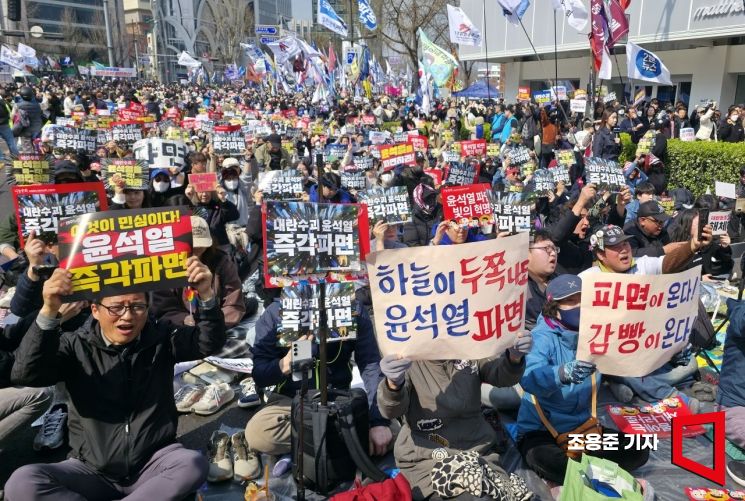 On the morning of the 4th, the day of the impeachment ruling of former President Yoon Seok-yeol, citizens and organization members supporting the impeachment are shouting slogans at a rally near the Constitutional Court in Anguk-dong, Seoul. Photo by Jo Yong-jun
The NYT noted that the public's response was immediate when the martial law troops sent by former President Yoon attempted to enter the National Assembly to seize the legislative body by force. It viewed that angry citizens took to the streets and blocked the military with their bare hands, buying time for the National Assembly to hold a vote to lift the martial law. It added that the Constitutional Court then unanimously decided to dismiss the president.
The NYT highlighted that for Koreans, democracy is not something simply given but something won through decades of struggle involving torture, imprisonment, and bloodshed. The NYT said that to outside observers, this incident appears as a victory of the democratic institutions established in the late 1980s. It wrote, "Democracy is a deeply cherished part of life for Koreans," and "All major political milestones?ending dictatorship, free elections, ousting leaders who abuse power?were achieved after citizens took to the streets."
Daniel Snyder, a Stanford University professor who covered Korea as a journalist in the 1980s, said, "The response to former President Yoon's coup attempt demonstrated the maturity of Korean democracy." He analyzed that the fact that conservative-leaning judges also joined the unanimous decision of the Constitutional Court not only shows the clarity of the incident but also demonstrates the ability to overcome ideological polarization.
© The Asia Business Daily(www.asiae.co.kr). All rights reserved.
![Clutching a Stolen Dior Bag, Saying "I Hate Being Poor but Real"... The Grotesque Con of a "Human Knockoff" [Slate]](https://cwcontent.asiae.co.kr/asiaresize/183/2026021902243444107_1771435474.jpg)
















