Awareness of Political Methods in the Constitutional Court's Ruling
Criticizing Yoon for Mobilizing Military and Police, Pointing Out Issues with the National Assembly
Right After Impeachment, Lee Jae-myung Says, "The Political Community Must Deeply Reflect"
Former President Yoon Seok-yeol has finally been dismissed. The attempt by the sitting president to mobilize the military and police instead of engaging in dialogue and compromise in politics ultimately ended with the National Assembly lifting the emergency martial law, initiating impeachment proceedings, and the Constitutional Court's decision to remove him from office. However, while the Constitutional Court sternly held former President Yoon accountable for his wrongdoing, it also issued a warning to our political system.
In the Constitutional Court's impeachment ruling on the 4th, the key points consistently emphasized that "the matter should have been resolved politically" regarding the process leading to the declaration of emergency martial law by former President Yoon. The Court ordered his dismissal, stating that former President Yoon "violated his duty as the president of all citizens to transcend his supporters and unify the social community, mobilized the military and police to undermine the authority of constitutional institutions such as the National Assembly, infringed on the basic human rights of the people, thereby betraying the trust of the sovereign Korean people and neglecting his constitutional duty to uphold the constitution."
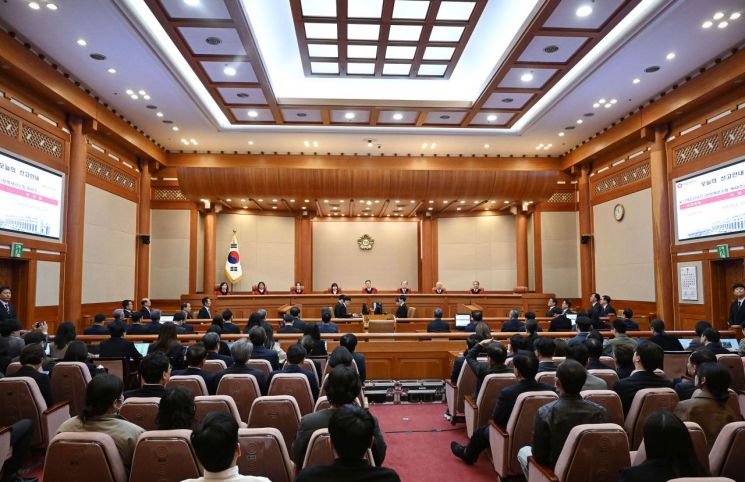 Acting Chief Justice Hyung-bae and constitutional justices are seated in the Grand Bench of the Constitutional Court in Jongno-gu, Seoul, on the 4th, for the ruling on the impeachment trial of President Yoon Seok-yeol. Photo by Yonhap News.
However, during the process leading to this conclusion, there were several mentions that seemed to consider former President Yoon's perspective.
The Court referred to the opposition party's successive impeachment trials, the opposition's unilateral reduction of the budget bill in the National Assembly's Budget and Accounts Special Committee this year, and the opposition's unilateral passage of laws, stating, "In this process, the respondent (former President Yoon) likely felt a grave sense of responsibility to somehow overcome the paralysis of state affairs and the significant harm to national interests caused by the opposition's overreach."
Additionally, the Court stated, "The respondent's judgment that the exercise of the National Assembly's authority constituted an abuse of power or caused paralysis of state affairs should be politically respected." This indicates that at least the perception of the situation felt by former President Yoon can be acknowledged to some extent.
The Court also more directly pointed out the problems of the National Assembly, saying, "The National Assembly should have respected minority opinions and, based on tolerance and restraint in its relationship with the government, strived to reach conclusions through dialogue and compromise." Although referring to the National Assembly, this was a critique aimed at the ruling opposition party for the lack of negotiation and compromise efforts.
However, the Court viewed the responsibility as not solely lying with the National Assembly or the opposition party but also with the ruling forces, including former President Yoon. The Court judged, "The conflict between the respondent and the National Assembly cannot be attributed to one party's responsibility alone; it is a political issue that must be resolved according to democratic principles." This means shared responsibility. The crisis of state paralysis perceived by former President Yoon is a problem shared not only by the National Assembly, specifically the opposition party holding the majority of seats, but also by the ruling forces including former President Yoon himself.
Nonetheless, what the Court fundamentally took issue with was the method former President Yoon chose to resolve the conflict.
The Court held that former President Yoon should have respected the National Assembly and maintained the principles of checks and balances within the constitutional framework. It is the president's role and expectation to seek solutions through political means, not through unreasonable methods such as mobilizing the military and police. The Court emphasized to former President Yoon that "he should have respected the National Assembly, the people's representative, as a partner in cooperation" and "even if he judged the exercise of the National Assembly's authority as majority tyranny, he should have ensured that checks and balances were realized through constitutional remedies." Regarding conflict resolution, the Court pointed out that "political issues should be resolved according to democratic principles" and "expressions of political views or public decision-making must be conducted within the scope compatible with constitutionally guaranteed democracy." In other words, former President Yoon should have sought political means rather than unconstitutional measures such as martial law.
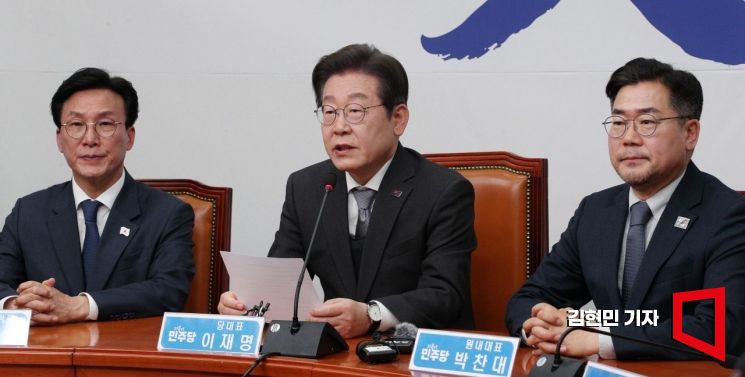 Lee Jae-myung, leader of the Democratic Party of Korea, is expressing his position on the Constitutional Court's ruling to dismiss President Yoon Seok-yeol at the National Assembly on the 4th. 2025.4.4 Photo by Kim Hyun-min
Lee Jae-myung, leader of the Democratic Party of Korea, also attracted attention by expressing reflection after the impeachment ruling, which signified a victory for the opposition party, during a press conference. Lee said, "The impeachment of a sitting president for the second time is a tragedy in the constitutional history of the Republic of Korea that must never happen again," adding, "All politicians, including myself, must deeply reflect and take responsibility. We will do our best to ensure that the tragedy of constitutional destruction is not repeated and that politics becomes the hope of the people and the nation."
Woo Won-shik, Speaker of the National Assembly, also emphasized 'unity' in a special statement, urging that our politics must change. He said, "Resolving political differences and conflicts within the framework of the constitution and laws and transforming diversity into competitiveness is what politics must do," and called for "an end to all acts that incite confrontation, conflict, and division, and the expulsion of extreme confrontational language."
© The Asia Business Daily(www.asiae.co.kr). All rights reserved.


















