Joint Launch of the "Crisis Response Council"
Gwangyang City, Jeollanam-do (Mayor Jung Inhwa) held an inaugural ceremony for the 'Jeonnam Steel Industry Crisis Response Council' at the Gwangyang Bay Area Materials and Parts Knowledge Industry Center on the 3rd, together with Jeollanam-do and Suncheon City, officially launching joint efforts to respond to crises and strengthen competitiveness in the Gwangyang Bay Area steel industry.
This council was established to address the complex internal and external crises, including the United States' high steel tariffs (25%), China's technological advancement and low-price offensive, and the stagnation of domestic steel demand industries. The council brings together a wide range of stakeholders from Gwangyang City, Jeollanam-do, Suncheon City, industry, academia, related organizations, and the political sector.
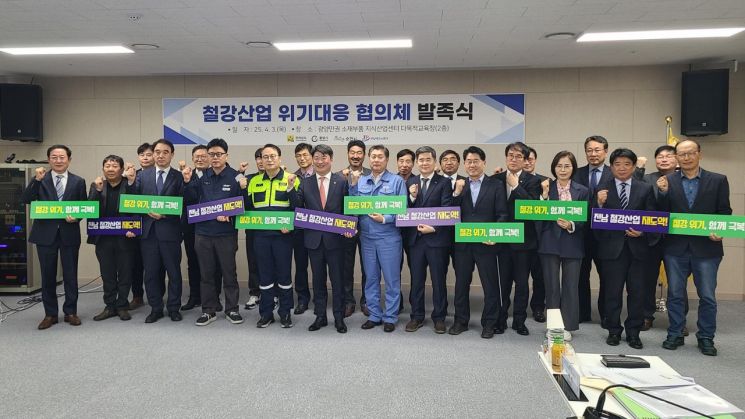 On the 3rd, Gwangyang City, together with Jeollanam-do and Suncheon City, held the launch ceremony of the 'Jeonnam Steel Industry Crisis Response Council' at the Gwangyang Bay Area Materials and Components Knowledge Industry Center, initiating full-scale joint efforts to respond to the crisis and strengthen the competitiveness of the steel industry in the Gwangyang Bay area. Provided by Gwangyang City
The council is chaired by Park Changhwan, Vice Governor for Economic Affairs of Jeollanam-do, with Kim Gihong, Deputy Mayor of Gwangyang City, Jung Kwanghyun, Deputy Mayor of Suncheon City, and So Youngho, Director of Strategic Industries at Jeollanam-do, serving as vice chairs. Major steel-related companies such as POSCO Gwangyang Works, Hyundai Steel, Donga Steel, SNNC, Hanwha Ocean Ecotech, Sungwon, Jungang EMC, TY Powderler, and Megaplan Tech are participating.
In addition, a total of 28 members, including heads of economic organizations and institutions, and members of provincial and city councils, will participate to provide policy advice on crisis response in the steel industry, make joint proposals to the government, identify and address corporate difficulties and regulations, discover and propose new projects, and jointly host lectures and seminars.
The council will operate from April 2025 until the end of the steel industry crisis, holding regular meetings every other month and additional meetings as needed, ensuring a flexible system for prompt response to issues.
The inaugural ceremony proceeded in the following order: a report on the council's formation, presentations on domestic and international industry trends, outlook and demand survey results, and discussions on crisis response strategies.
The progress report detailed the background and process of forming the public-private council jointly by Jeollanam-do, Gwangyang City, and Suncheon City, based on the recognition that the Gwangyang Bay Area steel industry is facing a structural crisis due to the expansion of external risks such as the high steel tariffs imposed by the Trump administration's second term.
Against this backdrop, Jeollanam-do, Gwangyang City, and Suncheon City agreed to the official launch of the 'Jeonnam Steel Industry Crisis Response Council' for effective response. The council will serve as the main executor leading the survival strategy and future transformation of the Gwangyang Bay Area industry.
Park Changhwan, Vice Governor for Economic Affairs of Jeollanam-do, stated, "The steel industry, which accounts for 23% of Jeonnam's GRDP, is expected to face significant challenges due to worsening internal and external conditions. Not only large and medium-sized companies such as POSCO, but also small partner firms are struggling greatly, so POSCO needs to adopt a more inclusive perspective towards its partners."
He added, "Jeollanam-do will respond swiftly to changes in the global trade environment and continue to implement effective measures to strengthen the competitiveness of the steel industry."
Lim Sungki, CEO of Jungang EMC, said, "Due to production cuts by large companies and reduced orders from POSCO, small and medium-sized enterprises are seeing a sharp decline in orders. On top of that, rising plate prices are increasing manufacturing costs, further burdening management."
He emphasized, "It is urgent to establish institutional foundations that provide practical support for SMEs, such as expanding government support programs and introducing a price indexation system to cope with rising raw material costs."
Hong Jungui, Director of the Korea Iron and Steel Association, stated, "Although the crisis originating from China continues, the trend of de-Chinaization can also present new opportunities for the domestic steel industry." He added, "The domestic steel industry is sufficiently competitive, and if a fair market environment is established, there is ample room for a rebound."
He also said, "The government and National Assembly must continue efforts to minimize damage to export companies," and added, "The Steel Association will also develop various response strategies to help the industry overcome this crisis."
Lee Hwayeop, Director of Future Industries at Gwangyang City, commented, "In the case of Pohang City, which has an industrial structure similar to Gwangyang, whenever an industrial crisis occurs, Pohang City, Gyeongbuk Province, and local National Assembly members unite to promptly revise related laws and secure practical support. For this steel industry crisis, local governments, companies, and the political sector must jointly implement effective and appropriate support strategies, focusing on the suggestions made by the council, such as parliamentary forums and reflecting regional pledges in the presidential election."
He added, "Since it is difficult to resolve corporate difficulties all at once, a new approach is needed to separately propose concrete short-term and mid-to-long-term support measures."
Meanwhile, according to an in-depth demand survey of steel companies conducted by Jeonnam Technopark, 57% of steel companies in the Gwangyang Bay Area expect a decrease in sales this year. The main difficulties cited were: decrease in customer demand (32%), rising raw material costs (29%), and burden of technology development (15%).
In addition, more than half of export companies expect a decrease in exports in 2025, with risks identified as exchange rate volatility, global economic slowdown, and oversupply from China.
© The Asia Business Daily(www.asiae.co.kr). All rights reserved.

















